49 works in this view — arrow keys or swipe to move between them.
Dance in Art
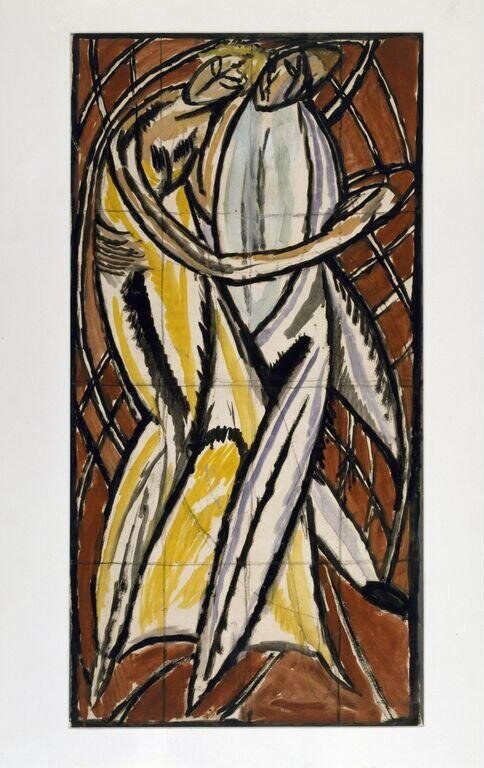
Dancing Couple
Bell, Vanessa
- Collection:
- Watercolour
- Source:
- Victoria and Albert Museum
- Rights:
- Rights vary by item — check the source record before reusing this image. Source record ↗
- Recorded as:
- V&A — check rights per item
For dancers and historians, this work documents a pivotal moment when modernist artists began to represent dance not as spectacle or narrative, but as pure movement and formal abstraction—a shift that would influence both visual art and choreographic practice throughout the 20th century. The intersection of trained classical technique with expressionist distortion shows how dance itself was being reimagined by the artistic avant-garde.
What you are looking at
A single figure dominates this vertical composition, caught mid-movement against a warm russet background crisscrossed with bold black lines suggesting a latticed or geometric structure. The dancer is rendered in pale cream and white with strokes of yellow ochre, their body twisted and extended in a fluid, balletic pose. The torso leans back with one arm raised overhead in an arc; the legs extend at sharp angles, one bent sharply at the knee. The figure appears weightless, suspended in the moment of a turn or leap. The artist has used heavy black outlines throughout—delineating the dancer's limbs, torso, and the architectural grid behind—creating a dynamic tension between the sinuous human form and the rigid, angular framework. Light seems to fall unevenly across the figure, with deeper shadows pooling in the folds of what may be drapery or fabric.
The dancing
A single dancer, rendered with expressive elongation of limbs and an arched spine that suggests advanced technical control. The arm extended overhead and the acute angles of the legs indicate a mid-movement moment—likely a turn with the supporting leg bent, the free leg extended or held at height. The body is flexible and extends through the torso; the pose reads as deliberate and trained. The artist shows understanding of balletic line through the raised arm and lengthened neck, though the gestural language is more expressionist than documentary.
The dance depicted
This appears to be a theatrical dance scene, most likely ballet or early modern dance, executed around 1913 when experimental attitudes toward dance representation were strong. The elevated, turned-out leg position and the vertical momentum of the pose suggest classical ballet training, but the raw expressionist treatment and the twisted, almost ecstatic quality of the movement hint at the emerging modern dance idiom. The figure could represent a Romantic ballet vocabulary—a turn, an arabesque moment, or a pose of yearning—but rendered through a vanguard artist's eye that privileges emotional and formal intensity over anatomical precision.
How it was made
The work is executed in watercolour, a medium that the artist has used with both fluidity and control. Bold black lines—likely applied with pen or dark watercolour and a firm hand—scaffold the composition, creating a framework that pushes the pale washed figure forward. The watercolour allows for soft gradations and luminosity in the dancer's body while the graphic overlaid grid provides structural counterpoint. This combination of fluid wash and assertive line was characteristic of early 20th-century modernist printmaking and painting, suggesting the work was intended for a cultured audience familiar with Post-Impressionist and Fauvist approaches to the human figure.
About this work
This watercolour depicts a single dancer in a moment of balletic motion, captured with the formal sophistication and expressionist intensity characteristic of early 20th-century modernism. The work balances classical dance vocabulary—the raised arm, the extended leg, the sense of trained control—against a deliberately fractured and geometric pictorial space. The artist's use of bold black outlines and warm underlying washes creates a figure that is simultaneously grounded and transcendent, a bridge between the Romantic ballet tradition and the emerging avant-garde. The work sits within a moment when visual artists became newly fascinated by capturing not anatomical accuracy but the essential energy and emotional charge of the dancing body.
How to look at it
Look first at the moment the artist has chosen: this is not a pose held still for the camera, but a single instant within a continuous movement—a turn or lift in progress. Notice how the artist has used the black lines not to outline but to create a scaffolding that the dancer seems to move against and through. The latticed background is not mere decoration but an active compositional partner that creates spatial tension. The pale, almost ghostly rendering of the body against the warm ground and dark lines suggests both ethereality and structural intensity—the dancer is simultaneously solid and weightless. The extended, arched pose and the artist's choice to render the figure alone, without partner or stage furniture, emphasize the dancer's isolation and the inward focus of modern dance.
The artist
Vanessa Bell (1879–1961) was a painter, designer, and member of the Bloomsbury Group, a London-based circle of intellectuals and artists who reshaped early 20th-century British modernism. Bell was alert to developments in Continental art—Cubism, Fauvism, Post-Impressionism—and synthesized these with British sensibility. She designed sets and costumes for the Ballets Russes and other theatrical enterprises, giving her direct engagement with dance as both visual and kinetic phenomenon. Her works on paper, including watercolours, often prioritize expressive line and bold colour over representational detail, reflecting her training and her commitment to modernist formal innovation.
The period
In 1913, dance and visual art were in intense dialogue. The Ballets Russes, under Serge Diaghilev, had revolutionized both choreography and design since 1909, commissioning avant-garde artists (Picasso, Matisse, Goncharova) to create sets and costumes. Simultaneously, modernist painters across Europe were discovering dance as a subject that allowed exploration of movement, line, and abstraction—from Futurists' attempts to capture speed to the Cubists' fragmented forms. In Britain, the Bloomsbury circle engaged with these currents while maintaining a distinctly English aesthetic. Bell's watercolour dates to a moment when dance was being recognized as a model for modernist formal invention: the body as a vehicle for exploring line, rhythm, weight, and spatial organization rather than as a vehicle for narrative.
Where it lives
The work is held in the Vanessa Bell archive (va) as part of a watercolour collection. Bell's papers and works on paper reside in institutional collections focused on Bloomsbury and early 20th-century British modernism.
Dance in this work
Questions about this work
Is this a real dance or a made-up pose?
The pose draws on real classical ballet vocabulary—the raised arm, the turned-out leg, the sense of vertical lift and control are recognizably trained. But the artist has exaggerated and twisted the pose for expressive effect, so this is less a document of an actual step than an interpretation of how a trained dancer's body moves. The artist is responding to the energy and line of the dance, not recording it with scientific precision.
Why is there a grid behind the dancer?
The latticed lines create both a sense of spatial structure and a tension with the fluidity of the moving body. This was a common modernist strategy—using geometric abstraction to frame and intensify the organic human form. Here it suggests that the dancer is moving through and against an ordered world, adding psychological and formal complexity to the image.
What kind of dance is this—ballet or modern dance?
The pose is rooted in ballet vocabulary, but the raw, expressionist way it is rendered—the exaggeration, the emotional intensity, the disregard for pure anatomical beauty—suggests the artist was influenced by both. In 1913, these traditions were beginning to merge, and the Bloomsbury Group was engaged with both classical and modern dance. This watercolour sits in that space between traditions.
Who was the dancer, or is this imaginary?
The catalogue record does not identify a specific dancer, so this may be a study from imagination, from memory, or from observation of a studio or rehearsal. What matters is that Bell was deeply engaged with the visual life of dance in London and Paris and was responding to real movement practice, even if no single model is documented here.
More dance artwork





