49 works in this view — arrow keys or swipe to move between them.
Dance in Art
Polovtsian Dances
Choumoff, Pierre
- Collection:
- Photograph
- Source:
- Victoria and Albert Museum
- Rights:
- Rights vary by item — check the source record before reusing this image. Source record ↗
- Recorded as:
- V&A — check rights per item
The Polovtsian Dances were foundational to the Ballets Russes and to orientalism in early modernist dance; this photograph is one of the primary visual documents through which that work was seen and remembered. Understanding how and why dancers like this were posed, lit, and circulated in photographic form is essential to any critical history of dance, race, and the visual culture of the early 20th century.
What you are looking at
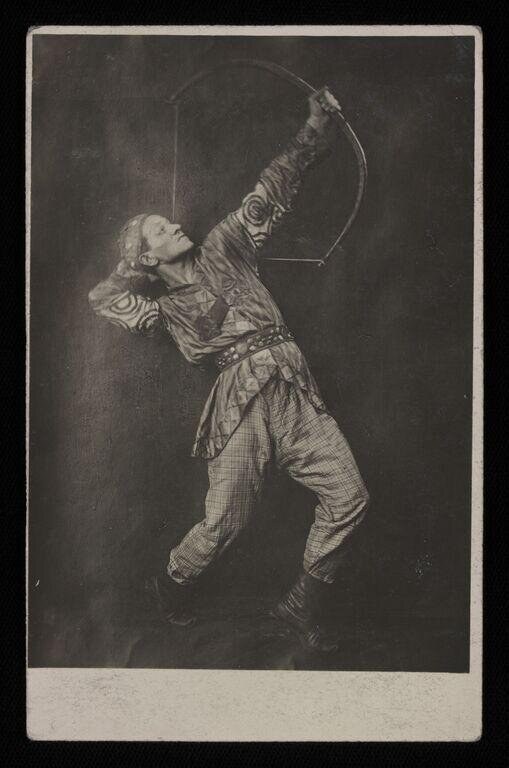
A single male dancer in mid-leap against a dark background, captured in a dramatic moment of athletic suspension. He wears richly patterned costume typical of early 20th-century orientalist theatrical dress: a tunic with ornate geometric embroidery, a decorated belt, and fitted leggings. His body is arched backward in an extreme pose, one arm raised high holding what appears to be a curved prop or weapon (possibly a scimitar or bow), the other extended for balance. His head is thrown back, face upturned. The photograph is rendered as a tonal print—possibly a gelatin silver or bromoil process—with dramatic lighting that emphasizes the musculature and the three-dimensionality of the leap. The dark surround isolates the figure completely, focusing all attention on the violent energy and exoticism of the pose.
The dancing
A single male dancer executed in a high ballistic leap with extreme spinal extension. The torso is arched deeply backward, the weight appears to be driven through extended legs in flight. One arm is raised vertically, holding a prop; the other is extended laterally. The neck is extended, head tilted back. The posture suggests neither classical ballet technique nor academic modern dance—the extreme back-arch and the weightedness of the leap indicate a style concerned with dramatic, orientalist spectacle rather than the verticality and control of Cecchetti or Vaganova training.
The dance depicted
This is almost certainly a moment from the Polovtsian Dances, the famous act from Borodin's opera Prince Igor, choreographed by Michel Fokine for the Ballets Russes in 1909. The Polovtsian Dances were among the most sensational and widely reproduced images from early 20th-century dance, performed across Europe and America to great acclaim. The costume—orientalist tunic, belt, and leggings—matches the Polovtsian warrior aesthetic. The violent, arched leap and the prop (likely representing a weapon) are consistent with the ballet's character as a display of 'wild' male virility and exotic spectacle. The photographic style and the date (1925) place this in the period when the Ballets Russes works were being extensively documented and circulated in photographic form.
How it was made
This is a photograph, most likely a gelatin silver print or bromoil process, printed as a single tonal image. The photographic medium allowed for dramatic modeling of form through light and shadow—the lighting here is carefully controlled to emphasize musculature, the arc of the body, and the three-dimensional depth of the leap. The contrast and tonal range suggest professional studio photography. Photographs of dancers from this period were disseminated through postcards, theatrical programs, magazines, and art galleries, making them far more widely seen than stage performances themselves. This particular image has the finish and composition of promotional dance photography rather than documentary theater photography.
About this work
A photograph of a male dancer in an extreme back-arched leap, wearing orientalist costume, held in the collection as an example of Polovtsian Dances from the 1920s. The Polovtsian Dances were the most celebrated and reproduced dance spectacle of the early Ballets Russes, and photographs like this one shaped how millions of Europeans and Americans understood 'oriental' male dance virtuosity. The image sits at the intersection of theatrical dance, orientalism, and the photographic circulation of dance as a visual spectacle. It documents both a specific choreographic moment and the aesthetic and ideological frameworks through which early modernist ballet presented non-European dance.
How to look at it
Attend to the extreme extension of the body—the deep back-arch is not an ornamental flourish but the signature moment of the work, chosen to suggest both virtuosity and exoticism. The lighting is carefully controlled to make the body read as a sculptural form in space, emphasizing musculature and three-dimensionality. Notice how the photograph isolates the dancer completely against the dark ground, removing any narrative or environmental context—the body itself is the spectacle. The prop held high in the raised arm suggests weaponry and male virility, but the posture of the body—passive, arched, available to the gaze—complicates that message in ways worth thinking about.
The artist
Pierre Choumoff was a photographer active in the 1920s–1930s, known for his theatrical and dance photography. He worked in the tradition of professional studio dance photography that served the ballet world—documenting performers, creating promotional images, and producing photographs for sale to enthusiasts. His work is part of the extensive photographic archive created around the Ballets Russes and its legacy.
The period
In 1925, the Ballets Russes, founded in 1909, was at the height of its international fame and influence. The Polovtsian Dances, created by Michel Fokine in 1909, remained one of its most iconic and frequently performed works. Early modernist ballet was deeply invested in orientalism—the aestheticization and exoticization of non-European cultures—as a source of wildness, sensuality, and spectacle. Photography played a crucial role in disseminating these images: more people saw dance through photographs than ever saw live performance. The 1920s saw an explosion of dance photography as a commercial and artistic medium, with professional photographers creating studio portraits of dancers in costume and character.
Where it lives
Held by VA (Victoria and Albert Museum, likely the Theatre Collection or Photography Collection). The catalogue record identifies it as a photograph from a collection of dance documentation, though accessioning details are not recorded.
Dance in this work
Questions about this work
Is this a real dance or a staged pose?
Both. This is a photograph of a moment from the Polovtsian Dances, a fully choreographed ballet first performed in 1909. However, the photograph itself is a studio portrait taken in the 1920s, posed and lit for the camera—not a documentary image of a stage performance. Dancers often posed for such photographs in costume between performances or in special sessions with photographers. The pose is drawn from the choreography, but it is not a candid moment from a live show.
What is the curved object in the dancer's hand?
Most likely a scimitar or curved dagger, consistent with the Polovtsian (Central Asian warrior) character. The Polovtsian Dances were designed to evoke wildness and exoticism, and the prop reinforces that character. In live performance, such props were both functional (used in choreographed sword and combat movement) and symbolic markers of 'otherness' and male virility.
Who was this dancer?
The catalogue record does not identify the performer. The photograph is attributed to Pierre Choumoff and dated 1925, but the dancer's name is not recorded. This was not uncommon for commercial dance photography of the period—the focus was on the character, the costume, and the spectacle rather than on the individual dancer's identity.
Why is the body arched so far back?
The extreme back-arch is a signature moment of the Polovtsian Dances, designed to display athleticism and to suggest an exotic, uninhibited physicality. In the logic of orientalist ballet, such extreme postures were read as markers of 'wildness' and non-European embodiment. The arch also makes for a visually striking photograph—it shows off the dancer's strength and flexibility while creating a dramatic silhouette.
More dance artwork





