49 works in this view — arrow keys or swipe to move between them.
Dance in Art
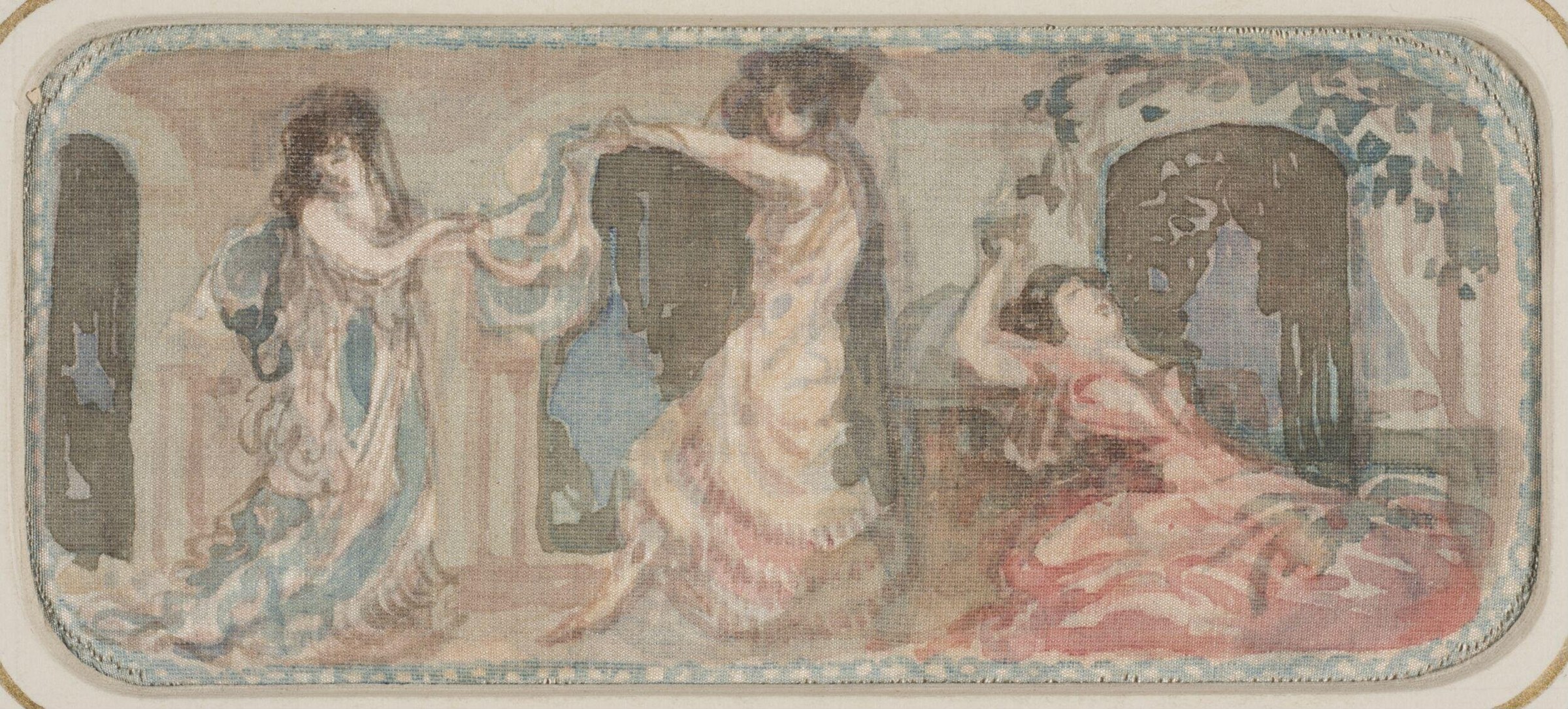
Two female figures dancing in a room
Charles Conder
- Collection:
- Drawing
- Source:
- Victoria and Albert Museum
- Rights:
- Rights vary by item — check the source record before reusing this image. Source record ↗
- Recorded as:
- V&A — check rights per item
This work documents a crucial moment in the history of how Western art imagined dance—the moment when Romantic idealization of classical antiquity merged with an emerging belief that 'true' dance could be recovered from ancient sources. Conder's vision of effortless, graceful movement in classical dress reflects ideas that would directly influence Isadora Duncan and the birth of modern dance. For historians and dancers, it shows how visual artists and choreographers of the period were collaborating in a shared fantasy of liberation from academic ballet and a return to nature and antiquity.
What you are looking at
A pale, tempera or gouache interior scene depicts two female figures dancing together in a neoclassical room with draped columns. The woman on the right, dressed in a flowing rose-pink gown with classical drapery, appears to be the principal dancer; she stands with one arm raised and her body in a graceful, elongated pose suggesting upward momentum. At left, a second figure in pale drapery moves toward her, creating a sense of dynamic interaction. The setting is minimal and ethereal—cream walls, simplified architectural elements, and soft tonal washes create a dreamlike quality. A third female head appears in profile at the far right, perhaps an attendant or observer. The colour palette is muted: soft pinks, pale blues, and warm ochres predominate, giving the whole a faded, almost romantic quality. The composition is horizontal and intimate, suggesting a private moment rather than public performance.
The dancing
Both dancers move in an extended, languid style characteristic of late nineteenth-century aesthetic movement imagery. The principal dancer on the right supports most of her weight on one leg while her other extends behind or to the side; her raised arm and lifted torso suggest a pose derived from Greek vase painting or classical sculpture. The second figure leans inward with a gentle curve through the spine, her arms fluid and her overall frame soft. There is no rigid frame or partnering hold; instead, the connection is gestural and psychological. The movement reads as unforced and contemplative rather than technically virtuosic.
The dance depicted
This work most likely depicts a fantasy or aesthetic interpretation of classical or Greek-inspired dance as understood in the 1890s, rather than a specific historical dance form. The elongated poses, the transparent drapery, and the neoclassical setting all point to the late nineteenth-century craze for 'Greek' or 'classical' dance—a movement associated with figures like Isadora Duncan, though Duncan's own performances postdate this work. The image reflects the Romantic and Aesthetic movements' idealization of ancient Greece and the belief that authentic, 'natural' movement could be recovered through classical study. The setting, costume, and gesture all emphasize beauty and reverie over technical display.
How it was made
The work appears to be executed in gouache or tempera on paper or prepared board, identifiable from the matte surface, the subtle blending of soft tones, and the delicate linear details. The technique allows for translucent washes that create the ethereal, almost watercolour-like quality of the draperies and the atmospheric perspective of the room. This medium was favoured for decorative and intimate works in the 1890s and was well-suited to the Aesthetic movement's taste for refinement and nuance. The small, horizontal format and the soft palette suggest this was made as a finished work for a private collection or as a study for a larger scheme, rather than for public exhibition.
About this work
This is a small decorative panel by Charles Conder, a key figure in the Aesthetic movement of the 1890s, depicting two female dancers in a neoclassical interior. The work exemplifies the period's fascination with classical antiquity reinterpreted through a modern, dreamlike sensibility. Rather than documenting an actual dance practice, it presents an idealized vision of grace, beauty, and movement inspired by Greek art and the growing interest in 'natural' or 'classical' choreography. The delicate technique and intimate scale suggest this was a precious object, made for aesthetes and collectors who valued such refined explorations of beauty and form. It belongs in a dance history context as evidence of how late nineteenth-century artists imagined and aestheticized movement, and of the classical revival that would help shape modern dance.
How to look at it
The viewer should attend to the moment of pause and transition Conder has chosen: the dancers are not in mid-leap or extreme extension, but in a state of gentle, sustained elevation and flow. Notice how both figures rest their weight lightly and asymmetrically, as if gravity itself is negotiable. The artist emphasizes line and silhouette—the contour of the raised arm, the curve of the spine—over muscularity or technical precision. This choice reflects the Aesthetic belief that true beauty lies in harmony and proportion rather than virtuosity. The pale, uniform interior and the absence of spectators or musicians create an inward, private quality; this is movement for its own sake, witnessed only by fellow initiates.
The artist
Charles Conder (1854–1909) was an English painter and designer closely associated with the Aesthetic movement and the Decadent movement of the 1890s. He was known for decorative panels, book illustrations, and delicate paintings in gouache and watercolour that often depicted literary, mythological, or romantic subjects. Conder worked in London and Paris, was influenced by Japanese art, and collaborated with theatre designers and writers. His style emphasized mood, refinement, and a subtle, muted palette; he was not primarily a painter of contemporary life but of fantasy, reverie, and historical fancy. He died of syphilis at 55, having produced a large body of small, intimate, and highly prized works.
The period
In 1890, ballet was dominated by the Russian Imperial Ballet and the Paris Opéra style—technically demanding, narrative, and deeply conventional. Simultaneously, a counter-movement was forming among artists, writers, and progressive thinkers who associated ballet and academic dance with artificiality and constraint. The Aesthetic movement, which peaked in the 1880s–90s, celebrated 'art for art's sake' and drew heavily on classical antiquity, Japanese prints, and the notion of beauty as an end in itself. This same period saw the rise of the 'Greek dance' or 'classical dance' movement, in which artists and dancers (notably including Isadora Duncan, who began her career in the mid-1890s) sought to create or recover a more 'natural', expressive movement vocabulary based on ancient sources. Conder's panel sits at the intersection of these currents: Aesthetic refinement, classical revival, and the emerging critique of academic ballet.
Where it lives
The work is recorded as a drawing in a collection noted as 'va', which likely refers to the Victoria and Albert Museum in London. The catalogue record is minimal and does not specify the exact medium, dimensions, or accession number, indicating it may be a works-on-paper collection item with limited institutional description.
Dance in this work
Questions about this work
Is this Isadora Duncan?
Almost certainly not. Conder died in 1909 and this work dates to 1890, before Duncan's revolutionary performances became widely known. However, both the painting and Duncan's early work emerge from the same cultural moment: the late nineteenth-century Aesthetic movement's fascination with classical antiquity and the idea that 'natural', expressive movement could be recovered from ancient Greece.
What kind of dance is this supposed to be?
There is no single answer. Conder was not documenting a real dance technique or tradition, but rather visualizing an ideal—a fantasy of how ancient Greek movement might have looked. The painting reflects the period's 'classical' or 'Greek' dance movement, which was more a visual and philosophical concept than a codified technique. The elongated poses and transparent drapery echo Greek sculpture and vase painting rather than any historical dance notation.
Why does it look so faded and dreamy?
That is deliberate. Conder worked in gouache and other soft media precisely to achieve this ethereal, intimate quality. The pale colours and matte finish were fashionable among Aesthetic movement collectors and suited the mood of reverie and timelessness the artist wanted to convey. The effect suggests something remembered or imagined rather than witnessed in documentary fashion.
Is this a preparatory sketch or a finished work?
It appears to be a finished decorative panel. Conder was known for creating small, highly refined gouache panels as completed works for private collectors. The careful composition, balanced colour scheme, and the inclusion of all narrative elements suggest this is not a rough sketch but a carefully realized piece, even if its small scale and intimate character might initially suggest otherwise.
More dance artwork





