49 works in this view — arrow keys or swipe to move between them.
Dance in Art
Poster
The Dance Library
- Collection:
- Poster
- Source:
- Victoria and Albert Museum
- Rights:
- Rights vary by item — check the source record before reusing this image. Source record ↗
- Recorded as:
- V&A — check rights per item
This poster is a primary source for the history of British ballet in the 1980s: it records the Sadler's Wells company's Christmas season programming, the visual presentation of classical ballet to urban audiences, and the relationship between sponsorship (Sainsbury's) and arts funding at the time. For dancers and choreographers, it documents a specific moment in how classical ballet was performed and marketed in Britain, and the continuing centrality of romantic and classical narratives to the professional ballet repertoire.
What you are looking at
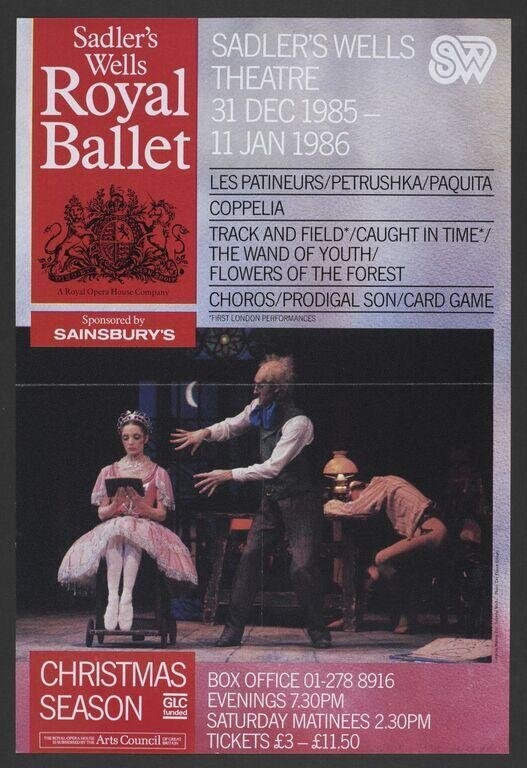
This is a theatrical poster for the Sadler's Wells Royal Ballet's Christmas season at the Sadler's Wells Theatre, 31 December 1985–11 January 1986, sponsored by Sainsbury's. The lower half shows a stage photograph from a performance: a young female dancer in a pale pink tutu and pointe shoes stands at left, her posture upright and classical; a male dancer in dark vest and tights leans toward her with arms extended in an expressive gesture; a third figure in reddish-brown costume crouches or sits at right. The lighting is warm and focused, with a painted moon visible above. The upper portion of the poster lists the ballets in the season—Les Patineurs, Petrushka, Paquita, Coppelia, Track and Field, Caught in Time, The Wand of Youth, Flowers of the Forest, Chorus, Prodigal Son, and Card Game. Ticket prices (£3–£11.50) and performance times are given at the foot. The design combines the institutional red-and-white livery of the Royal Ballet with a soft gradient background, creating a formal but accessible visual identity for a major London company's festive programming.
The dancing
The female dancer stands in a classical ballet frame—upright torso, pointe shoes visible, arms held in a soft, open position. The male dancer's body leans forward dynamically, both arms extended outward in an expressive, almost pleading gesture; his weight appears on the balls of his feet, suggesting vigorous movement or emotional intensity. The crouching or seated third figure, less clearly lit, anchors the composition at the lower right. The spatial relationship—the two principal figures in focus, the subordinate figure framing the depth—follows the conventions of narrative or character-driven ballet staging.
The dance depicted
The photograph captures a moment from one of the ballets listed on the poster, most likely Coppelia (a classic three-act comedy about a young couple and a mechanical doll), Petrushka (Stravinsky's tragic puppet ballet), or The Prodigal Son (a dramatic one-act work). The style is unambiguously classical ballet: the female dancer's pointe work, tutu, and carriage; the male dancer's partnering frame and expressive upper body; the emotional storytelling evident in gesture and spatial positioning. The warm lighting and the suggestion of melodrama in the male dancer's posture point to a romantic or dramatic narrative central to the work, typical of either the Romantic ballet repertoire (19th century) or 20th-century classical works that drew on those conventions.
How it was made
This is a colour offset lithographic poster, a standard medium for theatrical promotion of the period. The photographic image in the lower half is a high-quality colour halftone reproduction, printed in register with the typography and the designer's graphic elements above. Offset lithography allowed the Royal Ballet to circulate thousands of copies across London; the inclusion of a stage photograph lends documentary credibility and appeals to audiences who recognize the dancers or the particular staging. The integration of photography with graphic design and typography was a mature technique by 1985, allowing the poster to function simultaneously as artistic announcement, institutional branding, and practical ticketing information.
About this work
This is a theatrical poster advertising the Sadler's Wells Royal Ballet's Christmas season in late 1985. It presents a vivid, stage-lit moment from a classical ballet—a young woman in a tutu, a male dancer in expressive partnering, and a third figure—against the administrative and marketing apparatus of a major British ballet company. The work is a document of the company's repertoire at a specific moment, capturing not only the visual language of classical ballet in performance but also the professional design and distribution infrastructure that brought that work to London audiences. It belongs in a dance archive as evidence of how ballet companies communicated with the public, how they positioned themselves within London's cultural life, and what ballets occupied their stages in the mid-1980s.
How to look at it
Notice the freeze-frame moment chosen for the stage photograph: the male dancer's gesture is at its most expansive and emotionally open, the female dancer calm and composed, the lighting theatrical and warm. This compositional choice—capturing a moment of dramatic tension or emotional declaration—is typical of ballet publicity of the period, designed to convey narrative excitement and professional artistry simultaneously. The classical ballet frame of the female dancer's body (upright, turned out, on pointe) is instantly legible as 'classical ballet' to any viewer familiar with the form; the male dancer's open, expressive arms and forward-leaning torso signal the Romantic or neo-Romantic idiom that dominated the company's classical repertoire.
The period
The Sadler's Wells Theatre, one of London's two major ballet companies (the other being the Royal Ballet at the Royal Opera House), maintained a repertoire of classical and contemporary works in the 1980s. This season, programmed for the Christmas period when ballet attracts both regular and casual audiences, mixes canonical works (Coppelia, Petrushka, The Prodigal Son) with contemporary commissions (Track and Field, Caught in Time, The Wand of Youth). The mid-1980s saw British ballet facing financial pressure, reflected in the visible presence of corporate sponsorship (Sainsbury's supermarket chain); colour offset printing and sophisticated graphic design were standard for theatrical marketing, aimed at a middle-class London audience. The inclusion of both narrative ballets and abstract/contemporary works reflects the company's positioning between tradition and modernism.
Where it lives
This poster is held by the Dance Library, likely as part of their archive of twentieth-century British theatrical ephemera. It is one of thousands of theatre posters produced for distribution in London during the 1985–86 season, and survives as a record of the company's public-facing visual communications and the ballets they performed during this period.
Dance in this work
Questions about this work
What ballets were the Sadler's Wells Royal Ballet performing at Christmas 1985?
According to the poster, the season included Les Patineurs, Petrushka, Paquita, Coppelia, Track and Field, Caught in Time, The Wand of Youth, Flowers of the Forest, Chorus, Prodigal Son, and Card Game. The photograph appears to capture a moment from one of the narrative ballets, possibly Coppelia or Petrushka, though the exact work is not identified on the poster.
Why is Sainsbury's supermarket listed as a sponsor?
By the 1980s, British arts organisations relied increasingly on corporate funding to supplement public subsidy and ticket revenue. Sainsbury's sponsorship of this season would have provided financial support in exchange for brand visibility and association with a prestigious cultural institution.
How can I tell what dance this is from the photograph alone?
The style is unmistakably classical ballet: the female dancer in pointe shoes and tutu, standing in an upright, turned-out position; the male dancer in tight-fitting rehearsal dress, using expressive arms and forward weight in a partnering frame. The warm lighting and the suggestion of narrative emotion—the male dancer's reaching gesture—point to either a Romantic-era ballet or a twentieth-century work in the Romantic tradition. Without additional context, the specific ballet cannot be determined from the image alone.
More dance artwork





