49 works in this view — arrow keys or swipe to move between them.
Dance in Art
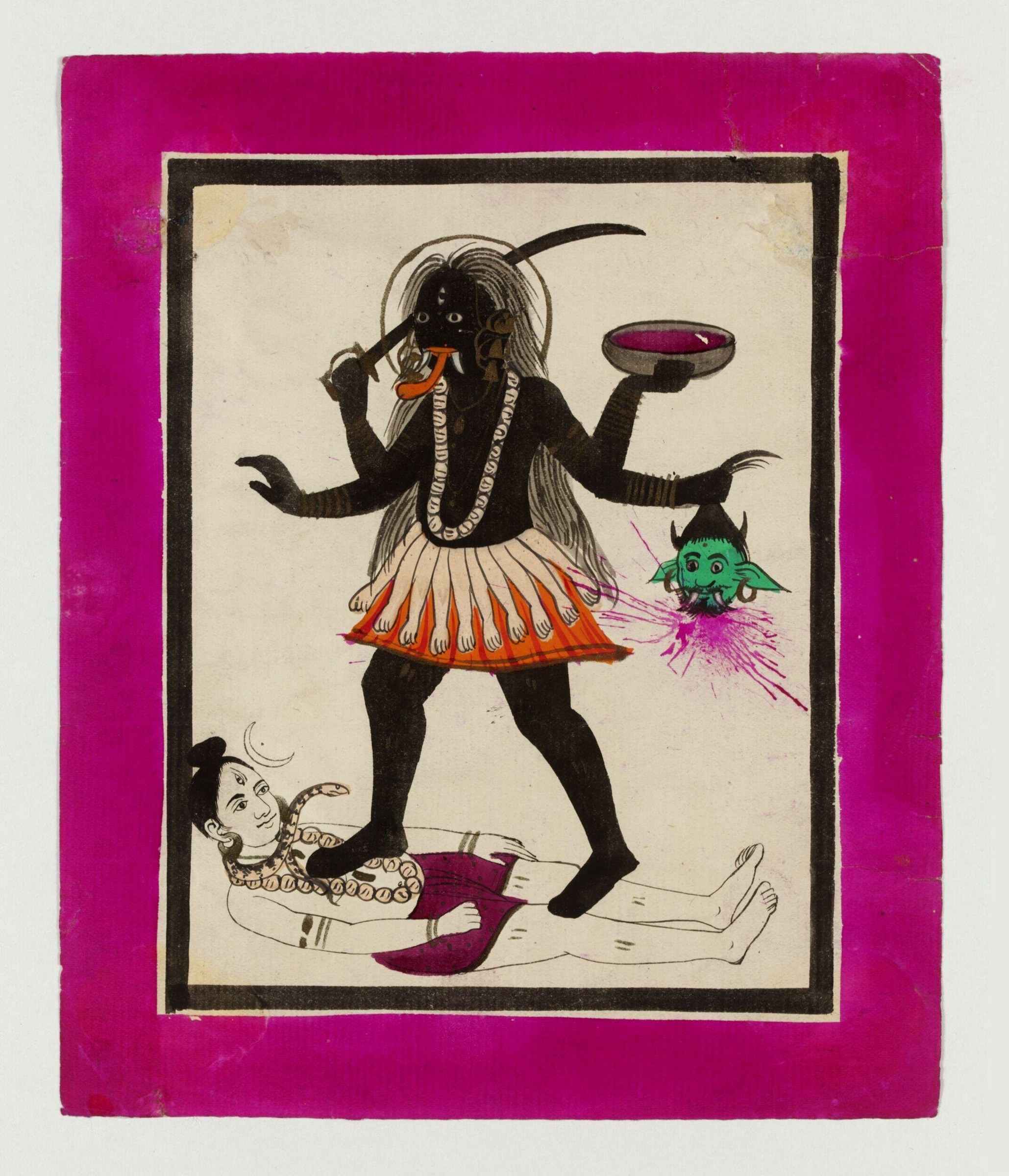
Kali dancing on Shiva
Unknown
- Collection:
- Drawing
- Source:
- Victoria and Albert Museum
- Rights:
- Rights vary by item — check the source record before reusing this image. Source record ↗
- Recorded as:
- V&A — check rights per item
This work documents how classical Indian dance vocabulary—mudras, asanas, and dynamic asymmetrical composition—served as the visual language for representing the sacred body and divine power in devotional art. It shows that Indian dance was not merely entertainment but a system of codified gesture understood across visual media, from temple sculpture to manuscript and print. For historians of dance, it reveals that the poses and hand-positions recognizable in modern Bharatanatyam and Odissi existed as a symbolic system centuries before their modern formalization.
What you are looking at
A black-figured deity with a face of dark, masklike intensity dominates the composition, wearing a crescent moon or curved blade as a headdress and a long strand of beads across the chest. The figure has four arms in dynamic, gestural positions: one raised to the face, one extended downward, one held aloft, and one gesturing toward a small green demon or rakshasa at the figure's hip. A skirt of orange-red feathers or flame-like folds extends from the waist, and black legs plant the figure in a wide, striding stance. Below, a pale-skinned figure in burgundy drapery and jewelry lies prone on the ground, with the dark deity's foot or leg positioned over the recumbent form. The composition is rendered in the style of traditional Indian manuscript or print art, with bold black outlines, minimal background, and selective hand-coloring in orange, green, and burgundy on a cream ground.
The dancing
The standing figure maintains an assertive, wide-legged stance with weight distributed across both legs in a posture of dominance and power. The four arms are held in distinct mudras and gestures: one hand raised to the face (suggesting revelation or intensity), one lowered in abhaya or dismissal, one extended outward, and one gesturing downward. The prone figure below is entirely passive, horizontal, with arms and legs extended in submission. The compositional relationship is one of absolute asymmetry—the dynamic vertical figure anchored by the horizontal, powerless form beneath.
The dance depicted
This image depicts Kali dancing upon the prostrate body of Shiva, a central iconographic moment in Hindu sacred narrative and devotional art. The work illustrates a moment of cosmic dance (natya) rather than a social or theatrical dance, drawing from classical Sanskrit drama and temple sculpture traditions. Kali's multi-armed pose and dynamic contrapposto derive from the vocabulary of Bharatanatyam and Odissi, classical Indian dance forms in which such mudras (hand gestures) and asanas (body positions) carry specific symbolic meaning. The artist has captured not a naturalistic human movement but a ritually codified and symbolically dense pose—a frozen instant of divine power.
How it was made
The work is an illustration or print, likely from an Indian manuscript tradition or a hand-colored print of the 18th or 19th century. The technique employs bold black outlines (characteristic of Indian miniature painting and woodcut traditions) with selective hand-applied pigmentation in organic colors. This method allowed for rapid production and circulation of devotional imagery, and the retention of white ground emphasizes the graphic clarity of line. The style suggests commercial production for a religious or educated audience familiar with Hindu iconography.
About this work
This is a devotional image representing the deity Kali in her most powerful form, dancing in cosmic triumph over the inert body of Shiva. It belongs to a long tradition of Indian religious art visualizing moments from Hindu mythology through the vocabulary of classical dance. The artist has translated an abstract theological concept—the terrible and generative power of the divine feminine—into a concrete, kinetic image, using the pose-language of Indian classical dance to do so. For audiences trained in Bharatanatyam or Odissi, the mudras and body positioning would have been immediately legible as sacred language; for others, the image conveys dominance, ecstasy, and cosmic authority through gesture alone.
How to look at it
Attend first to the four arms and their distinct positions: each one articulates a different gesture or mudra, and together they create a complex rhythm that cannot be read in a single glance—the eye must travel. Notice the contrast between the violent curve of the crescent headdress and the straight, planted legs: the upper body spirals with energy while the lower body anchors the figure in stable, powerful contact with the ground. Observe how the pale, supine figure below reads not as a victim but as a cosmic principle (Shiva, the void, the still point) against which the dynamic feminine force defines itself. The convention at work is Indian iconography, in which multiple arms signify divine or superhuman status, and mudras carry precise symbolic meaning; without that knowledge, the image may read as merely grotesque, but with it, every hand position is a word.
The artist
Unknown. The work reflects a tradition of Indian devotional printmaking and manuscript illustration that flourished in urban commercial centers from the 18th century onward, particularly in centres like Calcutta, Varanasi, and Jaipur. Such works were produced in workshops for a market that included both Hindu devotees and European collectors, resulting in a hybrid aesthetic that retained indigenous iconographic content while responding to print technologies (lithography in particular) that enabled mass circulation.
The period
This image emerges from a period when Indian classical dance traditions were undergoing significant transformation. By the 19th century, classical forms like Bharatanatyam (then called Sadir or Nautch) and Odissi were increasingly documented and codified in textual and visual form. Simultaneously, devotional art and mythology were being disseminated through new print technologies to mass audiences. The Kali cult, centered on the goddess's transgressive power and ecstatic worship, experienced a significant revival in Bengal and other regions during this period, producing an explosion of Kali imagery in popular and elite art. This image sits within that explosion, using the visual language of classical dance to make the abstract theological concept of shakti (divine feminine power) viscerally immediate.
Where it lives
Held in a collection labeled 'va' in the source record. Catalogued as a drawing but likely a hand-colored print or manuscript illustration. The work's origins, date, and artist remain unrecorded in the current catalogue.
Dance in this work
Questions about this work
Why does Kali have four arms?
In Hindu iconography, multiple arms signify divine or superhuman power and capability. Each arm can simultaneously perform a distinct gesture or hold an attribute, allowing a single figure to embody multiple aspects or actions. In Kali's case, the four arms typically represent destruction, creation, fearlessness (abhaya), and blessings. This multiplication of limbs is a visual language exclusive to the divine.
Is this a real dance, or just mythology?
The image depicts a cosmic or mythological moment, but the artist has rendered it using the pose-vocabulary of classical Indian dance—mudras (hand gestures), asanas (body positions), and dynamic asymmetrical balance. For trained dancers in Bharatanatyam or Odissi, this imagery would be immediately recognizable as a translation of their own movement language into devotional art.
Who is the figure under Kali's foot?
According to the title and Hindu mythology, this is Shiva, the supreme yogi and destroyer-renewer god. In certain tantric and devotional traditions, Kali's dance upon Shiva represents the movement of shakti (feminine divine power) and the dissolution of ego. Shiva's inertness contrasts with Kali's violent dynamism.
What is the green creature at Kali's side?
This appears to be a demon or rakshasa, often depicted as a monstrous or grotesque being in Hindu iconography. In some versions of Kali imagery, demons or negative forces are subdued or controlled by the goddess, making them attributes of her power rather than independent threats.
More dance artwork





