49 works in this view — arrow keys or swipe to move between them.
Dance in Art
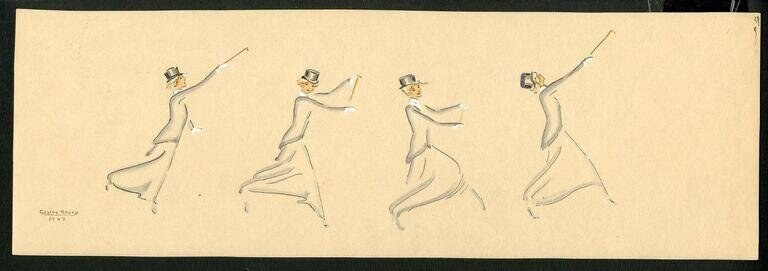
Adeline Genée performing the Hunting Dance
Avery, Claire
- Collection:
- Illustration
- Source:
- Victoria and Albert Museum
- Rights:
- Rights vary by item — check the source record before reusing this image. Source record ↗
- Recorded as:
- V&A — check rights per item
Adeline Genée was a foundational figure in ballet history and a major star of the legitimate stage in the early 1900s; her performances set standards for technical and dramatic interpretation that influenced an entire generation. This sketch is one of the few visual records of how she actually moved in a specific role, capturing not the idealized form of academic ballet but the living, working body of a professional dancer in a theatrical costume and character solo.
What you are looking at
Four sequential sketches of a female dancer in theatrical dress, each capturing a different moment of the same movement phrase. The dancer wears a fitted bodice with what appears to be a decorative hat or headdress, and a skirt that swings freely with the motion. In each frame, her body is captured mid-gesture with one arm extended upward, holding what appears to be a hunting crop or similar implement. Her weight shifts dynamically from frame to frame—in some sketches she rises onto the ball of one foot while the other leg extends, creating a sense of spiraling or turning movement. The poses progress from a more grounded stance to increasingly lifted and extended positions. The drawing is spare and elegant, rendered in quick pencil or ink lines that emphasize the continuous flow of the dancer's movement rather than anatomical detail. The repetition across four poses suggests the artist was studying the mechanics and rhythm of a specific choreographic figure.
The dancing
A single female dancer shown in four sequential attitudes, demonstrating the progression of movement through space and time. Her upper body remains relatively vertical while her lower body generates the momentum—legs bend and straighten in a rhythmic pattern suggesting a traveling phrase or turning sequence. The raised arm and the prop (hunting crop) are constant elements, positioned to suggest both elegance and sport. The dancer's frame is light and vertical, with visible weight transfer from one foot to the other; there is no partnering or closed hold. The sketchy rendering prioritizes the line of the body and the flow of fabric over exact anatomical precision.
The dance depicted
This is almost certainly a study of a solo from the *Hunting Dance*, a choreography associated with Adeline Genée, one of the most celebrated ballerinas of the early 20th century. Genée specialized in light, comedic roles and character dances; the hunting theme and the use of a property suggest this was a divertissement or short ballet scene rather than a formal classical solo. The sequential presentation indicates the artist was documenting actual performance material or studying how the dancer moved through space—a common practice for theater illustrators and costume designers. The lifting, turning quality and the upswept arm position are consistent with the ballet technique of the Romantic and late-classical eras.
How it was made
Pencil sketch on paper, executed with economical line work and minimal shading. The technique is characteristic of theater press illustration or rehearsal documentation from the Edwardian period—quick, gestural studies made to capture movement rather than to render finished form. The repetition across four frames suggests a contact sheet or study page, possibly made from observation of live performance or from photographs. This kind of linear, sequential sketch was well suited to reproduction in newspapers and theater programs of the era, making such works important records of how specific dancers and choreographies were actually performed.
About this work
This is a theater sketch documenting a moment in the career of Adeline Genée, one of the most significant ballet stars of the early 20th century. The four-frame study captures the kinetic essence of a hunting-themed solo, showing the dancer in various attitudes of movement as she travels and turns across the stage. The work belongs in a dance archive both as a record of a specific dancer's performance and as evidence of how theater artists of the period documented live dance—through quick, gestural studies that prioritize movement and line over anatomical accuracy. It represents the intersection of dance documentation and visual art at a moment when ballet was moving toward modernism while still rooted in 19th-century vocabulary.
How to look at it
Trace the pathway of the dancer's body across the four frames: notice how the extension and spiraling action accumulates and shifts with each repetition. The artist has deliberately omitted unnecessary anatomical detail—instead, the line of the arm, the tilt of the torso, and the reach of the leg tell you everything about the quality and direction of the movement. The hunting crop, held aloft in each frame, anchors the character of the dance; this is not abstract ballet but a narrative or character piece. The progression from frame to frame shows you not what the dancer looked like at any single instant, but how she moved through time.
The artist
Claire Avery was a theater illustrator and costume designer active in the Edwardian and early Georgian periods. She contributed sketches and designs to major theatrical publications and worked closely with dancers and choreographers to document performance material. Her practice was rooted in the tradition of theater notation and design documentation—using the sketch as both a record of what she observed and a communication tool for costume makers, choreographers, and other theater professionals.
The period
In the early 1900s, ballet occupied a complex position in Anglo-American theatrical culture. While the Russian Imperial Ballet under Diaghilev was about to revolutionize European perception of the form, the English and American stage still supported a thriving tradition of short ballets, divertissements, and character dances performed by stars like Genée. Theater illustration was a major medium of dance documentation—photographs of performance were rare and usually formal, so artists' sketches in newspapers and programs were often the only visual record of how a dancer moved. This sketch predates film as a practical tool for choreographic preservation, making such drawings essential historical evidence.
Where it lives
This sketch is part of a collection of Edwardian theater illustration and design material. It is catalogued as an illustration, suggesting it was created as working theater documentation rather than as a finished artwork for exhibition. The attribution to Avery and the identification of Genée indicate it was either published in a theater program or preserved in a production archive.
Dance in this work
Questions about this work
Who was Adeline Genée?
Adeline Genée (1878–1970) was one of the most celebrated ballet and musical theater stars of the late 19th and early 20th centuries. She was known for her technical precision, dramatic intelligence, and command of character roles. She danced across Europe and America, and her career bridged the worlds of classical ballet and popular theater.
What is a 'Hunting Dance'?
A hunting dance was a character solo or divertissement—a short, thematic dance number—popular in ballet and musical theater of the era. Such pieces were often set to descriptive or folk-inflected music and allowed dancers to show both technical skill and theatrical personality. The hunting theme provided a narrative frame and justified the use of properties like the crop visible in these sketches.
Why are there four sketches instead of one?
The four frames show different moments in the same movement phrase, allowing a viewer (choreographer, costume maker, fellow dancer) to understand the full arc and continuity of the solo. This sequential approach to movement documentation was standard in theater design and notation—it communicates rhythm and progression in a way a single image cannot.
How does this sketch compare to a photograph?
A photograph freezes a single instant; this sketch sequence unfolds movement across time. Because it is drawn rather than photographed, the artist could emphasize the essential line and momentum of the movement, omit distracting detail, and show the dancer in four different moments on a single sheet—something a camera could not do in 1908.
More dance artwork





