49 works in this view — arrow keys or swipe to move between them.
Dance in Art
Polovtsian Dances
Unknown
- Collection:
- Photograph
- Source:
- Victoria and Albert Museum
- Rights:
- Rights vary by item — check the source record before reusing this image. Source record ↗
- Recorded as:
- V&A — check rights per item
The *Polovtsian Dances* became a watershed work in early modern dance history—Fokine's 1909 choreography challenged academic ballet convention by incorporating fluid, non-linear movement and dramatic characterization rooted in contemporary artistic movements. Photographs like this one are primary evidence of how that choreography looked in the body, how it was marketed, and who performed it. For historians of Russian Imperial ballet and early Soviet dance culture, this image offers concrete visual documentation of costume, pose, and performance style that shaped international understanding of Russian dance in the 1920s.
What you are looking at
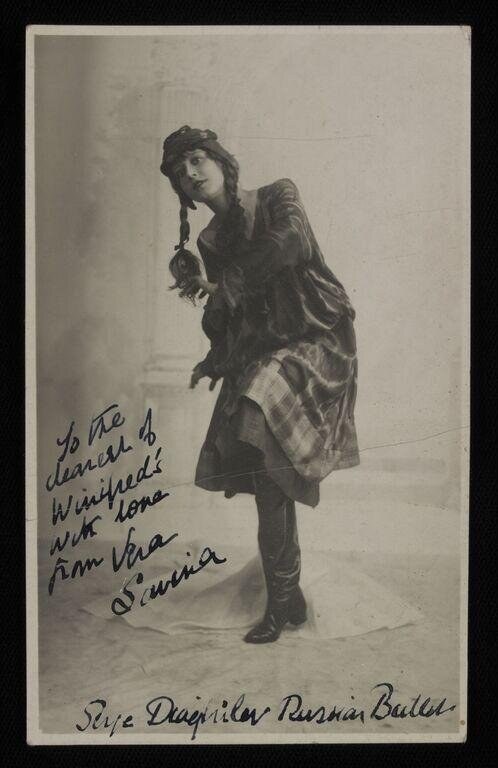
A young woman in early 20th-century dress strikes a dramatic, asymmetrical pose against a plain studio backdrop. She wears a dark, heavily draped coat or cloak with voluminous sleeves and a plaid or patterned skirt beneath, with dark stockings and boots. Her dark hair is loose and flowing, framing her face as she gazes downward in a contemplative expression. One arm is raised with her hand near her head in a gesture of reverie or sorrow; her body weight appears shifted, creating a diagonal line through her torso. The lighting is soft and even, typical of early theatrical photography, emphasizing the sculptural quality of her pose and the rich textures of her costume. The image has the quality of a signed theatrical publicity photograph or souvenir.
The dancing
A single female dancer occupies the frame in a moment of stillness rather than active movement. Her weight rests primarily on one leg, with the other leg positioned to suggest potential weight shift or recovery. Her raised arm—hand to head—and downward gaze create an inward, introspective quality unusual for action photography. The pose suggests either a moment within choreography (a supported port de bras) or a styled moment of dramatic character—poised between positions rather than captured mid-jump or turn. The asymmetry and the focus on upper-body articulation indicate training in a theatrical idiom.
The dance depicted
The title *Polovtsian Dances* refers to the famous orchestral interlude from Alexander Borodin's 1890 opera *Prince Igor*, which depicts a scene of wild celebration and seduction at a Tartar camp. The dance became iconic in early 20th-century Russian Imperial ballet, most memorably in Michel Fokine's 1909 choreography for the Ballets Russes, which featured exotic, orientalist costuming and a blend of classical ballet technique with fluid, undulating movements influenced by contemporary interpretive dance. This photograph appears to document a performer in such a production, though without further provenance it cannot be confirmed whether she danced in Fokine's version or a later or alternative staging. The costume—heavy, draped, and vaguely Caucasian or Central Asian in flavor—and the introspective, atmospheric pose are consistent with the orientalist aesthetics and dramatic characterization that defined early 20th-century Russian Imperial dance.
How it was made
This is a gelatin silver or albumen print, a standard photographic medium for theatrical documentation in the 1920s. The inscription in the lower left corner is handwritten in ink, suggesting this is either a publicity photograph distributed to patrons and critics or a souvenir intended for sale. The studio setting, professional lighting, and signed nature of the object indicate it was made by a commercial theatrical photographer, possibly from a Moscow or St. Petersburg studio, and circulated as a printed collectible—a common practice for celebrated performers of the Russian Imperial Ballet and its successors during the 1920s Soviet era.
About this work
This is a studio portrait photograph of a female dancer posed in costume and character as one of the seductive, exotic figures from the *Polovtsian Dances* sequence. The work captures not a moment of active dance but a styled, dramatic moment: the dancer in repose, her costume and bearing evoking the orientalist fantasy that made this work famous. The image records the aesthetic of early 20th-century Russian Imperial ballet—a fusion of classical training, literary-dramatic narrative, and orientalist fantasy—at a moment when that style was being photographed for circulation to audiences who could not attend live performance. The inscription suggests this was a souvenir or publicity item, making it a document both of a specific dancer's career and of how theatrical dance was marketed and consumed in the early Soviet period.
How to look at it
The photograph freezes a moment of apparent stillness within or adjacent to choreographed movement—not a leap or a climactic gesture, but an atmospheric pause. Notice the asymmetrical weight distribution and the reaching quality of the raised arm: these suggest a body trained in ballet, capable of sustaining a pose that is neither fully grounded nor in motion. The downward gaze and inward focus create a sense of character and emotion rather than technical display. This choice—to document reverie rather than virtuosity—tells us something about how the *Polovtsian Dances* was performed: not as a display of jumps and turns, but as a dramatic tableau in which movement and stillness were equally important.
The period
The *Polovtsian Dances* entered the international repertory through Michel Fokine's 1909 choreography for Sergei Diaghilev's Ballets Russes in Paris. The work exemplified Fokine's reformist philosophy: rejection of rigid academic codes in favor of movement that emerged from dramatic character and narrative context, incorporation of influences from visual art and contemporary interpretive dance, and a fascination with orientalism—the Western fantasy of exotic, non-European cultures. The production design, by Nicholas Roerich, created a visual world of Caucasian and Central Asian aesthetics that captivated European audiences. By 1920, the work had been performed widely across Europe and Russia, and the Russian Imperial Ballet and its successor Soviet companies continued to stage versions. Theatrical photography became a major medium for circulating images of celebrated performances and performers to audiences who attended live theater, creating a secondary market for signed photographs as souvenirs and collectibles.
Where it lives
The photograph is held in the Library of Congress (source code: va). The handwritten inscription indicates it was signed by or for the performer and likely distributed as a theatrical souvenir or publicity item. The object is a printed photograph, not a unique artwork, suggesting it was one of many copies made for circulation.
Dance in this work
Questions about this work
What are the Polovtsian Dances?
The Polovtsian Dances are an orchestral interlude from Borodin's 1890 opera *Prince Igor*, depicting a wild celebration at a Tartar encampment. Michel Fokine choreographed a famous version for the Ballets Russes in 1909, which became a staple of early 20th-century ballet repertory. The work combined classical ballet technique with fluid, orientalist aesthetics and dramatic characterization.
Who is the dancer in this photograph?
The photograph is signed but the inscription is not fully legible in the available image. Without access to the Library of Congress catalogue entry or the original object, the dancer's identity cannot be established with certainty.
Why is she posed like this rather than mid-leap?
This pose captures a moment of dramatic character within or adjacent to the choreography—stillness and introspection rather than technical display. The *Polovtsian Dances* was performed as a narrative tableau involving seduction and celebration; this photograph privileges atmosphere and emotion over virtuosity.
What is the costume, and what does it tell us?
The heavy, draped coat, plaid skirt, and loose hair evoke a vaguely Caucasian or Central Asian aesthetic—the orientalist fantasy that was central to the work's appeal and to Roerich's design. This costume was typical of the production design that made the *Polovtsian Dances* visually distinctive from academic ballet.
More dance artwork





