49 works in this view — arrow keys or swipe to move between them.
Dance in Art
Oriental Dance
Unknown artist
- Collection:
- Photograph
- Source:
- Victoria and Albert Museum
- Rights:
- Rights vary by item — check the source record before reusing this image. Source record ↗
- Recorded as:
- V&A — check rights per item
This photograph is an artifact of early 20th-century orientalism and the theatrical presentation of non-Western dance to Western audiences. It shows how 'Oriental Dance' was packaged, posed, and photographed—often divorced from its original contexts—and reveals the aesthetic conventions and costume choices that shaped Western understanding of dance traditions beyond Europe and America. The image is also a reminder that many early 20th-century photographs of dancers, particularly women and performers of color, were created under power imbalances and often misrepresented or exoticized the traditions they claimed to document.
What you are looking at
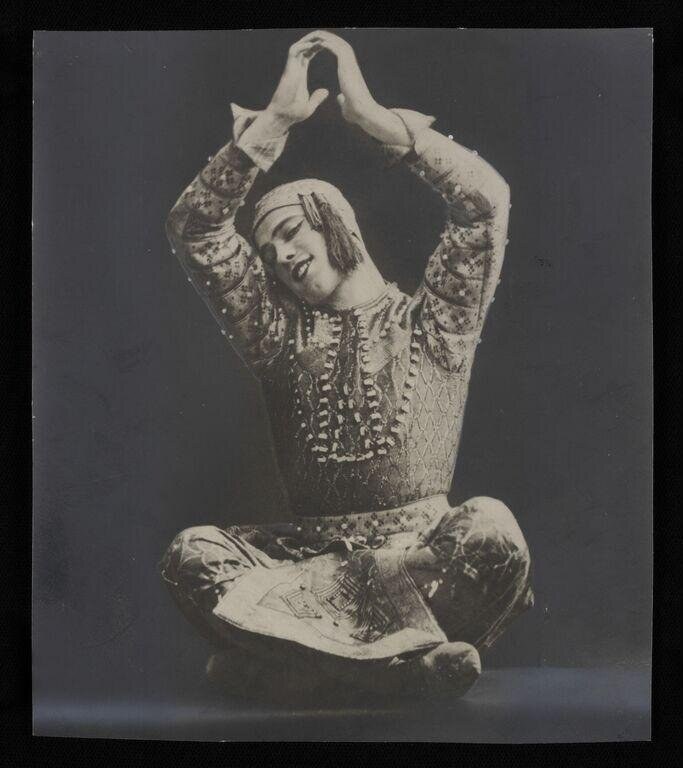
A single dancer sits cross-legged on the ground against a dark background, wearing an ornate long-sleeved tunic densely patterned with geometric embroidery or brocade. The garment appears to be Central Asian or Middle Eastern in origin, with elaborate detailing down the front. A light headscarf or head covering frames the dancer's face. Both arms are raised above the head in a graceful curved frame, with hands meeting or nearly touching to form a heart or arch shape. The pose suggests a moment of stillness within movement—the dancer's gaze is downward and inward, creating an impression of introspection or devotion. The photograph is rendered in soft grey tones typical of early 20th-century gelatin silver prints, with careful attention to the textures of the fabric and the subtle modeling of the body.
The dancing
A single figure in a seated position, knees bent and legs folded, creates a compact, grounded silhouette. The upper body is upright and the arms describe a symmetrical, lifted frame with hands brought together above the head in a gentle curve—a pose that suggests both openness and inward focus. The head is tilted slightly downward in a gesture of repose or meditation. The photographer has captured the dancer from the front at a slight distance, emphasizing the geometry of the pose and the ornamental quality of the costume.
The dance depicted
The title 'Oriental Dance' and the seated position with raised arms suggest a form of seated or stillness-based Middle Eastern, Central Asian, or South Asian dance, though without clearer contextual information the specific tradition cannot be confidently identified. The pose does not conform to the typical moving vocabulary of raqs sharqi (belly dance) or most folk forms from the region; instead it appears to represent a moment of contemplative or ritualistic stillness, possibly a tableau vivant or posed study created for photographic documentation. The costume—richly embroidered with geometric patterns—aligns with early 20th-century theatrical or orientalist representations of 'exotic' dance for Western audiences.
How it was made
This is a photograph, almost certainly a gelatin silver print from the early 20th century, as indicated by the soft grey monochromatic palette and the subtle gradations of tone. The photographer has lit the figure carefully to model the form and showcase the textile detail of the elaborate tunic. The dark, plain background isolates the dancer and focuses attention entirely on the pose and garment. The photograph was likely created as a studio portrait or theatrical documentation—common practice for dancers and performers of the era—and appears designed for reproduction and circulation as a postcard, publicity image, or gallery print.
About this work
This is a studio photograph of a dancer posed in a seated position wearing an ornately embroidered tunic, created around 1910 when Western audiences were consuming 'Oriental Dance' through theatrical performance, photography, and orientalist imagery. The image belongs to a body of early 20th-century photographic work documenting dancers—particularly those performing 'exotic' or non-Western forms—for audiences fascinated by cultural difference. The photograph's formal composition and careful lighting suggest it was intended as a professional study, likely for exhibition, promotion, or collection. Its presence in a dance art gallery acknowledges the complex history of how dance was documented, staged, and commodified in this period, and how photographic technology made distant or unfamiliar performance traditions visible to new audiences.
How to look at it
Observe the precise geometry of the pose: the symmetry of the arms, the enclosed quality of the crossed-leg position, and the downward tilt of the head create a composition that reads as meditative rather than kinetic. The photograph does not capture motion or a transitive moment in a sequence of steps; instead it presents a stillness—a held shape. Notice how the photographer has chosen to emphasize the textile and surface detail of the costume through careful lighting, inviting the viewer to admire the garment as much as the body. The dark background and formal framing are conventions of early 20th-century studio photography designed to present the subject as a specimen or artwork rather than as a person in an actual space.
The period
The year 1910 falls in the high period of orientalism in European and American visual culture. 'Oriental Dance'—a category that conflated many distinct Middle Eastern, Central Asian, and South Asian traditions—was a staple of music halls, cabarets, world's fairs, and theatrical revues. Photography had become the dominant medium for documenting and circulating images of performance, and studio portraiture of dancers was a thriving commercial practice. The poses and costumes in such photographs were often shaped more by Western aesthetic expectations and theatrical convention than by the actual practice of dance in its original cultural context. This image sits at the intersection of theatrical modernism, photographic documentation, and colonial-era cultural representation.
Where it lives
Held by the collection listed as 'va' in the catalogue record. The photograph is catalogued as a work titled 'Oriental Dance' dated to 1910, with no artist attribution recorded.
Dance in this work
Questions about this work
Is this belly dance?
No. The pose is static and contemplative rather than kinetic. The seated position and raised-arm frame do not correspond to the typical movement vocabulary of raqs sharqi. This appears to be a studio study or tableau—a posed image created for the camera—rather than a capture of an actual dance in motion.
Where is this dancer from?
The photograph does not tell us. The costume is ornately embroidered in geometric patterns suggestive of Central Asian, Middle Eastern, or possibly South Asian dress, but the title 'Oriental Dance' is a vague Western category that could refer to many traditions. The image itself is a studio photograph created around 1910, likely for a Western audience, and may not represent an actual performer or tradition with authenticity.
Why is this in a dance gallery if it's just a posed photograph?
Because it is an important historical document of how dance was understood, performed, and circulated in the early 20th century. It shows the conventions of theatrical 'Oriental Dance,' the role of photography in making distant performance visible to Western audiences, and the power dynamics embedded in how non-Western dancers were represented. As an image, it teaches us about dance history, aesthetics, and cultural representation as much as about dance itself.
More dance artwork





