49 works in this view — arrow keys or swipe to move between them.
Dance in Art
Unknown
- Collection:
- Source:
- Victoria and Albert Museum
- Rights:
- Rights vary by item — check the source record before reusing this image. Source record ↗
- Recorded as:
- V&A — check rights per item
This work is evidence of how 19th-century artists and patrons imagined ancient Greek dance, and what they privileged in that imagining — the flowing line, the abandonment of the body to drapery and motion, and the integration of music and female movement into a single celebratory act. For historians of dance reconstruction and the classical revival, it documents the visual language available to artists seeking to depict ancient movement without written choreographic records.
What you are looking at
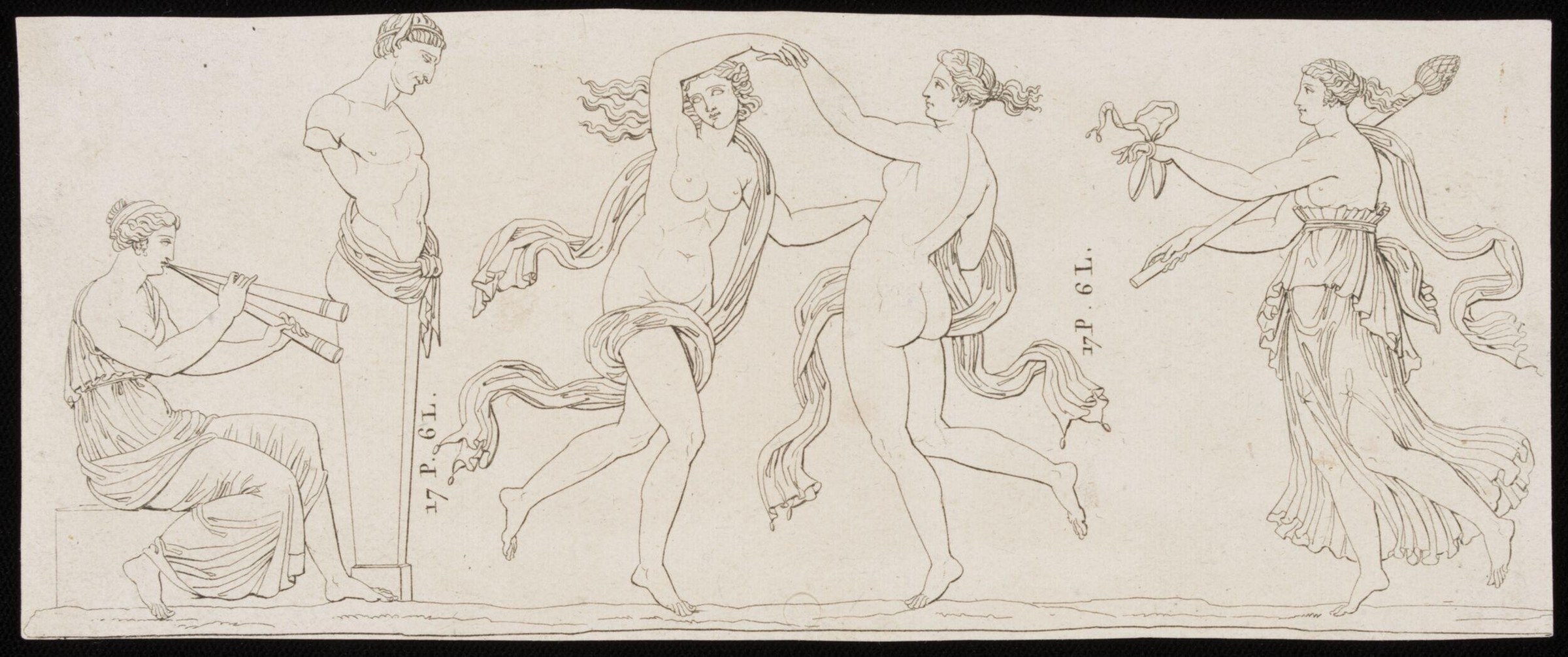
A linear procession of six female figures in classical dress unfolds across the print from left to right. The leftmost figure sits playing a double-pipes (aulos), her body draped in heavy folds of fabric. To her right, a standing nude figure holds drapery above her head in a billowing arc. The central figures are unclothed or minimally draped, posed in attitudes of motion — one with legs in a wide stride, another with arms raised and fabric streaming. The rightmost figure wears fuller drapery and holds what appears to be a laurel wreath or similar attribute. All figures are rendered in fine line work against a plain ground, with careful attention to the fall of fabric and the musculature of the body. The composition reads as a study of movement and classical form rather than a narrative scene. Text labels appear between some figures, though they are not legible at this reproduction size.
The dancing
The bodies are rendered in classical Greek or Greco-Roman style, with careful anatomical proportion. The dancer-figures move through space with extended limbs and flowing drapery; several are captured mid-stride or mid-gesture, with arms raised or extended in gestures of abandon or offering. The weight is distributed to suggest forward motion or pivoting movement. The musician on the left sits with her instrument held to her mouth, establishing the musical accompaniment for the action. The spacing and scale suggest these are studies of individual poses rather than figures in direct physical interaction — they occupy a shared ground but do not touch or form couples.
The dance depicted
This print appears to depict Greek or Greco-Roman maidens or nymphs in dancing or celebratory movement, possibly in a context of religious or festive ritual. The style and attributes (aulos music, flowing drapery, nudity treated as classical rather than erotic) suggest a classical revival subject, common in 19th-century academic art. The figures perform no recognisable ballroom or theatrical dance of the 1860s; instead they represent an imagined vision of ancient Greek female movement and celebration. Whether these are maenad-like figures, attendants of a goddess, or generic classical dancers cannot be determined from the image alone, but the emphasis on abandonment of movement and musical accompaniment suggests Dionysian or festal context.
How it was made
This is a fine engraving or etching executed in carefully controlled line work, producing a print of high finish and circulation quality. The technique allows the artist to render both the sculptural form of the body and the complex texture of drapery through modulation of line density and direction. Such prints were common in 19th-century art education and reproduction; this work's high finish and academic subject matter suggest it was produced for a wide audience of artists and educated patrons. The medium's association with fine-art reproduction and its capacity to preserve anatomical study made it the natural choice for classical subject matter.
About this work
This engraving depicts six classically draped female figures in dancing or processional movement, accompanied by music from a double-pipes player. The work belongs to the 19th-century academic revival of Greco-Roman art and the period's obsession with recovering and imagining ancient movement practices. It sits at the intersection of classical scholarship, fine-art anatomical study, and dance history — part of a wider 19th-century effort to reconstruct ideal ancient female movement through line and drapery study.
The print served as both an artwork in its own right and as a reference document for artists and performers interested in classical form. Its presentation as a linear study of poses rather than a narrative scene suggests its use in art education or in the design of theatrical or decorative works invoking classical themes.
How to look at it
Trace the progression from left to right: notice how the seated musician establishes the temporal frame (music as the condition for dance), and how each succeeding figure elaborates a different pose or attitude within what seems to be a single moment or continuous action. The draping is not incidental — it is the medium through which the artist shows movement, the way fabric displacement reveals the path of the body's motion. Look at how the artist distinguishes between figures in repose or transition and those captured at the peak of action: legs extended, arms lifted, the body stretched to its fullest extension. This is a study in what an educated 19th-century artist believed ancient dance looked like.
The period
The 1860s saw a peak in European academic interest in Greek and Roman art and life, driven by archaeology, classical education, and the Neoclassical and Romantic movements in visual culture. In the same period, theatre and dance were undergoing their own classical revival — the ballet d'action was established, and artists were beginning to imagine and stage versions of classical subjects. Academic prints of classical subjects circulated widely, serving as reference for painters, sculptors, and set designers. The emphasis on the female body in classical dress and motion reflects both the period's fascination with ideal form and its anxiety about representing female movement as both virtuous and expressive.
Where it lives
The work is held as a print in an unspecified collection. It is catalogued only as 'Print' with no artist attribution, date of creation (recorded as 1860), medium, or publication information preserved in the catalogue record.
Dance in this work
Questions about this work
Are these figures meant to be a specific group from mythology?
The image does not include sufficient iconographic detail to identify a specific mythological narrative. The aulos music, flowing drapery, and unclothed or semi-clothed bodies suggest a context of celebration, ritual, or festival, but the work presents itself as a study of classical female movement in general rather than a scene illustrating a particular story. The labels between figures, which are not legible in this reproduction, may provide more specific information.
What is the double-pipes instrument the seated figure is playing?
The instrument is the aulos, a paired reed pipe that was the standard musical accompaniment for Greek dance and theatre. Its presence anchors the scene in classical antiquity and establishes that what we are seeing is a dance accompanied by authentic (or imagined to be authentic) ancient music.
Is this a record of an actual ancient dance, or an invention?
It is an invention — specifically, a 19th-century academic artist's imagining of how ancient Greek dance might have looked. No choreographic records of ancient Greek dance survive, so all such depictions are reconstructions based on visual evidence (sculpture, vase painting), literary references, and the artist's own aesthetic assumptions about what ideal classical movement should be.
Who would have used this print?
Such fine engravings circulated among artists, art students, and educated patrons. It would have served as a reference for painters and sculptors working on classical subjects, as inspiration for theatre designers staging classical plays or ballets, and as a general document of 'taste' in classical form and movement.
More dance artwork





