49 works in this view — arrow keys or swipe to move between them.
Dance in Art
Unknown
- Collection:
- Source:
- Victoria and Albert Museum
- Rights:
- Rights vary by item — check the source record before reusing this image. Source record ↗
- Recorded as:
- V&A — check rights per item
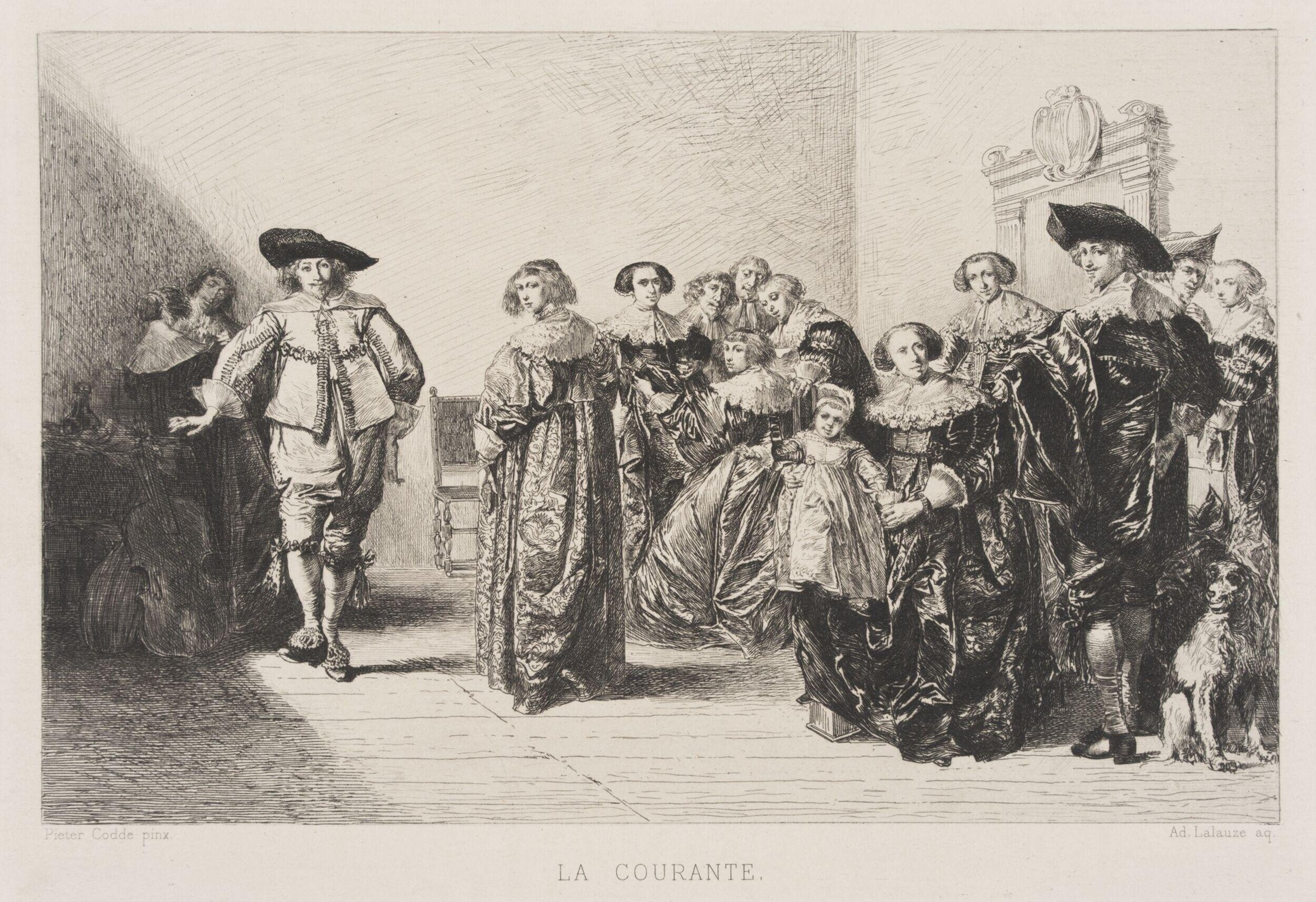
This engraving is valuable not as a record of courante technique but as evidence of how the dance functioned as an emblem of court status and French cultural authority in the 18th century. The work demonstrates the shift in dance imagery from documenting movement to representing ceremony and fashion, a shift that tells us much about how dancing was understood and valued in aristocratic society. For dance historians, it offers crucial context for interpreting the written sources and dance notations that survive from this era.
What you are looking at
This engraving depicts a formal court scene centered on a woman in an elaborate gown who appears to be the focus of attention. She wears a voluminous white silk dress with a fitted bodice and stands in the middle ground, surrounded by richly dressed courtiers in dark velvet and ornate fabrics. The composition is divided between foreground figures on the left—including a man in a three-cornered hat and knee breeches who gestures toward the central group—and a dense cluster of onlookers on the right, including children and a small dog. The architectural setting features classical pilasters and a decorative urn in the background, suggesting an interior palace or grand reception room. The entire scene is rendered in the fine linear hatching characteristic of 18th-century engraving, creating subtle gradations of light and shadow across the silk fabrics and faces. The title 'LA COURANTE' labels this as a courante—a court dance—though the figures are shown in static, conversational attitudes rather than in active movement.
The dancing
The central woman stands upright with composed posture, her body oriented toward the viewer, her hands positioned at her sides in a gesture of formal presentation rather than active dance. The man on the left wears the characteristic dress of a dancing master or nobleman and gestures with an open hand toward the assembled company, as if introducing or explaining. The surrounding courtiers stand in relaxed attitudes of observation and conversation rather than dance positions. No couple is shown in a closed hold or dance frame; instead, the gathering suggests a moment of social ritual—possibly a presentation, an introduction to the dance, or the instant before the courante begins. The density of the composition and the careful attention to the folds and texture of each figure's dress dominate over the depiction of bodily movement or technique.
The dance depicted
The title and the formal court dress establish that this depicts the courante, one of the most important court dances of the 16th and 17th centuries. The courante was a moderate-paced, processional dance in triple metre, danced by couples and prized for its elegance and controlled movement. However, this engraving does not show the dance in progress: instead it captures a moment of presentation, social interaction, or formal introduction—possibly the gathering before the dance begins, or an allegorical representation of the courante as a social institution. The absence of visible footwork, the static poses, and the emphasis on dress and ceremony over movement suggest that the artist's primary interest was in depicting the courante as a marker of courtly refinement and social order rather than as a kinetic event. This approach is consistent with 18th-century prints that used dance scenes to represent court life and aristocratic elegance.
How it was made
This is an engraving on paper, rendered in the formal linear technique typical of French or European court art of the 18th century. The fine parallel hatching and careful cross-hatching build tone and model form, particularly visible in the treatment of silk fabrics, faces, and the architectural background. Engraving allowed for precise detail and wide distribution; prints of this quality were collected by educated audiences and served as records of court ritual and theatrical spectacle. The technique's formal linearity and its capacity for fine tonal gradation made it ideal for depicting the elaborate costume and social ceremony that dominated court dance imagery in this period. The print bears marks suggesting it was a commercial publication—such prints were sold to collectors interested in court fashion, dance, and French culture.
About this work
This is a formal engraving depicting the courante, one of the principal dances of the European court from the 16th through 18th centuries. Rather than showing active dancers, the image presents a static scene of courtly assembly—a moment of formal presentation or social gathering centered on an elegantly dressed woman. The composition emphasizes costume, architectural setting, and the social hierarchy of the court rather than the actual technique or movement of the dance. The engraving belongs to a tradition of court dance imagery that used scenes of dance to represent aristocratic refinement, ceremony, and social order. For dance historians, it documents not the movement itself but the cultural and sartorial context in which the courante was performed—the dress, the setting, and the social rituals that framed one of the most prestigious dances of the ancien régime.
How to look at it
The viewer should note what is absent: there is no frozen moment of movement, no visible step or lift, no clear demonstration of technique. Instead, attend to the social and sartorial details—the hierarchy of the gathering, the textures and colors of dress, the architectural framing, and the moment of presentation or introduction. The engraving is less interested in showing how the courante was danced than in showing what it meant to dance it: a marker of status, education, and belonging to the court world. The static quality of the scene, the formal poses, and the emphasis on ceremony all suggest that by the 18th century, the courante was being valued as much for what it represented—refinement, order, legitimacy—as for the movement itself.
The period
The courante was at the height of its prestige in the 17th century and remained a fundamental court dance into the 18th century, by which time it had become somewhat conservative and formal compared to newer dances like the minuet and gavotte. This print dates from the mid-18th century, a period when court dances were increasingly documented in printed images aimed at aristocratic collectors and at a growing educated public interested in French fashion and culture. The formal, allegorical approach to representing the dance—showing it as an institution and a social practice rather than as kinetic motion—was characteristic of this era. By this time, dance was being recorded and disseminated through multiple media: written dance notation (Beauchamp-Feuillet notation), printed instruction books with diagrams, choreographic scores, and engravings such as this one that situated dance within court ceremony and aristocratic life.
Where it lives
The work is catalogued as a print of unknown artist from circa 1860, held in an unspecified print collection. The inscription 'LA COURANTE' appears below the composition in the engraving itself.
Dance in this work
Questions about this work
What is a courante and why was it important?
The courante was one of the principal social dances of the European court from the 16th to 18th centuries, performed by couples to moderate-paced music in triple metre. It was considered one of the most prestigious dances and was essential to courtly education and court ritual. By the 18th century it had become somewhat formal and conservative, but it remained an emblem of aristocratic culture.
Why doesn't this image show people actually dancing?
This engraving captures a moment of social presentation or ceremony rather than active movement. It may show the instant before the dance begins, or it may be an allegorical representation of the courante as a social institution. This approach—depicting dance as ceremony and social order rather than kinetic movement—was typical of 18th-century court dance imagery.
Who danced the courante and where?
The courante was danced by aristocrats and courtiers in royal courts and aristocratic households across Europe. It was a centerpiece of court balls and formal ceremonies, and knowledge of the dance was essential to anyone who moved in court circles. The dress and setting in this engraving are typical of the French court or courts modeled on French practice.
How do we know about courante technique if images like this don't show movement?
Dance technique from this era is documented in written dance notation systems (such as Beauchamp-Feuillet notation), in printed instruction manuals with diagrams, and in choreographic scores. Images like this one, while not showing technique, provide crucial context about how the dance was valued and situated within court culture.
More dance artwork





