49 works in this view — arrow keys or swipe to move between them.
Dance in Art
Feliks Topolski Collection
Topolski, Feliks
- Collection:
- Drawing
- Source:
- Victoria and Albert Museum
- Rights:
- Rights vary by item — check the source record before reusing this image. Source record ↗
- Recorded as:
- V&A — check rights per item
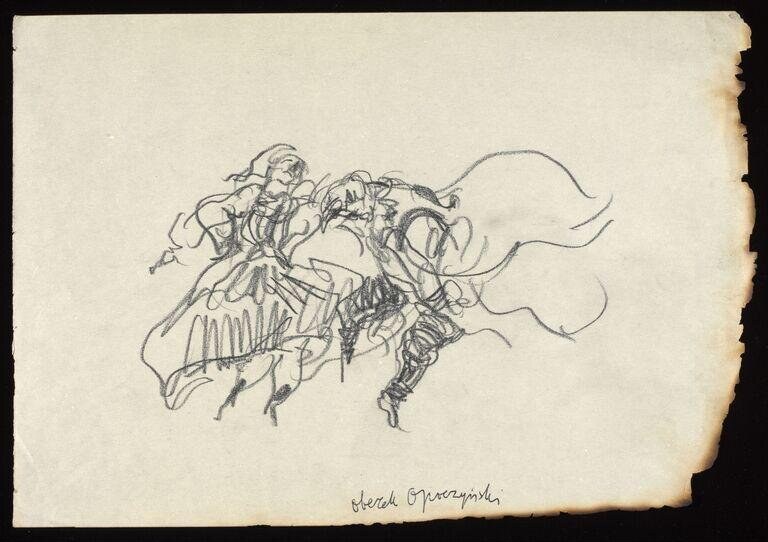
The sketch preserves a fleeting moment of live performance in a medium suited to capturing spontaneous motion—exactly what photography of the same era often struggled to convey. For historians of early twentieth-century ballet and theatrical dance, such sketches provide evidence of how movement was actually executed and how working artists understood and recorded choreography.
What you are looking at
A pen sketch of two figures in dynamic motion, rendered with loose, energetic line work that captures gestural immediacy rather than anatomical precision. The figures are depicted mid-leap or mid-turn, their bodies angled sharply across the composition with limbs extended and drapery billowing behind them. The figure on the left wears what appears to be a tunic or classical garment with vertical pleating; the figure on the right is more heavily draped. Both are shown in attitudes of vigorous movement—the left figure lunges forward with one leg extended, while the right figure's body twists, with fabric streaming. The sketch technique itself—rapid, overlapping strokes with minimal detail—conveys urgency and spontaneity. No setting or background is established; the figures float against blank paper, making the movement itself the sole subject.
The dancing
Two figures in close spatial relationship, both airborne or in the moment of flight. The left figure appears to be in a forward lunge with extended limbs, weight committed forward; the right figure's frame is twisted, suggesting a turn or rotation. The drapery of their costumes—which falls in classical folds—suggests both the weight and flow of theatrical garments and serves to emphasize the velocity of movement. The sketchy technique makes precise foot placement impossible to determine, but the overall body angle and extension suggest trained, balletic movement rather than social or folk dance.
The dance depicted
The style and composition suggest Romantic or classical ballet, likely a duet from the nineteenth-century theatrical repertoire. The pleated tunic, the classical drapery, and the attitudes of the bodies are consistent with academic ballet vocabulary of the period. The loose sketch technique is characteristic of rehearsal or preparatory work, possibly capturing an impression of dancers in motion rather than a finished design. Without more context, the specific ballet cannot be identified, but the treatment suggests this is a record of live performance or choreography rather than a formal design study.
How it was made
Pen and ink sketch on cream paper, executed with rapid, assured line work and minimal shading. The technique prioritizes gestural capture over detail—the artist has used overlapping and repeated strokes to suggest movement and volume rather than careful modeling. This approach is typical of life study or rehearsal notation and suggests the work was made quickly, in direct observation or immediate memory of movement. The economy of line and the energetic quality indicate an artist comfortable with working from dancers in motion.
About this work
This sketch documents two classical ballet dancers mid-performance, rendered in the loose, vital line style characteristic of early twentieth-century life drawing. The artist has captured the essential rhythm and weight of the movement rather than its precise anatomy, using costume and drapery to signal theatrical context and balletic tradition. The work belongs to a long tradition of choreographic notation through sketching, a practice that served both as documentation and as a creative tool for dancers, choreographers, and designers.
The sketch is notable for its capture of momentum and its refusal of static beauty—the figures are caught in the flux of movement, their bodies ungainly and dynamic rather than posed. This approach reflects a modernist interest in movement itself as the subject, distinct from the formal portraiture of dancers that dominated earlier periods.
How to look at it
Attend to the moment of suspension the artist has chosen: neither the preparation nor the landing, but the instant of flight. Notice how the drapery reads as weight and momentum, trailing behind the bodies as evidence of their velocity. The overlapping lines and pentimenti (corrections visible in the sketch) show the artist searching for the right angle and proportion—this is thinking-in-line, not a finished copy. The energy comes from the artist's own hand speed matching the dancers' speed.
The artist
Feliks Topolski (1907–1989) was a Polish-born painter and printmaker who became a prominent British artist and documenter of twentieth-century life and culture. He was known for his energetic, fluid draftsmanship and for his ability to capture movement and character with remarkable economy of line. Topolski worked extensively as a theatre artist and designer, and his archive includes numerous sketches of dancers, performers, and theatrical moments. His approach combined acute observational skill with modernist abstraction of form—he was interested in the essential gesture rather than detail, making him an ideal recorder of performance.
The period
In 1950, when this sketch was likely made, ballet in Britain was experiencing a period of growth and consolidation following the establishment of the Royal Ballet and the Sadler's Wells Ballet. Topolski was active as a theatre documenter and designer during this period, and the sketch may relate to a specific performance or production. The loose, expressionist style of the drawing reflects mid-century modernist approaches to figuration, distinct from the academic finish of earlier ballet imagery. The post-war theatre world was increasingly interested in capturing the immediacy of performance rather than its formal or static qualities.
Where it lives
This work is part of the Feliks Topolski Collection, held at the Victoria and Albert Museum. The collection documents the artist's extensive engagement with theatre, performance, and contemporary life throughout the twentieth century.
Dance in this work
Questions about this work
Is this a design for a ballet costume or set?
The sketch appears to be a record of dancers in motion rather than a formal design proposal. Its loose, notational quality and the lack of detail suggest the artist was capturing an impression of live performance or choreography—work that might serve as reference for later, more finished designs, but which is primarily observational.
Can you identify which ballet this is from?
The sketch does not contain enough specific contextual information to identify a particular work with confidence. The classical costume and balletic movement suggest a work from the nineteenth-century repertoire or a twentieth-century pastiche of that style, but without additional documentation or inscription, the specific ballet remains unknown.
Why is the drawing so loose and unfinished-looking?
The sketch technique is deliberate, not unfinished. Topolski used rapid line work to capture the essential qualities of movement—weight, velocity, and gesture—more effectively than careful detail could. This approach was common among theatre artists and choreographers who used sketching as a working tool to understand and record performance.
More dance artwork





