49 works in this view — arrow keys or swipe to move between them.
Dance in Art
Theatre costume
Unknown
- Collection:
- Theatre costume
- Source:
- Victoria and Albert Museum
- Rights:
- Rights vary by item — check the source record before reusing this image. Source record ↗
- Recorded as:
- V&A — check rights per item
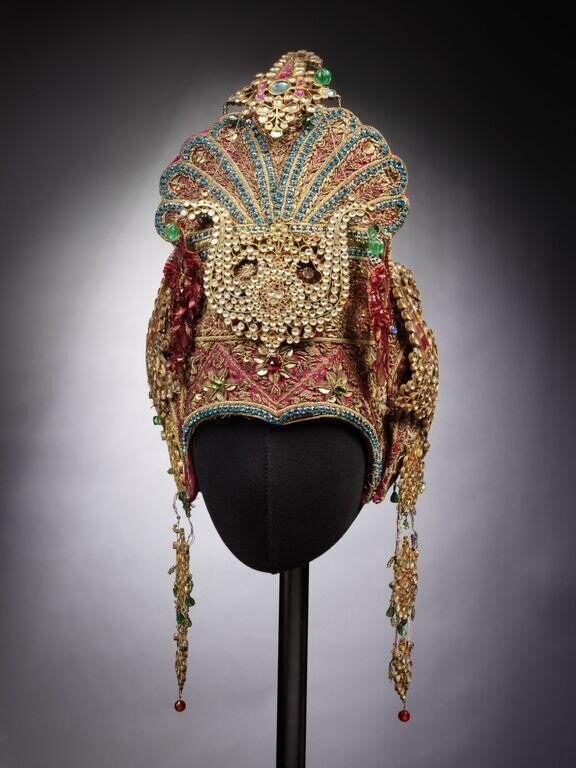
This headdress represents the material and visual grammar of Russian Imperial ballet's use of folk ornament to code character and spectacle. It shows the level of craft, expense, and visual ambition invested in costumes for principal roles, and the ways theatrical tradition drew on and transformed Russian material culture. For dancers and historians, it is direct evidence of what bodies wore and carried, and how that weight, dimension, and visual mass shaped movement and presence on stage.
What you are looking at
A single elaborate theatrical headdress dominates the composition, displayed on a featureless black bust form against a neutral gradient background. The costume is a tour de force of ornamental opulence: a towering crown or kokoshnik of gilt metal, studded densely with seed pearls and cabochon gemstones in deep red, emerald green, and pale translucent stones, rising in a fan or peacock-tail formation from the crown. Below hangs a substantial draped panel of deep burgundy silk or velvet, richly embroidered with gold thread in scrolling arabesques and floral patterns. From either side cascade long ornamental braids or tassels in gold and garnets, terminating in large faceted ruby or garnet drops. The palette is saturated: burnished gold, wine red, deep green, the cool glint of pearls and crystal catching studio light. This is costume for a dancer of rank, or a character of supernatural or royal status.
The dancing
No human figure is present; the headdress and accompanying drapery are displayed as museum object on a neutral mannequin. The implicit wearer would experience considerable weight and restriction—the vertical mass of the crown would demand an upright carriage and stable head position. The long trailing ornaments suggest movement would create visual drama and auditory effect (the gems and metal would catch light and possibly produce sound). The sheer opulence and frontal orientation of the piece suggest a performer meant to be seen, stationary or moving with deliberate formality rather than rapid naturalistic action.
The dance depicted
This headdress belongs to Russian theatrical dance tradition, most likely Romantic or Imperial ballet of the 19th century, or possibly court spectacle and pantomime of an earlier era. The kokoshnik form—a high ornamental crown rooted in Russian folk costume—signals either a Russian character role (a peasant maiden, often represented in imperial ballets through exoticised costume) or a supernatural being (swan maiden, nymph) coded as Russian or Slavic. The craftsmanship and materials suggest this was worn by a soloist or principal character, not a corps member. Without inscription or provenance detail, identification remains conditional; similar ornament appears in ballets of the 1880s–1920s. The absence of the wearer makes definitive attribution to a specific choreography or dancer impossible.
How it was made
This is a three-dimensional artifact—a constructed headdress combining metalwork (gilt-metal armature), textile embroidery, and applied gemstones. The photograph is a studio documentation shot: the object is lit frontally with soft directional light to reveal surface texture and jewel refraction, posed on a museum mannequin and photographed at a scale that allows full visibility. Such documentation photographs became standard practice in museums and auction houses in the 20th century, particularly for textiles and costume. The photograph itself is likely mid-to-late 20th century, though the costume itself could date anywhere from the 1870s to the 1920s. The neutral presentation mode makes the headdress legible as artifact rather than as it would appear on a living dancer in motion and stage lighting.
About this work
This is a museum photograph of a theatrical headdress—a kokoshnik crown—from Russian Imperial ballet or related court spectacle tradition. The object combines Russian folk ornamental form with materials and craftsmanship of professional stage costume: it is both ethnographic marker and luxury artifact. Preserved and displayed as a documentary record of dance costume practice, it represents the material culture and visual strategy of late 19th- or early 20th-century European theatrical dance, specifically the representation of Russian or Slavic character and the deployment of opulent visual excess to signal character status and supernatural register.
As a photograph of costume, this work is a historical document: it records how dancers' bodies were dressed, what they wore, and the technical and aesthetic choices embedded in that dress. For historians of Russian ballet, theatrical design, and the politics of exoticism and national character on stage, the headdress is a primary source. For dancers and choreographers, it is a record of material tradition and the visual grammar of a particular theatrical world.
How to look at it
Attend to the vertical mass and frontal orientation: this headdress was designed to be seen from front and sides, to read as a complete sculptural form. Note the density of ornament and the weight implied—the dancer wearing this could not turn her head freely or move without deliberation. The trailing ornaments (the long braids and gem-drops) would move with the dancer's motion, extending the visual line of the body and creating an effect of enhanced height and authority. The dark burgundy and gold palette would read across a theatre; the jewels would catch and return stage light. Look at how the kaftan-panel drapes: it suggests the dancer stood upright, formally positioned, rather than bent or in motion. This is costume for a character meant to command visual attention and occupy stage space with presence and stillness, not rapid naturalistic action.
The artist
The maker is unknown. The headdress was likely created by costume workshops attached to the Imperial Theatre in St. Petersburg (later Mariinsky Theatre) or by independent artisans working under commission. Russian Imperial ballet employed specialised craftspeople—master tailors, embroiderers, metalworkers—who produced and maintained elaborate costume stocks. The level of material luxury and technical finish suggests professional theatrical production rather than folk or amateur making, though the design draws consciously on Russian folk ornamental traditions.
The period
Russian Imperial ballet in the late 19th and early 20th centuries deployed folk ornament and national character as central choreographic and visual strategy. Ballets such as Swan Lake (1895), The Sleeping Beauty (1890), and The Firebird (1910) included scenes and roles coded as Russian or Slavic, and dancers in such roles wore elaborate kokoshniki and embroidered costume that signalled both local character and theatrical fantasy. The kokoshnik itself is a traditional Russian headdress, but theatrical versions—like this one—transformed it into an object of jewelled spectacle, amplifying its height, weight, and visual impact far beyond folk use. This reflected both the Imperial ballet's investment in lavish spectacle and broader European Romantic and Orientalist aesthetics that fetishised non-Western ornament and exoticised Eastern Europe. In dance history, such costume is inseparable from the racial and ethnic politics of casting and representation: Russian peasants and supernatural Slavic maidens were typically danced by white European dancers in costume, a practice that raises questions about embodiment, authenticity, and power that remain live for contemporary dance practice and historiography.
Where it lives
The object is held in a theatre costume collection (the source record lists 'Theatre costume' as both collection and source). It is catalogued as an artifact, not as a photograph or artwork. The photograph itself is the documentation mode by which museum collections make costume visible to remote viewers; the original three-dimensional object is the primary source.
Dance in this work
Questions about this work
What is a kokoshnik?
A kokoshnik is a traditional Russian ornamental headdress, typically worn by women and girls in folk costume. It is a rigid high crown, often decorated with embroidery, pearls, and metal. In folk tradition, different regions and communities had distinctive kokoshniki. In theatre, particularly Imperial Russian ballet, the kokoshnik was adapted and greatly enlarged, becoming a spectacular ornament that signalled Russian or Slavic character and added theatrical height and authority to a dancer's silhouette.
Why would a dancer wear something so heavy?
Theatrical presence and visual spectacle were priorities. The weight and height of the headdress made the dancer's body appear more commanding and extended in space. It also forced upright posture and deliberate movement, which suited the formal character roles (peasants, supernatural maidens, courtiers) that wore such costume. In an era before amplified sound and with large theatres, visual scale and ornamental display conveyed character, status, and mood to distant audiences.
Could a dancer perform complex movements in this costume?
Not complex or rapid virtuosic movements. The headdress would restrict head movement and the trailing ornaments would complicate turns and jumps. This costume suited characters who danced in character scenes—processionals, courtship dances, magical or supernatural moments—rather than technical solo variations. The character roles wearing such costume were typically performed by soloists and principals, but in scenes designed for presence and pantomime rather than classical ballet technique.
What does the gold embroidery tell us?
Gold thread embroidery was expensive, labour-intensive work. The presence of high-quality gold work signals this was costume for a role of importance—a principal character, not a corps member. The scrolling floral and arabesque patterns are decorative, but they also reference ornamental traditions in Russian textile and architectural design. For a contemporary viewer familiar with Russian folk and decorative arts, such embroidery would have signalled 'Russian' or 'Eastern European' character and luxury.
More dance artwork





