49 works in this view — arrow keys or swipe to move between them.
Dance in Art
Firebird
Goncharova, Natalia
- Collection:
- Theatre costume
- Source:
- Victoria and Albert Museum
- Rights:
- Rights vary by item — check the source record before reusing this image. Source record ↗
- Recorded as:
- V&A — check rights per item
Goncharova's Firebird costume is a canonical example of early modernist theater design and marks the moment when avant-garde visual art entered dance directly, without mediation. For dance historians, it demonstrates how costume itself communicates choreographic intention — the flame motifs are not merely decorative but are integral to how the Firebird character moves, burns, escapes, and possesses power. For art historians, it proves that the most radical Russian painters of the early twentieth century saw theater as a vital laboratory for formal experiment.
What you are looking at
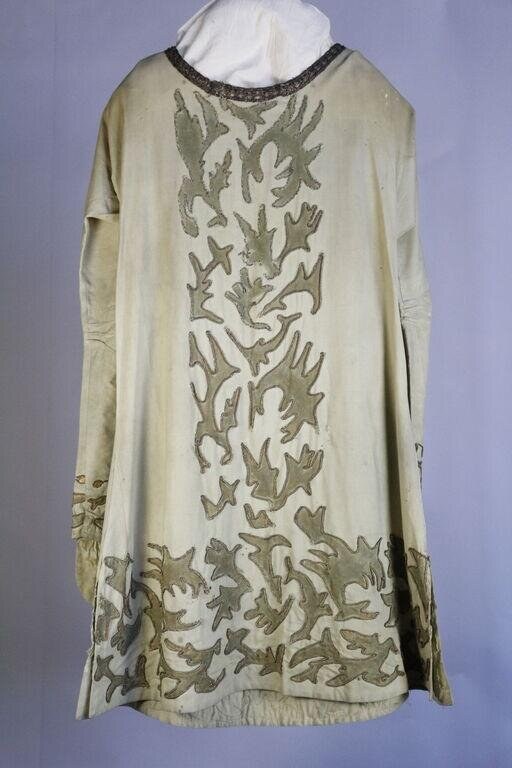
A long sleeveless tunic or robe hangs on display against a neutral background, viewed from behind. The garment is cream or pale gold linen with an elaborate appliqué design in olive and sage green silk or wool covering the back in a dense, vertical composition. The design consists of dozens of stylized flame-like or leaf-like shapes arranged in a column down the center and spreading across the lower hem and sleeves. The neckline is trimmed with a narrow darker (possibly grey-green) woven band. The appliqué work is meticulous and three-dimensional, with the shapes carefully cut and stitched to create a rich surface texture. The lower hem shows the most concentrated density of the motif, with overlapping flame-shapes in various scales suggesting movement and energy.
The dancing
This is a costume, not a depiction of dancers in motion. The garment itself suggests the body it would clothe — the length indicates a full-length robe, the sleeveless construction would allow free arm movement, and the proportions suggest a dancer of substantial height or presence. The costume is designed to create visual impact through the back, which would be prominent when the wearer faces an audience or moves through space. The weight of the appliqué suggests the fabric would drape and catch light in performance.
The dance depicted
This is a costume, almost certainly for *The Firebird*, the 1910 Ballets Russes production with choreography by Michel Fokine, music by Stravinsky, and design by Goncharova. The appliqué flames are the signature visual metaphor of the Firebird character — a magical bird of Russian folklore who must be captured and tamed. The costume embodies the supernatural, avian quality of the role through its emphasis on sharp, upward-reaching shapes that suggest feathers, wings, or fire itself. The palette of golds and greens evokes both the bird's plumage and the magical forest setting. This was a landmark costume in early modern dance design, influential in establishing the Ballets Russes house style and Goncharova's reputation as a radical theater artist.
How it was made
This is a textile costume constructed from linen base with hand-appliquéd silk or wool in contrasting colors. The technique of appliqué — cutting shapes from one fabric and stitching them to another — allows for bold graphic composition without the weight of heavy embroidery. The method is well-suited to theater, as the flat shapes read clearly from a distance on stage while remaining sculptural in person. The conservation of the object as a museum artifact suggests its historical significance was recognized early, preserving a primary document of early-twentieth-century avant-garde theater practice.
About this work
This is a stage costume designed by Natalia Goncharova for *The Firebird*, one of the most celebrated early productions of the Ballets Russes. Goncharova was a painter and designer central to the Russian avant-garde, and her work for the theater synthesized her painting practice with the demands of live performance. The costume represents a watershed moment in dance design: the shift from decorative prettiness toward bold, abstract, symbolist costume that read as art in its own right. The Firebird role required a dancer of extraordinary technical skill and dramatic presence — the costume had to signal supernatural power, avian nature, and magical agency, all of which the appliqué flames accomplish through pure graphic force.
How to look at it
Examine the appliqué shapes closely: they are not uniform but vary in size and direction, creating visual rhythm and the sense of upward movement, as if flames are licking or wings are beating. Notice how the motif concentrates at the lower hem, suggesting the dancer would move through and disturb this dense field, creating movement in the costume itself. The choice to cover the back rather than the front reveals an understanding of theater composition — the audience watches the back in exits, in turns, in moments when the Firebird's supernatural nature would be most legible. The palette of cream and olive-green is restrained and sophisticated, reading as both natural (feathers, leaves) and otherworldly (the uncanny symmetry and density of the shapes).
The artist
Natalia Goncharova (1881–1962) was a Russian painter, sculptor, and designer central to the Russian avant-garde. Trained in Moscow, she moved through Cubism and Futurism before establishing her own practice rooted in Russian folk art and Orthodox iconography. She began designing for theater around 1909 and became the principal designer for Diaghilev's Ballets Russes from 1914 onward, creating costumes and sets for dozens of productions including *Le Coq d'Or*, *Les Noces*, and *La Liturgie*. Her theater work applied her painterly innovations directly to the moving body, making her one of the most influential figure designers of the twentieth century. She remained committed throughout her life to synthesizing folk tradition, modernist abstraction, and Russian spiritual aesthetics.
The period
The Firebird premiered in 1910, a moment when the Ballets Russes under Sergei Diaghilev was transforming theatrical dance by commissioning composers, visual artists, and choreographers of the first rank to work in concert. Fokine's choreography marked a break from the rigid academic ballet of the nineteenth century, restoring naturalism and emotional expression to classical technique. Goncharova's costume design arrived later (she joined the company in 1914, but the costume shown here is dated 1926), suggesting either a revival production or a late restaging. By the 1920s, the radical gesture of bringing fine art into theater had become established practice, but Goncharova's continued commitment to folk motif and symbolic abstraction kept the work rooted in Russian cultural specificity even as modernism became international.
Where it lives
The costume is held in a theater collection, catalogued simply as a costume for *The Firebird* designed by Goncharova and dated 1926. The source is marked 'va', suggesting it may be a reference catalog or visual archive. Theater costumes of this era were preserved when recognized as significant examples of avant-garde design practice, often donated to museums by companies, estates, or collectors after a production's run ended.
Dance in this work
Questions about this work
Did Goncharova design the original 1910 Firebird costume?
The record dates this costume to 1926, which would make it a restaging or revival production rather than the original premiere. Goncharova did not join the Ballets Russes until 1914, so the 1910 original would have had different designers. This 1926 costume represents her interpretation of the role for a later version of the ballet.
What do the flame shapes mean?
The Firebird is a magical bird from Russian folklore who burns with supernatural fire. The appliqué flames serve both as feathers and as literal fire, making the costume itself embody the character's essential nature — dangerous, beautiful, otherworldly, and powerful. The concentration of flames at the hem suggests the bird's plumage in motion.
How would a dancer move in this costume?
The sleeveless construction allows full arm and shoulder mobility, essential for both classical ballet technique and for the more naturalistic, bird-like movement Fokine choreographed. The weight of the appliqué would be noticeable — the dancer would feel the costume and would have to compensate for its mass. This physical constraint could enhance the sense of supernatural burden or power, making the costume active in the performance rather than merely decorative.
Why is this in a dance museum rather than an art museum?
Because it exists fundamentally as a costume for performance, not as an object of visual art alone. Its meaning is inseparable from the body that wears it and the movements that body makes on stage. The costume is designed not to be viewed static on a wall but to be transformed by dance.
More dance artwork





