49 works in this view — arrow keys or swipe to move between them.
Dance in Art
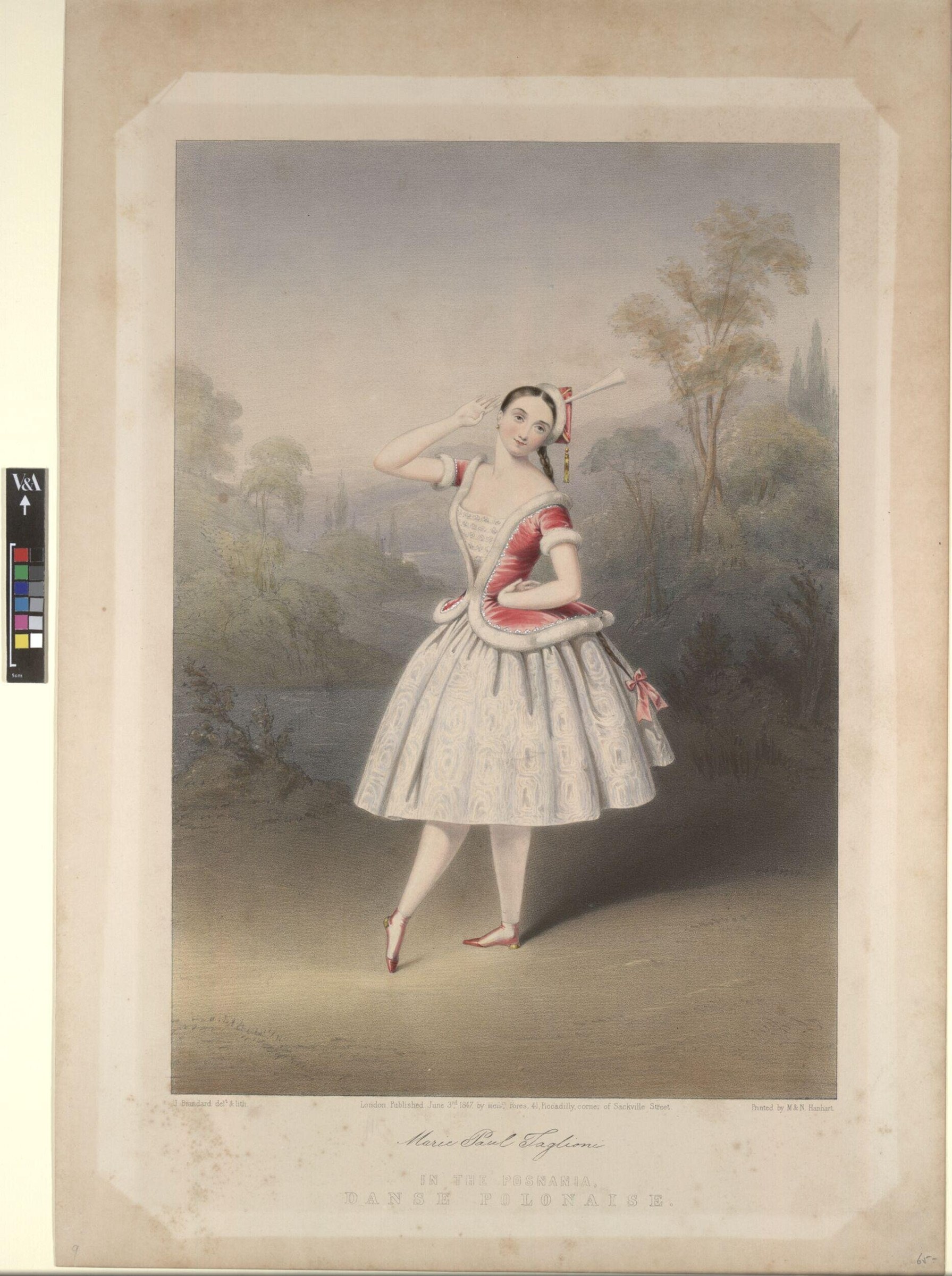
Marie Paul Taglioni (facsimile signature) / IN THE POSNANIA, / DANSE POLONAISE.
Brandard, John
- Collection:
- Source:
- Victoria and Albert Museum
- Rights:
- Rights vary by item — check the source record before reusing this image. Source record ↗
- Recorded as:
- V&A — check rights per item
As a documented portrait of Taglioni in a specific role, this lithograph is evidence of how Romantic ballet repertory was circulated, consumed, and remembered—through prints distributed far beyond the theater. For historians of dance and visual culture, it reveals the aesthetics of the Romantic body as seen by its own moment: elongated, ethereal, suspended between movement and stillness, the dancer's face and gesture more important than the articulation of steps.
What you are looking at
A young woman in Romantic-era theatrical dress stands alone in a stylized landscape, caught in a moment of dynamic repose. She wears a short, pale tulle skirt with a fitted red silk bodice and off-shoulder sleeves, her dark hair adorned with an ornamental comb or feather. Her weight rests on one leg in a pronounced attitude, the other foot pointed; her right arm is raised to her head in a languid gesture while her left arm hangs at her side. The background is a soft, atmospheric landscape of misty trees and water, rendered in pale greens and grays, typical of Romantic theatrical scenery. The composition isolates the figure against this diffuse setting, emphasizing her as the sole focus. A red ribbon or decoration hangs at her waist. The overall tonality is cool and ethereal, achieved through hand-coloring of what appears to be a lithographic base.
The dancing
The dancer's posture is one of supported repose rather than active movement: her body is elongated and graceful, the raised leg bent and turned out at the hip in a relaxed attitude derrière or attitude croisée. Her torso is upright with a slight forward tilt, and her raised arm curves softly from shoulder to head in a pose of reverie or distraction. The gesture suggests a moment stolen between movements—a rest or a moment of reflection—rather than the peak of an allegro. Her feet, in pale pink heeled slippers, show the turned-out carriage of academic ballet training.
The dance depicted
This is a portrait of the celebrated Romantic-era ballerina Marie Taglioni, depicted in the character role of a Polish peasant dancer. The title identifies the work as 'In the Posnania, Danse Polonaise'—linking her to a specific ballet or character piece performed to Polish-inflected music, likely part of the sprawling narrative ballets of the 1840s. The pose and costume are theatrical rather than ethnographically Polish; the tulle skirt, heeled slippers, and refined turnout belong to the Romantic ballet vocabulary, not vernacular folk practice. The 'Danse Polonaise' was a common divertissement in mid-nineteenth-century ballet, allowing prima ballerinas to display technical facility within a nationalist framework.
How it was made
This is a lithograph, hand-colored with watercolor or gouache, printed and tinted in the commercial fashion-plate tradition of the 1840s. The image displays the characteristic soft modeling of lithography, with delicate gradations achieved through stone and crayon work, particularly visible in the background landscape and the figure's flesh tones. The hand-coloring varies slightly in intensity, suggesting individual watercolor work applied after printing. This technique allowed rapid, economical production and wide circulation of theatrical portraits among audiences and collectors of dance imagery—far more accessible than oil paintings or engravings.
About this work
This is a commercial lithographic portrait of Marie Taglioni, one of the greatest Romantic-era ballerinas, in a character dance role from the 1840s. It captures her at the height of her celebrity, at a moment when Romantic ballet was establishing itself as the dominant theatrical dance form in Europe and when such printed portraits functioned as both souvenirs of performance and marketing tools for the theatrical celebrity system. The work belongs to a vast archive of hand-colored lithographs documenting the Romantic ballet's stars, roles, and visual vocabulary—a primary source for how nineteenth-century audiences saw and consumed dance imagery.
The portrait is remarkable for what it chooses NOT to show: despite the title's promise of a Polish dance, the image presents a highly formalized, balletic body in a moment of stillness and affect rather than national character or kinetic energy. It reveals how thoroughly ballet absorbed and aestheticized folk and national material, transforming peasant dances into occasions for the display of the trained, Romantic body.
How to look at it
Notice the deliberate stillness of the pose: this is not a moment captured mid-movement but a carefully composed attitude, a pause in which the dancer's body and face communicate emotion and character. The raised arm to the head is a Romantic gesture of reverie, melancholy, or introspection—not a functional part of a specific step combination. The landscape setting, though stylized, places her in a theatrical world rather than a ballroom or stage; it is an imagined space, not a real place. The heeled slipper and the turnout of the supporting leg are the technical markers that identify this as Romantic ballet, not folk dance, despite the title's invocation of Poland.
The artist
John Brandard was a prolific lithographic artist working in London in the 1840s–50s, specializing in theatrical and portrait subjects. He was part of the industrial-scale production of hand-colored lithographs documenting theatrical celebrities, particularly dancers. His work circulated through both theater audiences and the growing middle-class market for theatrical imagery; prints could be purchased as inexpensive mementos or framed as wall decoration. The signature 'Marie Paul Taglioni' is Taglioni's own facsimile autograph, added to the print—a common marketing practice that authenticated the portrait and increased its value as a souvenir.
The period
The 1840s were the mature decade of Romantic ballet in Europe. Marie Taglioni had already achieved legendary status through roles in *La Sylphide* (1832) and *La Tarantelle* (1839), and by this date was in her late thirties, still performing but in character roles and divertissements rather than the sylph roles of her youth. The hand-colored lithograph was the dominant medium for circulating images of dancers to a mass audience; theaters sold prints at intermission, and collectors assembled albums of theatrical portraits. This particular print captures a moment when national and character dances—Polish mazurkas, Italian tarantellas, Spanish boleros—were being absorbed into the Romantic ballet vocabulary as divertissement numbers that allowed prima ballerinas to display technical facility and dramatic character within a single act.
Where it lives
The work is held by the V&A Museum in London, part of their collection of theatrical prints and portraiture. The catalogue record describes it as a print, but does not record the medium; the V&A holds thousands of similar hand-colored lithographs from the theatrical world of the mid-nineteenth century.
Dance in this work
Questions about this work
Who was Marie Taglioni?
Taglioni (1804–1884) was the most celebrated ballerina of the Romantic era, famous for her role in *La Sylphide* and for her ethereal, elongated style of dancing. She performed across Europe and influenced the aesthetics of Romantic ballet profoundly. By the 1840s, when this print was made, she was still performing but increasingly in character and divertissement roles rather than the demanding aerial roles of her earlier career.
What is a 'Danse Polonaise' in ballet?
A Polonaise (or Polka) was a divertissement number performed in narrative ballets of the nineteenth century, typically in act 2 or 3, featuring a character dancer performing a stylized version of a Polish dance. These pieces allowed prima ballerinas to display technical ability and dramatic character while remaining within the Romantic ballet vocabulary of turnout, pointe work, and ethereal aesthetics. The actual Polish folk dance was heavily Romanticized in the balletic version.
Why are so many prints of Romantic ballet dancers colored by hand?
Hand-coloring was the only economical way to produce colored theatrical imagery at scale in the 1840s. Lithography allowed rapid printing, and watercolor or gouache was applied afterward by teams of colorists working from a sample print. This made theatrical portraits affordable for audiences and allowed theaters to sell them as souvenirs, creating a mass market for dance imagery that had not existed before.
Does this print show actual steps or just a posed portrait?
It is primarily a posed portrait—a careful composition designed to showcase Taglioni's celebrated grace and her role's character. The pose is balletic (turnout, supported leg, arched foot) but represents a moment of stillness or reverie rather than the execution of a specific step or combination. The gesture and face are as important as the body's technical alignment.
More dance artwork





