49 works in this view — arrow keys or swipe to move between them.
Dance in Art
Ballerina
Desmé, Robert
- Collection:
- photograph
- Source:
- Victoria and Albert Museum
- Rights:
- Rights vary by item — check the source record before reusing this image. Source record ↗
- Recorded as:
- V&A — check rights per item
This photograph documents the aesthetic and technical ideals of classical ballet as they were preserved and transmitted in the 1930s—the posture, the port de bras, the emotional register, and the costume conventions that defined what ballet was for practitioners and audiences of that era. For a dance historian or practitioner, such images are invaluable records of how the Romantic and classical traditions were embodied and understood at a specific moment in history.
What you are looking at
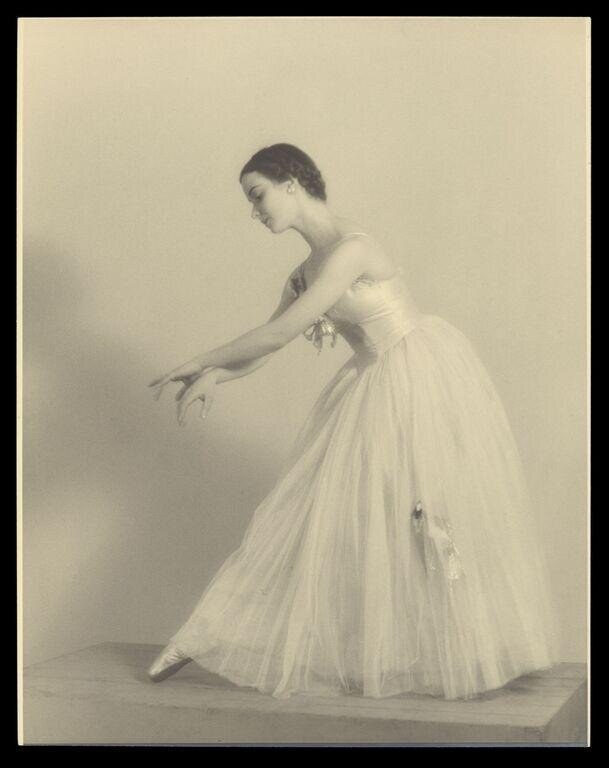
A young female dancer stands alone against a plain, light background in three-quarter profile view, her body angled to stage left. She wears a classical ballet tutu of white tulle, constructed in the Romantic style with a fitted bodice and a skirt of multiple layers of translucent fabric that falls to mid-calf, finished with a delicate bow at the waist. The tutu is sleeveless, leaving her shoulders and arms bare. Her posture is graceful and attentive: her body leans forward slightly from the hips, her left arm extends forward and downward in a soft, expressive gesture with fingers gently curved, while her right arm rests at her side. Her head is tilted downward in a contemplative or concentrating expression. She stands in soft pointe shoes, her weight forward and her stance suggesting a moment of movement or transition. The photograph captures her in a gentle arabesque-like quality, the extended leg supporting a balletic line. The neutral background and soft, diffused lighting emphasize the delicacy of her form and the ethereal quality of the tulle.
The dancing
The dancer's frame shows the classical ballet carriage of the mid-twentieth century: an upright torso with a slight forward tilt from the hip, one arm extended in a graceful port de bras position while the other hangs naturally at her side. Her head is bowed in concentration or emotion. The positioning suggests she is caught in a moment of adagio—either sustained movement or a transition between phrases. Her weight appears centered over her supporting leg, with a quality of lift through the torso despite the forward inclination. The soft extension of the gesturing arm and the controlled downward gaze convey technical control and emotional presence simultaneously.
The dance depicted
This is a classical ballet photograph, almost certainly depicting a soloist from the romantic or classical repertory of the early-to-mid twentieth century. The Romantic tutu, pointe shoes, and port de bras are unmistakable markers of ballet technique as codified in the nineteenth century and maintained throughout the twentieth. The solitary, introspective pose and the moment chosen—neither a jump nor a turn but a sustained, expressive position—suggests this may document a famous solo or a study of balletic form itself. The contemplative downward gaze and the forward-reaching arm gesture evoke the emotional vocabulary of Romantic ballet, where dancers embodied melancholy, longing, or reverie.
How it was made
This is a gelatin silver or similar black-and-white photographic print, likely made from a studio session with controlled lighting. The soft, even illumination and the clean separation of the figure from the background indicate professional studio photography of the mid-twentieth century. The photographer has composed the image to emphasize line and form: the dancer's silhouette and the delicate texture of the tulle are rendered with precision, while the neutral background isolates the subject. Photography was the dominant medium for dance documentation by 1939, allowing the capture of a single moment with greater fidelity than drawing or painting, and making such images widely reproducible for publication, instruction, and archival purposes.
About this work
This is a studio portrait photograph of a ballet dancer in classical tutu and pointe shoes, captured in a moment of gentle, sustained movement. The work belongs to the tradition of professional ballet photography—a genre that emerged in the late nineteenth century and became standard by the 1930s for documenting soloists, repertory roles, and the aesthetic ideals of the dance form. The image exemplifies the Romantic aesthetic in ballet: the ethereal tulle skirt, the emotional restraint of the downward gaze, the soft extension of the arm, and the solitary figure against emptiness all evoke the melancholic femininity associated with nineteenth-century Romantic ballet—yet the photograph is modernist in its medium, its clarity, and its emphasis on the body as formal object. The work sits at an intersection of dance documentation and fine art photography, serving both as a record of performance practice and as a statement about beauty, control, and the visual purity of classical ballet.
How to look at it
The photograph freezes a moment that is neither climactic nor virtuosic—no leap, no turn, no supported lift—but rather a pause within movement, an instant of emotional or technical reflection. Notice how the photographer has positioned the figure in three-quarter profile to show both the line of the body and the face; the head is bowed, directing your eye to the gesture of the arm and the extension of the supporting leg. The tulle catches light subtly, revealing the texture and weight of the fabric. Look at the quality of the extended arm: it is not rigid but alive with a gentle curvature that suggests ongoing motion or emotional intention. This is a photograph in service of the dance itself—not a candid moment, but a composed study of classical form and balletic beauty as it was understood at mid-century.
The artist
Robert Desmé (dates not established from available records) was a photographer active in the mid-twentieth century, working in the genre of dance and theatrical photography. Studio photographers of this period were essential to the documentation and promotion of ballet, creating images for publicity, instruction, and artistic preservation. Desmé's work sits within a long tradition of professional dance photography established by practitioners such as Baron de Meyer and others who made ballet visible to the public through the camera lens.
The period
By 1939, classical ballet had become an established international art form with codified technique and a repertory of canonical works. The Romantic aesthetic—emphasizing ethereal femininity, pointe work, and the illusion of weightlessness—had remained central to ballet despite the rise of modernist innovation. Studio photography of ballet dancers was a thriving practice, used both for publicity and archival documentation. The soft-focus, contemplative aesthetic of this image reflects the idealized vision of ballet that prevailed in mainstream culture, even as avant-garde artists and choreographers were beginning to question and reformulate the form.
Where it lives
The photograph is held in a collection designated 'va' (likely the Victoria and Albert Museum or a related archive in the United Kingdom). It is a gelatin silver print and is catalogued as a work of dance documentation and theatrical photography.
Dance in this work
Questions about this work
What ballet is she dancing?
The photograph does not identify a specific ballet or role. The pose and costume suggest a Romantic or classical solo—possibly a scene of reverie or emotion from a work such as Giselle or Swan Lake—but the image alone does not confirm which ballet or which moment. Photographers often created such studies of dancers in costume without reference to a particular performance.
Why is she looking down?
The downward gaze is characteristic of the Romantic balletic aesthetic, conveying introspection, melancholy, or emotional retreat—states that ballet of this era expressed through the body and face. It is also a compositional choice by the photographer, directing the viewer's eye along the line of the arm and emphasizing the dancer's concentration.
What is the tutu made of?
The tutu is constructed of layers of tulle, a lightweight, translucent silk or synthetic mesh fabric favored for ballet tutus because it creates volume, catches light beautifully, and allows the dancer's legs and movement to remain visible. The Romantic tutu, as shown here, reaches to mid-calf or below the knee, in contrast to the shorter classical tutus that became standard later.
Is this a performance photograph or a studio portrait?
This is a studio portrait. The neutral background, controlled lighting, and posed, composed quality distinguish it from a performance photograph. Studio portraits of dancers were created for publicity, archival documentation, and artistic purposes—not to document a specific performance.
More dance artwork





