49 works in this view — arrow keys or swipe to move between them.
Dance in Art
Ballerina
von Behr, Hans A.
- Collection:
- Photograph
- Source:
- Victoria and Albert Museum
- Rights:
- Rights vary by item — check the source record before reusing this image. Source record ↗
- Recorded as:
- V&A — check rights per item
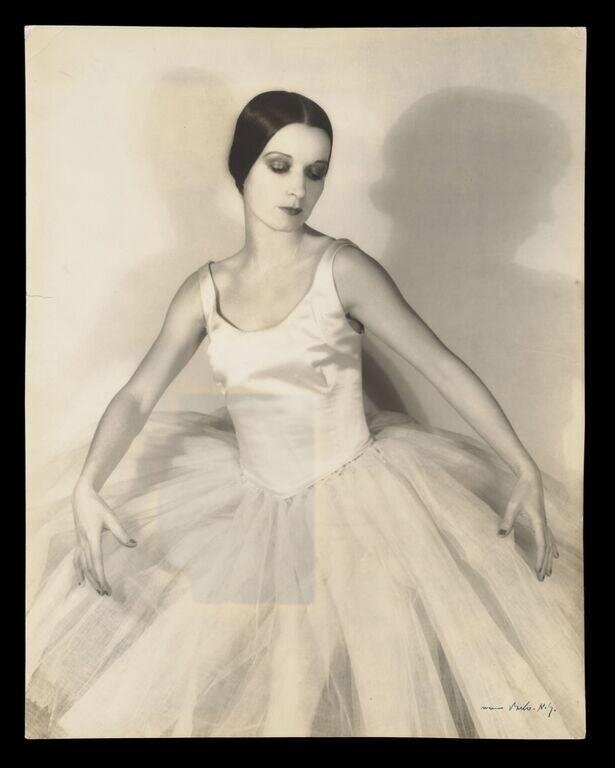
This photograph documents the visual culture of early 20th-century ballet at the moment when photography had become the primary means of circulating images of dancers. The composition and the dancer's costume and bearing are emblematic of how ballet presented itself during the interwar period—as an art of grace, refinement, and controlled emotion rather than virtuosic display. For historians of dance and photography, it is a clear example of how the medium shaped what audiences knew about dancers' bodies and how dancers understood their own public image.
What you are looking at
A single female dancer is pictured against a plain, light background in a studio or portrait setting. She wears a classical ballet costume: a simple white or pale sleeveless leotard and a voluminous tulle skirt that extends to mid-calf, gathered at the waist. Her dark hair is slicked back in the style typical of early 20th-century ballet. She gazes downward in a contemplative pose, with her left arm extended gracefully at her side while her right arm rests across her torso. Her weight appears to be settled rather than poised for movement. The photograph is a formal studio portrait, lit to emphasize the soft volume of the skirt and the refined line of her neck and shoulders. A signature appears in the lower right corner.
The dancing
The dancer stands in a relaxed, introspective stance rather than an active dancing position. Her posture is upright and graceful but not dynamic—her weight is centered and stable, without the tension of a preparation or the extension of an active step. Her arms are softly placed, neither in a ballet port de bras nor a working position. The elongation of her neck and the downward gaze suggest a moment of quiet reflection rather than performance or instruction. There is no visible pointe work, turnout, or the muscular engagement one would see in an action photograph.
The dance depicted
This is a portrait of a classical ballet dancer, almost certainly taken during the 1920s–1930s period when such studio portraiture was a standard way of documenting and promoting performers. The costume—a simple tulle skirt and sleeveless leotard—is consistent with the everyday rehearsal and performance dress of early 20th-century ballet. The photograph captures the dancer in a moment of stillness rather than performing a specific step or variation. The downward gaze and introspective quality suggest influence from the Romantic ballet tradition, with its emphasis on ethereal, withdrawn femininity, though the modernist photography technique and simplified costume place it squarely in the interwar era.
How it was made
This is a gelatin silver print or similar photographic process, rendered in grayscale. The photograph demonstrates the refined portrait technique of the early 20th century, with careful studio lighting that models the body, creates soft shadows, and emphasizes the texture and volume of the tulle skirt. The clean background and controlled setting indicate professional studio practice. The photographer's ability to capture the delicate tones of white fabric and the subtle contours of the dancer's form speaks to both technical mastery and an aesthetic privileging of restraint and elegance over dramatic effect. Such photographs were typically issued as cabinet cards or postcards for distribution to admirers, critics, and archives.
About this work
This is a studio portrait of a ballet dancer from the 1920s or 1930s, taken by the photographer Hans A. von Behr. It documents the appearance and costume of a classical dancer during the interwar period, a moment when photography was becoming the primary means of recording and circulating images of dancers to the public. The work belongs to the tradition of theatrical dance portraiture—a genre distinct from action or narrative dance photography, concerned with presenting the dancer as a figure of grace and refinement. The image is particularly valuable as evidence of how dancers presented themselves and were presented to audiences in this era: not mid-leap or mid-step, but in composed, introspective stillness that emphasizes line, costume, and the dancer's own presence rather than virtuosity or action.
How to look at it
Attend to the stillness of the pose and the absence of any suggestion of action or effort. The downward gaze and the settled weight communicate introspection and emotional restraint rather than virtuosity. Note how the photographer has used lighting to emphasize the softness and volume of the skirt—the tulle is the visual center of the composition, not the dancer's body or limbs. This reflects early 20th-century ballet aesthetics, which valued the visual poetry of costume and line over the visible exertion of technique. The simple background and centered composition are typical of portrait convention, designed to isolate the figure and direct attention to her presence rather than to any narrative or environmental context.
The artist
Hans A. von Behr was a photographer active in the 1920s and 1930s, known for theatrical and portrait photography. His signature appears on this print in the lower right. Like many photographers of the period, he specialized in studio portraiture of performers, particularly dancers, capturing them in controlled settings that emphasized elegance and refinement over action or spectacle.
The period
The 1920s and 1930s were a pivotal moment for ballet in Western culture. The Ballets Russes had transformed European and American dance audiences' expectations; classical ballet was undergoing a process of modernization and codification even as it retained its connection to the Romantic tradition. Simultaneously, photography had become the dominant medium for circulating images of performers. Where 19th-century dancers had been known through lithographs, engravings, and painted portraits, 20th-century audiences knew them primarily through photographs. This democratized access but also standardized the ways dancers were seen and presented. Studio portraits like this one became the primary visual record of a dancer's appearance and public identity.
Where it lives
The work is held in the Virginia collections (indicated by 'va' in the source field), likely as part of a broader holding of dance imagery or theatrical photographs. The signature and date conventions suggest it was issued as a professional studio portrait, the kind that would have been sold or distributed to admirers and archives.
Dance in this work
Questions about this work
Is this dancer performing a specific ballet?
No. This is a studio portrait taken outside a performance context. The dancer is posed in a moment of stillness and introspection, not executing a step or variation from a choreographed work. Such portraits were used to present the dancer to the public and to record her appearance for archives and admirers.
How can you tell this is from the 1920s or 1930s?
Several details converge: the simplified white leotard and tulle skirt (rather than the elaborate tutus of the 19th century or the varied costumes of later modernism); the hairstyling; the photographic technique and aesthetic; and the style of the portrait convention itself. These are consistent with early 20th-century ballet practice and portrait photography.
Why is the dancer looking down?
The downward gaze is a compositional choice common to ballet portraiture of this era, influenced by Romantic ballet aesthetics that valued introspection, delicacy, and emotional withdrawal. It also allows the photographer to compose the figure as a unified whole without the distraction of direct eye contact with the viewer.
What can we learn about ballet from this photograph?
The image shows us how ballet dancers of the period were trained to present themselves: with elongated necks, upright posture, and graceful arm placement even in stillness. The costume—simple, functional, emphasizing the line of the body and the poetry of the skirt—reflects the aesthetics of the era. The choice to photograph her in posed stillness rather than mid-leap tells us that elegance of line and refinement of presence were valued as highly as technical virtuosity.
More dance artwork





