49 works in this view — arrow keys or swipe to move between them.
Dance in Art
Ballerina
Dowse, Mary
- Collection:
- Panel
- Source:
- Victoria and Albert Museum
- Rights:
- Rights vary by item — check the source record before reusing this image. Source record ↗
- Recorded as:
- V&A — check rights per item
For dance historians and practitioners, this work is valuable as a record of how ballet was visualized and valued in mid-20th-century British art. The decorative framing and the choice to still the dancer rather than capture motion reveal changing attitudes toward how dance should be represented—not as spectacle or narrative, but as a moment of aesthetic perfection worthy of preservation and contemplation. For art historians, the work demonstrates the persistence of the ballerina as a subject and the continued appeal of combining graphic precision with ornamental design in post-war British decorative arts.
What you are looking at
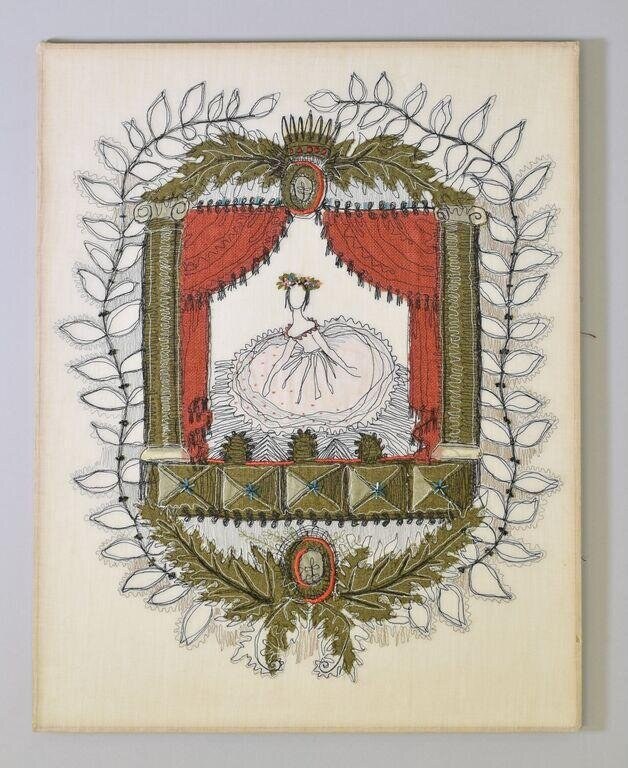
A solitary ballerina is depicted mid-performance within an elaborate decorative frame. She stands center stage in a classical pose, wearing a voluminous tutu rendered in pale pink or white, her body angled in profile or three-quarter view with the characteristic upright carriage of ballet. The stage itself is shallow and formal, with a simple railing or footlights dividing it from the auditorium. Above and around her stretches an ornate proscenium arch in deep red velvet with gold detailing, draped with swags that frame the figure like a jeweled box. The entire composition is enclosed in a naturalistic border of delicate line-drawn foliage—stems, leaves, and botanical elements rendered in fine pen work—which creates a sense of the ballerina as a precious artifact or specimen worthy of preservation. The interplay between the precise geometric formality of the theater frame and the organic flowing vegetation outside it sets up a tension between art and nature, performance and the everyday.
The dancing
The dancer stands in a classical upright position, likely in first or second position with the weight centered or slightly lifted through the legs. The arms are positioned to suggest the formal port de bras of academic ballet, with a graceful lift through the torso. The silhouette emphasizes the elongation of the neck and the straightness of the spine characteristic of ballet training. The tutu—full, bell-shaped, and voluminous—dominates the figure and reads as the epitome of Romantic or Classical ballet costume. There is no motion frozen mid-leap or turn; instead, the artist has chosen a moment of stillness and display, as though presenting the dancer herself as the artwork rather than capturing the kinetic moment of dance.
The dance depicted
This is a theatrical ballet image, almost certainly depicting Classical or Romantic ballet as practiced in the early 20th century. The full tutu, the upright carriage, the formal proscenium setting, and the pose all point to the vocabulary of European academic ballet as established by the 19th century. The image does not document a specific ballet or moment but rather presents an idealized type: the ballerina as a figure of refinement and grace. The choice to place her within a highly framed, almost shrine-like setting suggests that this is not meant to show the ballet as a dramatic event but rather to celebrate the ballerina herself as an object of artistic contemplation.
How it was made
This is a hand-coloured drawing or engraving, combining fine pen line-work in ink with watercolour or hand-applied pigment. The botanical border is executed in precise, delicate pen lines suggesting engraving or fine-point drawing, while the figure and architectural elements show evidence of careful hand-colouring in subdued tones—gold, red, pale pink, and greys. The technique allows for both graphic precision (the foliage, the architectural detail) and painterly softness (the tutu, the skin tones). The presence of hand-colouring and the ornamental detail suggest this was a work of some labour and expense, likely intended as a finished artwork for exhibition or collection rather than a preparatory sketch. The combination of media and the decorative framing imply a work aimed at an educated, aesthetically sophisticated audience.
About this work
This 1947 work by Mary Dowse presents the ballerina not as a moving dancer but as a contemplative object, framed and celebrated within nested formal structures. The image sits at the intersection of several artistic traditions: the long European tradition of depicting the ballet dancer as a symbol of grace and refinement; the Arts and Crafts revival of detailed hand-work and ornamental framing; and a mid-20th-century English sensibility that treated ballet as a cornerstone of national cultural identity. The work is both a celebration of ballet's aesthetic power and a meditation on how we see, frame, and preserve dancers in art. By placing the solitary figure within an elaborate decorative apparatus, Dowse invites viewers to consider the ballet dancer as both performer and artwork—a figure worthy of the kind of detailed, loving attention we might give to a natural specimen or a precious object.
How to look at it
Look first at the nested frames: the botanical border, the ornamental proscenium, the stage floor. Notice how each frame contains and elevates the ballerina, making her the focal point of an almost ceremonial presentation. Observe that she is not caught mid-movement but posed in stillness, which creates an effect of timelessness and dignity rather than virtuosity or drama. Pay attention to the fineness of the line-work in the foliage—it contrasts sharply with the painterly softness of the tutu and suggests that the artist valued precision, detail, and the evidence of the hand's labour. Finally, consider the colour choices: the restraint of the palette, the prominence of gold and red (colours of theatre and luxury), and the pale, almost ghostly quality of the tutu, which seems to float within its frames.
The artist
Mary Dowse (dates unknown to the author) was a British artist active in the mid-20th century. The work's careful hand-execution, ornamental sensibility, and choice of subject suggest she was working within or in dialogue with the aesthetic traditions of the Arts and Crafts movement and decorative arts practice. Without additional biographical information, it is difficult to establish her training, exhibition history, or broader artistic output; however, the sophistication of the technique and the ambitious scale of the composition suggest a practitioner with serious artistic training and engagement with contemporary aesthetic debates.
The period
In 1947, European ballet was recovering from the Second World War and entering a period of renewed institutional and public investment. British ballet in particular was becoming a source of national pride following the Ballets Russes' influence and the establishment of major British companies. Simultaneously, the decorative arts were undergoing a post-war reassessment; while modernism was ascendant, there remained a strong undercurrent of interest in hand-craft, ornament, and the integration of fine and decorative arts. The choice to depict ballet—a quintessentially European art form—and to do so using labour-intensive hand-colouring and ornamental framing suggests an artist invested in preserving and celebrating both ballet and the values of craftsmanship during a period of rapid industrial and cultural change.
Where it lives
The work is held in a panel format and is catalogued in the VA (Victoria and Albert Museum, London) collection. This suggests it is held as a decorative art or design object rather than a fine art painting, which is consistent with its ornamental ambitions and hand-coloured technique.
Dance in this work
Questions about this work
Is this a portrait of a particular dancer?
There is no evidence in the image or the record that this depicts a specific named dancer. The figure appears to be an idealized type—the ballerina as a symbolic figure of grace and refinement—rather than a portrait commissioned to record the likeness of a particular performer. The formal, almost heraldic quality of the composition reinforces this sense of a type rather than an individual.
Why is the ballerina surrounded by plants?
The botanical border frames the ballerina as if she were a precious specimen worthy of careful study and preservation. This ornamental device was common in decorative arts and suggests a desire to elevate the ballet dancer to the status of natural beauty or scientific curiosity—something rare and deserving of detailed, loving attention. The interplay between the organic forms of nature and the geometric precision of the stage also invites viewers to see the dancer as a bridge between art and nature.
What style of ballet is this?
The costume—a full, bell-shaped tutu—and the formal, upright carriage of the dancer suggest Classical or Romantic ballet as practiced in the European academic tradition. The image does not depict a specific ballet but rather presents an idealized image of ballet itself: the dancer as a figure of grace, refinement, and timeless beauty.
What medium is this artwork?
The work combines fine pen line-work (evident in the precise botanical border and architectural details) with hand-applied watercolour or pigment (visible in the soft, graduated tones of the tutu, the gold detailing, and the red velvet of the proscenium). This labour-intensive combination suggests a work of considerable artistic ambition intended for exhibition or collection.
More dance artwork





