49 works in this view — arrow keys or swipe to move between them.
Dance in Art
Ballerina
Sitzendorf Porcelain Manufactory
- Collection:
- Figurine
- Source:
- Victoria and Albert Museum
- Rights:
- Rights vary by item — check the source record before reusing this image. Source record ↗
- Recorded as:
- V&A — check rights per item
Porcelain figurines like this reveal how ballet imagery circulated through popular culture and domestic space in the early 20th century, long before ballet had become a mass-media phenomenon. The work shows how the ballerina became an icon of femininity and refinement, and how commercial manufacturers capitalized on that association. It is a primary document of how dance entered the visual culture of everyday life.
What you are looking at
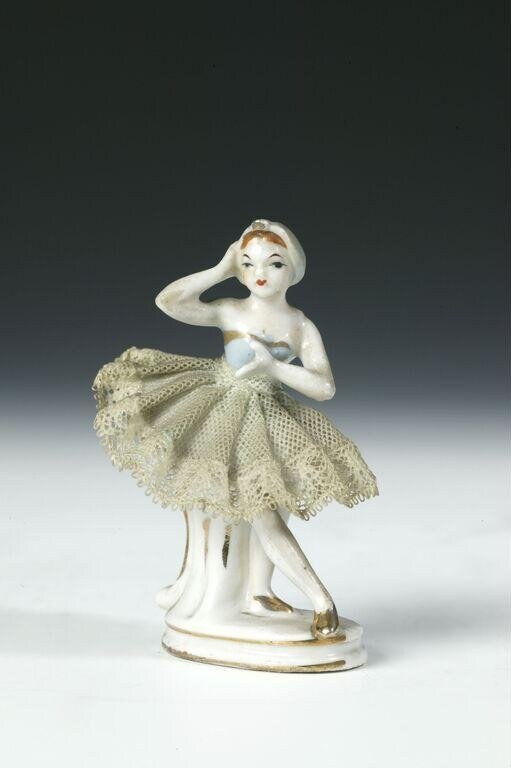
A porcelain figurine depicting a young female dancer in a moment of classical pose. She stands on a small oval base, her body weight balanced on one leg while the other is drawn up. Her right arm is raised and bent, hand touching her head in a graceful gesture; her left arm extends downward. She wears a white porcelain bodice with delicate painted features—dark hair styled in a close-cropped wave typical of 1920s fashion, with a small red mouth and refined facial expression. The lower half of her body is draped in an extraordinarily detailed cream-colored lace skirt, textured to suggest the open, fan-like construction of a classical tutu or skirt à la Degas. The lace has been individually modeled or applied to create a three-dimensional effect, catching light and shadow. The figurine appears small, likely 15–20 cm in height, and is finished with gilded or metallic accents on the base and details.
The dancing
The dancer's pose is fundamentally a moment of arrested motion: the weight-forward, on-one-leg stance suggests classical ballet technique. Her raised arm and hand-to-head gesture convey coyness, flirtation, or preparation—a standard vocabulary of the ballerina figurine tradition. The pose is demure and statuesque rather than dynamically balletic; there is no visible strain or extension, but rather a composed, almost demur presentation. The artist has prioritized charm and decorative appeal over anatomical accuracy or the full vocabulary of point-work technique.
The dance depicted
This depicts theatrical ballet in the Romantic or early twentieth-century vernacular tradition—specifically, the 'ballerina figurine' that became a popular porcelain genre in Europe during the late 19th and early 20th centuries. The lace skirt is a stylized interpretation of a classical tutu. The pose—raised arm, lifted leg, weight-forward stance—evokes the ballet idiom, though the artist has simplified and conventionalized it for decorative effect. The 1920 date, combined with the Art Deco sensibility in the hair and dress, suggests this was made at a moment when ballet imagery had become thoroughly absorbed into popular commercial ceramic manufacture, divorced from any specific ballet narrative or choreography.
How it was made
This is a porcelain figurine, likely produced by press-mold and hand-finishing techniques typical of the Sitzendorf manufactory. The skirt appears to have been modeled separately and applied or hand-built with individual strands of lace material, then fired—a labor-intensive technique that suggests this was a more costly decorative object for middle-class domestic display. The paints are underglaze, fired onto the biscuit. This production method was characteristic of Central European porcelain factories in the late 19th and early 20th centuries and allowed for high-volume but individually finished output.
About this work
This is a porcelain figurine of a ballet dancer made by the Sitzendorf manufactory around 1920. It belongs to a vast tradition of decorative ceramics—particularly German and Austrian porcelain—that made theatrical dance imagery available as an affordable luxury for domestic interiors during the Romantic era and its afterlife in the early 20th century. The figurine condenses the ideal of the classical ballerina—refined, graceful, and femininely appealing—into a small sculptural form. It was neither a record of any specific dance nor a tool for dancers themselves, but rather a consumer object that allowed middle-class households to associate themselves with the prestige and elegance of ballet.
How to look at it
Notice the extraordinary detail of the lace skirt, which dominates the composition and was the most labor-intensive element of the object's manufacture. The pose is not a snapshot of movement but a composed, presentational moment—the hand raised to the head is a gesture of vanity or reverie, not a functional element of choreography. Compare this with photographs or paintings of actual ballet dancers from the same period: the Sitzendorf figurine simplifies, sweetens, and decorates the ballet body for domestic consumption. The work is as much about interior design as about dance.
The artist
The Sitzendorf Porcelain Manufactory was founded in Thuringia, Germany, in the mid-19th century and became known for high-quality hand-painted porcelain figurines, particularly figures of dancers, courtiers, and other romantic or theatrical subjects. The factory operated throughout the 20th century and produced thousands of decorative figurines for export across Europe and North America. Sitzendorf was one of several German and Austrian factories (including Meissen, Royal Dux, and others) that made the theatrical figurine a staple of bourgeois interior decoration.
The period
In 1920, ballet occupied a peculiar cultural position in Europe. Diaghilev's Ballets Russes had revolutionized choreography and design in the 1910s, yet classical ballet remained a luxury accessible primarily to elite audiences in major cities. At the same time, the image of the ballerina—graceful, exquisite, and desirable—had become ubiquitous in commercial imagery, advertising, and decorative arts. The 1920s saw a boom in porcelain figurines as mass production improved and disposable income grew among the middle class. This figurine dates to a moment when ballet was being simultaneously elevated as modern art and domesticated as a commercial commodity.
Where it lives
This figurine is recorded in the collection identified as 'va' in the source record. Sitzendorf pieces are widely held in decorative arts museums and private collections across Europe and North America, making this a relatively common object within the broader category of porcelain figurines, though each hand-painted example is technically unique.
Dance in this work
Questions about this work
Is this a representation of a real dancer or a real ballet?
No. This is an idealized, generic image of a ballerina—a decorative type rather than a portrait or a record of any specific performance. The pose and costume are conventionalized in ways that suggest classical ballet, but they do not refer to any particular choreography or dancer. It is an icon of ballet rather than a document of it.
Why is so much effort spent on the lace skirt?
The lace skirt was the most visually striking and technically impressive element of the figurine, and thus the element that justified its cost and desirability as a luxury object. The skill required to model and fire individual strands of lace demonstrated the maker's expertise and the owner's taste and disposable income. It is as much a display of manufacturing prowess as it is a representation of ballet costume.
What did people do with figurines like this?
These were display objects for the parlor, mantelpiece, or bookshelf of middle-class European and American homes. They functioned as signs of refinement, cultural aspiration, and leisure. Collectors often assembled them in groups and displayed them prominently in the most visible rooms of the house, where they signaled the owner's connection to the world of high culture.
More dance artwork





