49 works in this view — arrow keys or swipe to move between them.
Dance in Art
Anna Pavlova poster
Serov
- Collection:
- Poster
- Source:
- Victoria and Albert Museum
- Rights:
- Rights vary by item — check the source record before reusing this image. Source record ↗
- Recorded as:
- V&A — check rights per item
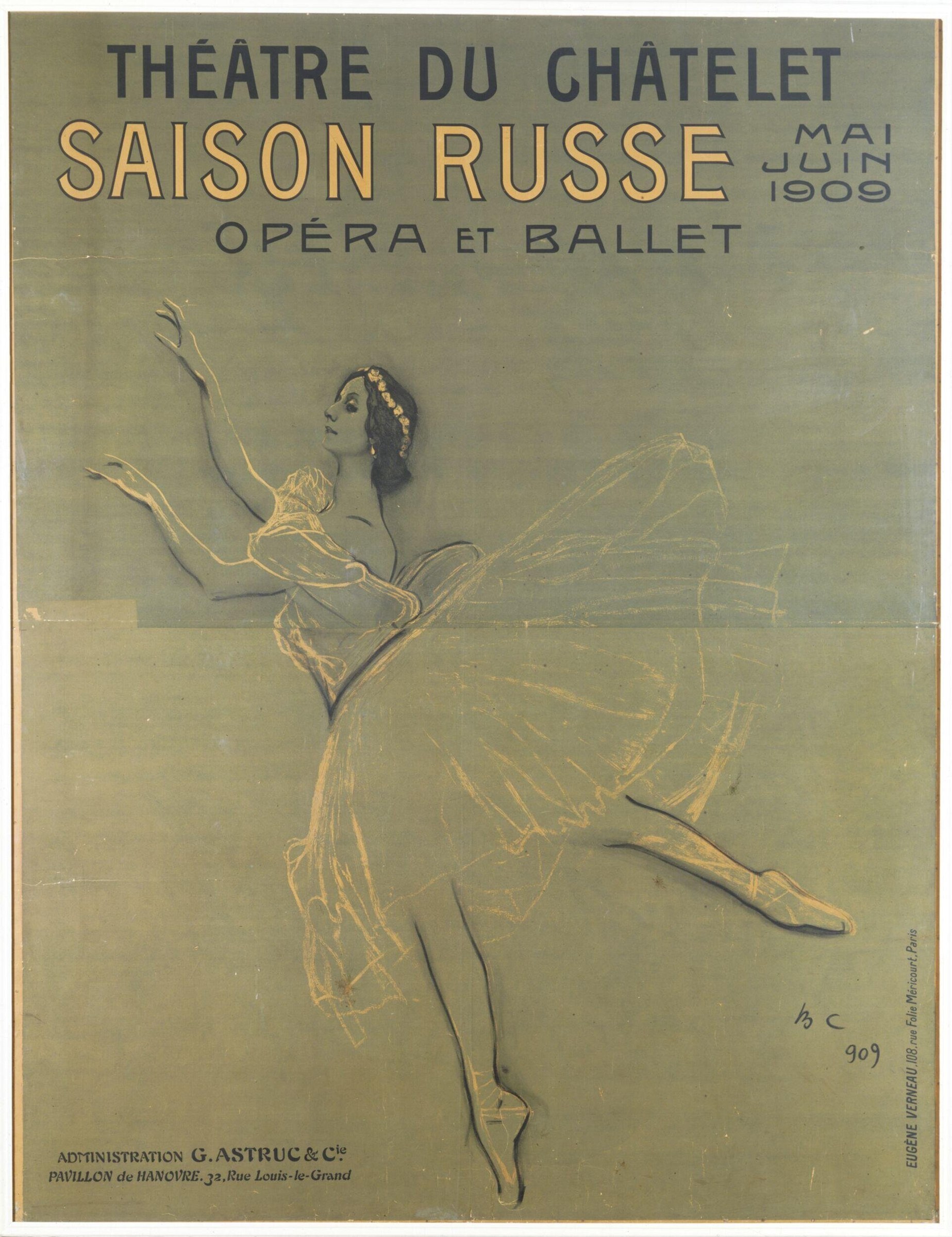
Pavlova was one of the defining figures of early twentieth-century ballet, and this poster documents her at the moment when the Ballets Russes was transforming European dance culture. The image preserves not only a record of how a legendary dancer looked and moved, but also the aesthetics of Edwardian theatrical promotion and the elevated status of ballet in elite European culture. For historians of dance, costume, and graphic design, this work offers evidence of how dancers were marketed, celebrated, and visualized in the century when ballet became a major art form.
What you are looking at
A single female dancer is captured mid-movement against a pale greenish background, rendered in what appears to be a soft, atmospheric style. She wears a classical ballet tutu of golden-yellow silk with layers of translucent material, and her upper body is draped in a delicate shawl or cape of the same warm tone. Her dark hair is arranged with a decorative circlet or ornament. The dancer is poised on one leg in an attitude or similar classical ballet position, with her free leg extended and her arms raised in an open, expressive frame—one arm lifted high, the other extended to the side. The composition isolates her figure almost entirely, giving the work the character of a portrait study of the dancer herself rather than a scene. The soft modeling and subtle color palette—creams, golds, and grays—suggest this is a drawing or print rather than a photograph, with the artist using line and wash to define form.
The dancing
The dancer stands in clear classical ballet posture, supported on a single leg in a turned-out position, with the working leg extended behind or to the side in a lifted line. Her upper body is held erect and centered, with the arms in an open port de bras—raised and graceful rather than grounded. The pose suggests a moment of balance and extension typical of Romantic or classical ballet vocabulary. The artist has paid careful attention to the elongation of the line from hip through the raised leg and the elegant taper of the ankle and foot in a pointed position.
The dance depicted
This is a portrait of a classical ballet dancer, almost certainly Anna Pavlova, one of the most celebrated prima ballerinas of the early twentieth century. The image captures her in the kind of posed studio portrait common among dancers of the period—not a theatrical scene but a formal presentation of the dancer's technique and presence. The classical ballet vocabulary evident in the pose (the turned-out leg, the pointed foot, the centered carriage of the upper body, the expressive arm placement) confirms her training in the Russian Imperial Ballet tradition. Pavlova was known for her technical mastery and her ability to embody both classical roles and modern choreography; this image conveys the understated elegance and perfect control that defined her artistry.
How it was made
This is a lithographic poster, a medium that allowed for soft tonal effects, layered color, and a combination of drawn line and printed tone. Lithography was the dominant medium for theatrical and artistic posters of the early twentieth century, enabling artists to reach a wide audience with high-quality reproductions. The poster format and the text along the top indicate this was a promotional document for a theatrical season rather than a fine-art print. The signature notation visible in the lower right and the publishing information at the base suggest this was created through a commercial printing house, making it a document of both artistic and commercial production.
About this work
This is a lithographic poster advertising the 1909 season of the Ballets Russes at the Théâtre du Châtelet in Paris, featuring the legendary Russian prima ballerina Anna Pavlova. The image combines a classical ballet portrait—a single dancer in a pose of perfect technical poise—with the commercial imperative of theatrical promotion. Serov's (or the credited artist's) approach is restrained and elegant: rather than depicting a narrative moment or a crowded stage, it isolates the figure of the dancer as the primary attraction, using soft color and careful draftsmanship to convey both her physical beauty and her command of classical technique.
The work belongs to a moment when Russian ballet was at the center of European cultural life, and when photographic reproduction and lithographic printing had made the dancer's image a commodity of mass circulation. Yet the image maintains a dignity and focus on the dancer's body and presence that elevates it beyond mere advertising.
How to look at it
Attend first to the isolation of the figure and the quietness of the composition—the artist has chosen not spectacle but presence. Notice the careful anatomy of the raised leg and foot: the turnout at the hip, the full extension of the knee, the pointed position of the ankle and foot, all rendered with precision and understanding of classical ballet technique. The artist has caught a moment of stillness and control rather than a moment of explosion or drama. The soft modeling and the gentle palette—the golden tutu, the pale drapery—convey luxury and refinement without ostentation. The pose itself, a classical attitude or similar figure, would have been instantly recognizable to an audience familiar with ballet as exemplifying technical mastery and grace.
The artist
The catalogue credits the work to Serov, likely the Russian artist Valentin Serov (1865–1911), a major figure in Russian painting and portraiture known for his elegant, psychologically acute likenesses. Serov was part of the same cultural world as Sergei Diaghilev and the Ballets Russes; he worked extensively as a portraitist and stage designer in the first years of the twentieth century. However, attribution of theatrical posters can be complex, as design and execution were often divided among artists, lithographers, and commercial studios. The soft, sympathetic rendering of the figure and the restraint of the composition are consistent with Serov's aesthetic approach to portraiture.
The period
This poster dates to 1909, a pivotal moment in European ballet and graphic design. The Ballets Russes, founded by Sergei Diaghilev, had just begun its revolutionary run in Paris in 1909, bringing Russian imperial training, choreography, and visual design to Western European audiences and radically reshaping what ballet could be. Simultaneously, the art nouveau and early modernist movements were transforming commercial graphic design, moving away from ornate decoration toward more restrained, psychologically focused imagery. Pavlova herself was at the height of her fame and would soon form her own company (Anna Pavlova's Imperial Russian Ballet), touring internationally and bringing classical Russian ballet to audiences worldwide. The poster reflects the high artistic aspirations of Diaghilev's enterprise: rather than the garish colors and crowded compositions common in entertainment advertising, Serov offers a subtle, naturalistic study of a single figure.
Where it lives
This is a lithographic poster from the archives of the Théâtre du Châtelet, the Parisian venue where the Ballets Russes performed its early seasons. The text and identifying information (administration, venue, season dates) indicate it was a commercial theatrical document intended for public distribution—hung in foyers, on street hoardings, or in the offices of the theater. The printing notation visible on the lower right suggests production through a commercial printing house in Paris.
Dance in this work
Questions about this work
Is this actually a portrait of Anna Pavlova?
The poster does not bear her name in the visible text, but historical evidence and the context of the 1909 Ballets Russes season strongly suggest it depicts her. She was the company's leading prima ballerina, and this type of isolated dancer portrait was a standard format for promotional imagery. The text on the poster advertises the season itself rather than individual works or performers.
What is she wearing?
A classical ballet tutu of golden or pale yellow silk, with many layers of translucent tulle creating the characteristic full, tiered skirt. Over the shoulders is a gossamer shawl or cape of the same material. Her hair is arranged with a jeweled ornament or circlet. This costume is typical of classical Russian imperial ballet of the period, worn in roles such as Odette/Odile in Swan Lake or in classical variations.
Why is she alone on the poster?
The isolation emphasizes the dancer's status as the primary attraction and appeal of the season. Rather than depicting a narrative scene or ensemble, the artist presents the dancer herself as a kind of portrait, focusing attention on her technique, presence, and beauty. This was a common strategy in theatrical posters for starring performers.
How was this poster made?
It is a color lithograph, a printing process that allowed artists to create soft tonal effects and multiple colors without photographic reproduction. The artist drew the image on a prepared stone or metal plate, which was then printed and hand-colored or printed with multiple color plates. This process was the standard for high-quality theatrical posters in the early twentieth century.
More dance artwork





