49 works in this view — arrow keys or swipe to move between them.
Dance in Art
H Beard Print Collection
unknown
- Collection:
- Source:
- Victoria and Albert Museum
- Rights:
- Rights vary by item — check the source record before reusing this image. Source record ↗
- Recorded as:
- V&A — check rights per item
This image is a primary document of how Romantic ballet dancers actually moved and appeared on stage—not an idealization in the manner of later costume designs, but a working record of technique and form. For historians and dancers, it provides concrete evidence of foot articulation, body alignment, and the relationship between costume (particularly the crucial role of the tulle skirt) and movement. The dated inscription and the print's format suggest it circulated as a teaching tool or souvenir, giving us insight into how ballet knowledge and imagery were shared in the 19th century.
What you are looking at
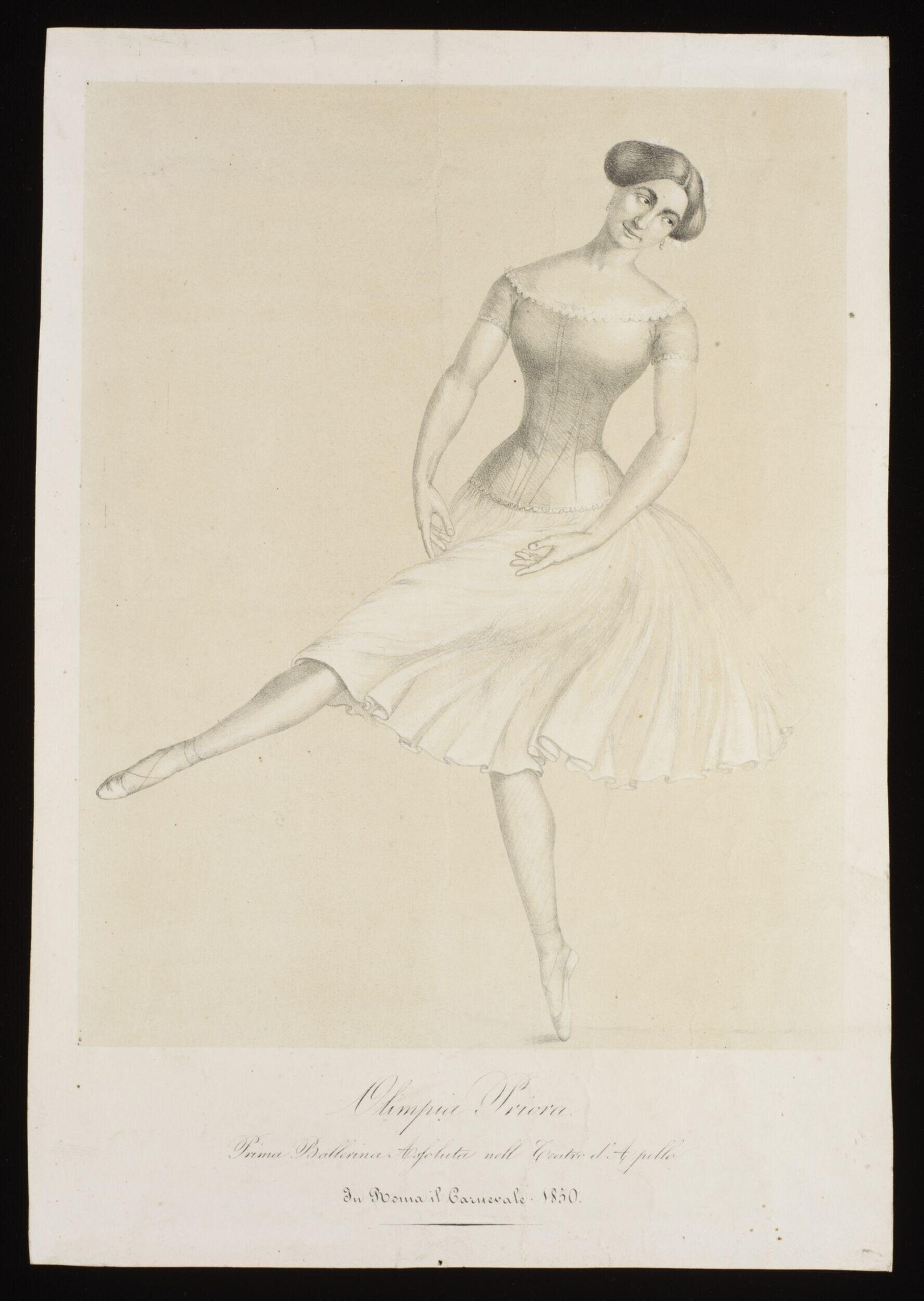
A single female dancer in a balletic pose is rendered in graphite against a cream ground. She stands in a controlled contrapposto position, her body weight concentrated on the ball of one foot while the other leg extends behind her in a graceful arabesque line. Her upper body twists slightly toward the viewer, her head tilted back with an expression of serene composure. She wears a close-fitted corset with horizontal reinforcing lines at the waist, short puffed sleeves, and a voluminous skirt of thin material that falls to mid-calf in soft, carefully modulated folds. Her legs and feet are rendered with particular attention: the supporting leg shows the characteristic musculature and line of a trained dancer, while the extended leg tapers to a pointed foot clad in what appears to be a soft ballet slipper. The drawing technique is refined and assured, using delicate shading to model the form and fine hatching to describe the fabric. A caption in French script appears below the figure.
The dancing
The single figure occupies the entire composition, posed in a balletic stance that demonstrates technical control. The dancer's weight is concentrated on a pointed supporting foot, with the opposite leg extended behind in arabesque—a characteristic position of classical ballet vocabulary. The upper back shows the slight rotation and lift required for this pose, while the arms are held in a soft, graceful position. The rendering of the pointed foot and the elongated line from hip through extended leg reveal the artist's understanding of ballet's aesthetic of elongation and turnout, fundamental to the technique.
The dance depicted
This is a balletic study, most likely from the early 19th century when Romantic ballet was establishing itself as a dominant theatrical form. The arabesque position, the pointe work suggested by the pointed foot, the corsetry, and the soft tulle skirt are all consistent with the classical vocabulary and costume conventions of Romantic ballet as danced in Paris and across Europe during the 1840s–1860s. The drawing's formal precision and its circulation as a print suggest this may document either a celebrated dancer of the period or a type of movement that had become canonical to the form. The inscription in French would clarify the dancer's identity or the ballet from which the pose derives, but it is not legible in this reproduction.
How it was made
This is a graphite drawing, likely prepared as the basis for or document of a theatrical performance. The confident handling of tone and the deliberate hatching to create volume suggest a trained hand, possibly a professional dance illustrator or theatre artist. The precision of the anatomical rendering—particularly the careful articulation of the foot and ankle in a pointed position—indicates that accuracy in ballet anatomy was a priority. The image was reproduced as a print for circulation, suggesting it had commercial or documentary value as a record of performance practice or as a teaching or promotional image.
About this work
This graphite drawing captures a single moment of Romantic-era ballet technique: a dancer held in the arabesque position, a foundational pose in classical vocabulary. The work documents both the physical discipline and the aesthetic ideals of early 19th-century theatrical ballet—elongation, grace, technical precision, and the ethereal quality conveyed through costume and pose. The drawing's refinement and its circulation as a print indicate it held significance either as a record of a celebrated performer or as a canonical representation of ballet movement in its moment. It belongs in a history of dance imagery because it fixes the exact technical and visual identity of a style that defined European theater for over a century.
How to look at it
Attend first to the technical command evident in the ankle and foot—the pointed position requires years of training, and the artist has rendered it with anatomical accuracy rather than flattery. Notice how the extended leg and the rotation of the torso work together to create the illusion of effortless grace: this is the Romantic ballet aesthetic in a single pose. The costume, particularly the way the skirt falls in soft folds while allowing the leg line to read clearly, is not incidental—it is central to the effect. Finally, observe the face and the downward gaze: the introspective, remote expression was essential to Romantic ballet's emotional vocabulary.
The artist
Unknown. The refined execution and professional quality suggest a trained illustrator or choreographer's assistant working within the theatrical world of the 1840s, possibly Paris. The legible French caption and the work's inclusion in a theater print collection (the H. Beard collection) indicate it was made within French or French-aligned theatrical traditions.
The period
The 1850 date places this at the height of European Romantic ballet, when the Romantic Movement's aesthetic of ethereality, melancholy, and otherworldliness dominated the theater. Ballet had become a female-centered spectacle, with male dancers diminished in importance; the female dancer's body, encased in corsetry yet made to appear weightless through the illusion of the tulle skirt and pointe work, was the central icon. The arabesque—a signature position that displays both technical skill and aesthetic grace—had become one of ballet's most recognizable and frequently represented poses. In the visual arts, prints and drawings of famous dancers circulated widely as souvenirs and teaching materials, part of a burgeoning dance imagery industry.
Where it lives
The work is held in the H. Beard Print Collection, indicating it was part of a collecting practice centered on theatrical and dance imagery. The format and inscription suggest it was a commercial print, possibly a souvenir or instructional image sold to the theater-going public or to students of dance.
Dance in this work
Questions about this work
What is the arabesque position?
It is a fundamental pose in ballet in which one leg is extended behind the body, while the dancer stands on the other leg, typically en pointe (on the tip of the toe). The extended leg is held at hip height or higher, creating an elongated line from the supporting foot through the extended heel. It appears in variations throughout ballet vocabulary and is prized for its aesthetic of grace and control.
How do we know this is meant to be ballet, not another form of dance?
Several markers are definitive: the pointed foot in a position that can only be maintained by a dancer trained in turnout and ankle articulation; the corset silhouette and tulle skirt, standard costume for Romantic ballet; the arabesque pose itself, which is a canonical ballet movement; and the refined graphite technique, which places the work in the tradition of professional dance documentation in 19th-century Europe.
Who was the dancer?
The French inscription below the image would identify the dancer, but it is not legible in this reproduction. The technical refinement of the drawing and its circulation as a print suggest it documented either a celebrated performer of the era or a canonical pose that had become iconic to the form itself.
Why is pointe work so important to this image?
Pointe work is fundamental to Romantic ballet's visual and technical identity. The dancer rises onto the tips of the toes, creating the illusion of weightlessness and otherworldliness that was central to the Romantic aesthetic. The artist's careful rendering of the pointed foot acknowledges this as a technical feat and as the visual foundation of the dancer's grace.
More dance artwork





