49 works in this view — arrow keys or swipe to move between them.
Dance in Art
Bouvier, Jules
- Collection:
- Source:
- Victoria and Albert Museum
- Rights:
- Rights vary by item — check the source record before reusing this image. Source record ↗
- Recorded as:
- V&A — check rights per item
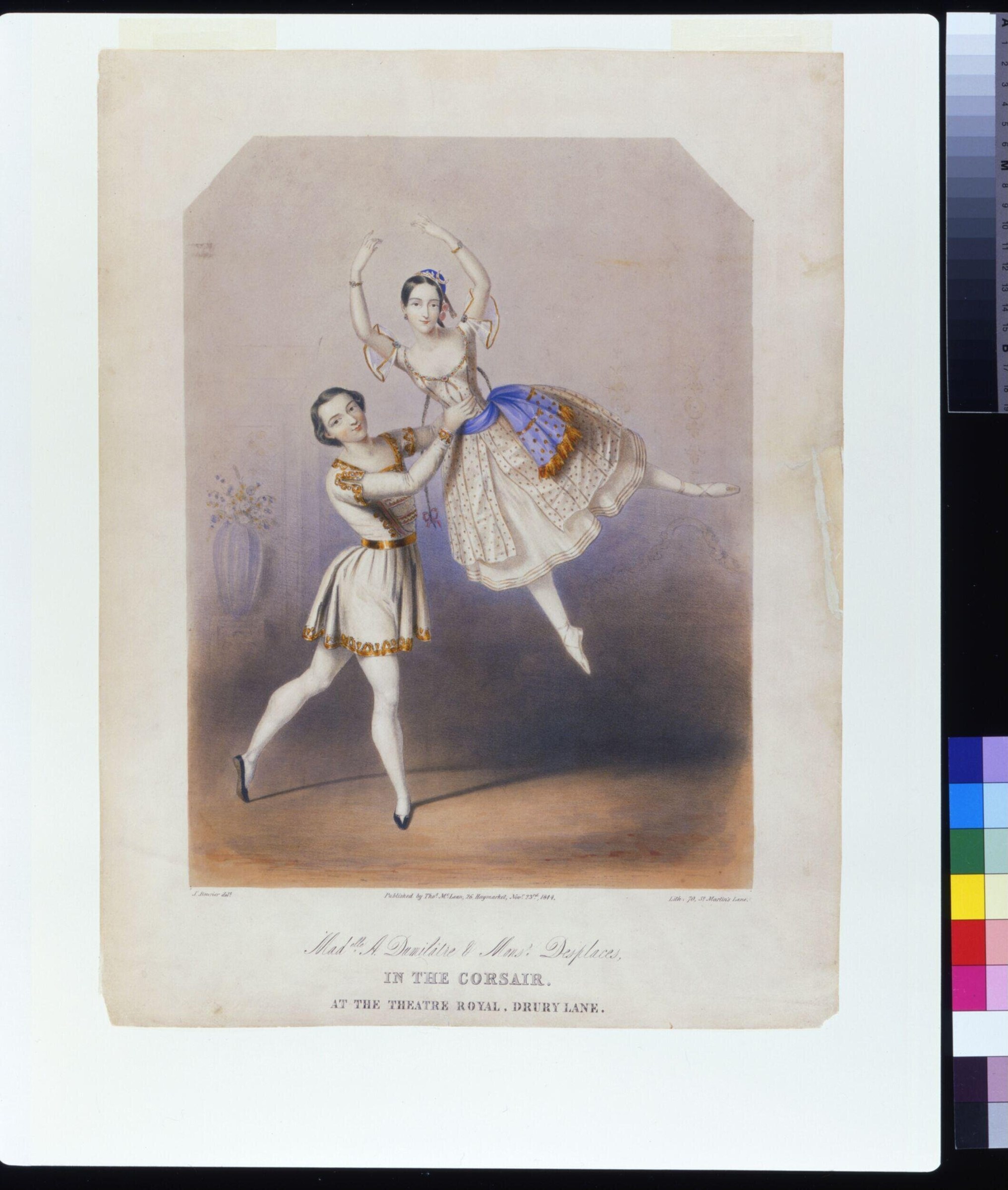
This print documents the visual language of Romantic ballet at its height—the shortened tutu, the pointe shoe, the elevated line, the narrative staging—and shows how these elements were circulated to a mass audience through affordable theatrical prints. For historians of dance and costume, it is a record of stage practice and aesthetics in the 1840s; for students of 19th-century popular culture, it shows how celebrity and spectacle were marketed before photography.
What you are looking at
A young ballerina in a white tutu with gold-trimmed hem stands on one leg in an elevated arabesque or similar classical pose, her supporting leg extended straight behind her and both arms raised. She wears a blue cape or drapery across her shoulders, and a tiara or decorative headdress. A young boy in a short gold-trimmed tunic stands to her left, gazing up at her with one arm extended toward her as if in support or admiration. The background is a soft neutral wash, darker at the base to suggest stage depth, with a vase or urn faintly visible to the left. The figures occupy the lower two-thirds of the composition; the upper area is an empty, luminous void. The whole scene has the quality of a theatrical moment, posed and elegant.
The dancing
The ballerina demonstrates the turned-out, extended line typical of early 19th-century ballet—her supporting leg appears straight and her free leg fully extended, though the precise position is not entirely legible from this angle. Her arms are raised in a classical frame. The boy is positioned lower and to the side, gazing upward; his posture and placement suggest a narrative role—perhaps a cherub, page, or child character. The two figures are not in physical contact but are compositionally linked, the boy attending to the dancer's elevation.
The dance depicted
This is a Romantic-era ballet scene, most likely from a work staged in the 1840s. The costumes, the use of a child attendant figure, and the narrative staging all point to the vocabulary of Romantic ballet as it developed in Paris in the 1820s and 1830s. The title *The Corsair* (likely *Le Corsaire*) was first staged in 1856, but this print predates that; however, the aesthetic and subject matter are consistent with the Romantic repertory of the period. The ballerina wears the shortened tutu and ethereal drapery typical of the Romantic period, and her pose—elevated on a single leg with extended line—would have been executed in block pointe shoes or with the toe of the slipper used for balance rather than the full en pointe technique that emerged later.
How it was made
This is a hand-colored lithograph or color-printed engraving, evidently produced for theatrical publicity or subscription publication. The soft modeling of light, the watercolor-like luminosity, and the careful registration of multiple color layers suggest lithography, which by the 1840s was the standard medium for theatrical portraiture and dance imagery. The technique allowed rapid production and wide circulation of affordable prints to theatregoers, and the choice of a single figure against a minimal background is typical of promotional sheets used to advertise star dancers and new productions.
About this work
This is a theatrical dance print from the 1840s—an image of a Romantic ballet as performed on the Paris stage. It records not a actual performance but an idealized moment: a young ballerina elevated on a single leg, attended by a child figure in an ornamental tunic. The print is an artifact of mid-19th-century dance culture, when lithography made theatrical imagery accessible to the middle-class audiences who frequented the opera and ballet. It shows us how the era's dancers were marketed and remembered—as ethereal, elevated, narrative figures, not as athletic or virtuosic performers, and it captures the precise aesthetic vocabulary of Romantic ballet: the tutu, the pale slipper, the turned-out line, the use of female elevation as a central visual motif.
The work belongs in this gallery because it is a primary document of how dance was understood and celebrated in its moment. It is not a record of actual movement—the pose is held, artificial, composed for the viewer's gaze. But that is precisely what makes it valuable: it shows us the ideal that Romantic ballet aspired to, the image of the dancer that audiences paid to see.
How to look at it
Attend first to the ballerina's elevated pose and the particular way her line is constructed—notice how her supporting leg appears absolutely straight and her free leg extended, with no sense of strain or effort. This is the Romantic ideal: elevation as weightlessness, not strength. Then observe the role of the child figure: he is not a dancer but an attendant, gazing upward in wonder or devotion. This hierarchical composition—one elevated figure attended by smaller ones—is a recurrent motif in Romantic ballet imagery and reflects the narrative and allegorical structures of the ballets themselves. Finally, look at the technique of coloring: the blue drapery is crisp and saturated, the flesh tones are pale and even, and the background is kept neutral so that the dancer remains the sole focus. This is how 19th-century theatrical prints sold the illusion of spectacle to an audience at home.
The artist
Jules Bouvier was a French lithographic artist and printmaker active in the mid-19th century, specializing in theatrical subjects and operatic scenes. His practice was typical of a large workshop tradition devoted to the production of affordable color prints for Parisian audiences. Bouvier's work circulated primarily through print sellers and theater lobbies rather than gallery exhibition, making him part of the commercial art world of entertainment.
The period
In the 1840s, Romantic ballet had reached its aesthetic peak in Paris, with artists like Théophile Gautier championing the ethereal and narrative dimensions of the form. The tutu had shortened dramatically from the full-length skirt of earlier decades, exposing the dancer's leg and allowing the virtuosity of the foot and ankle to be seen. The rise of lithography and color printing made theatrical imagery affordable and democratic, allowing middle-class theatergoers to own images of their favorite dancers. At the same time, photography was beginning to emerge as a rival medium, though it would take decades to displace the hand-colored print as the primary way dance was visually circulated.
Where it lives
This lithograph belongs to a large category of 19th-century theatrical prints produced for circulation among theater patrons. It was issued as a marketable commodity, sold singly or in series, and is now held in the collection noted in the record as 'va'—likely a Virginia institution. Such prints were often inscribed with publication information and the names of dancers and theaters, and they preserve an otherwise ephemeral visual record of stage life.
Dance in this work
Questions about this work
What dance is this?
This is a scene from a Romantic-era ballet, a theatrical form that dominated European dance in the mid-19th century. The title references *The Corsair*, a narrative ballet combining adventure, spectacle, and ethereal female dancers. The child figure and the narrative staging are typical of the period; the subject may have involved a fairy, sylph, or magical female character attended by sprites or child attendants.
What is the ballerina standing on?
She is balancing on one foot, likely using the toe of her slipper. Early 19th-century ballet did not yet use the rigid pointe shoes that became standard later; instead, dancers used soft slippers and rose on the toe of the foot, a technique that required strength but looked more fluid and weightless than later pointe work.
Who was this printed for?
Prints like this were sold to middle-class theatergoers as souvenirs and commemorations of performances they had attended or wished to attend. They could be bought singly at print shops or through the theater lobby, and they served as both advertisement and memento—similar to how theatrical photographs were marketed a generation later.
Is this a record of an actual performance?
No. This is an idealized image created for public consumption. The pose is held and composed for maximum visual effect rather than captured from live movement. It shows us the aesthetic ideal that Romantic ballet aspired to, not a documentation of how dancers actually moved moment by moment.
More dance artwork





