49 works in this view — arrow keys or swipe to move between them.
Dance in Art
Brooch
Unknown
- Collection:
- Brooch
- Source:
- Victoria and Albert Museum
- Rights:
- Rights vary by item — check the source record before reusing this image. Source record ↗
- Recorded as:
- V&A — check rights per item
Brooches and small ornaments like this one are primary evidence for how deeply the Romantic ballerina had penetrated middle-class visual culture by the mid-19th century. They show how a specialized art form became a consumer good, and how women's bodies and their movements were packaged and circulated as objects of beauty and aspiration. For dancers, such images illuminate what their historical predecessors were trained to embody and how their labor was understood, valued, and sold.
What you are looking at
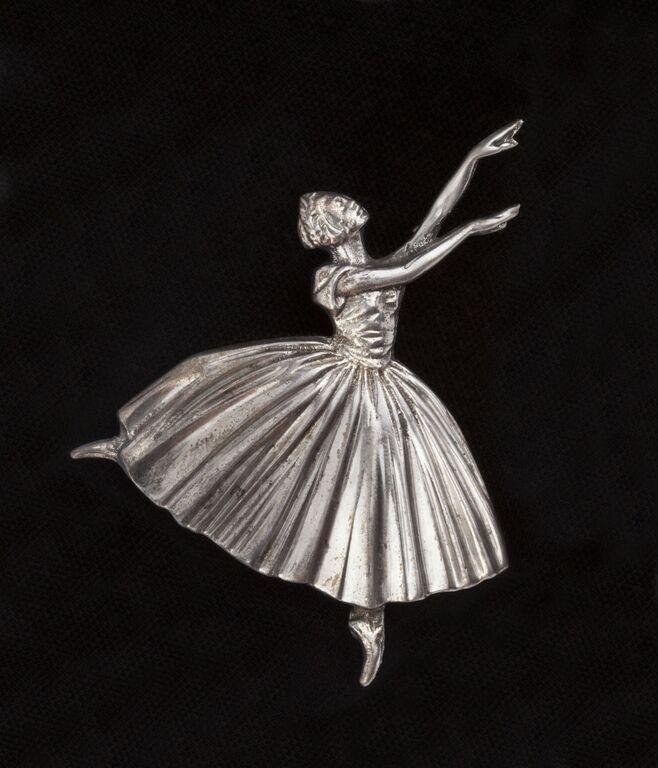
A silvered three-dimensional brooch depicts a single female dancer in a moment of sustained elevation. The figure wears a strapless bodice with a fitted waist and an expansive full skirt that flares dramatically from the hips, rendered in fine radiating lines that suggest both the weight and the movement of the fabric. Her upper body is lifted and rotated, with one arm extended upward and the other reaching outward at shoulder height, creating an open, aspiring line. Her legs are extended in a balletic attitude or arabesque, suggesting she is captured mid-leap or in a moment of extended suspension. The entire figure is rendered in polished silver that catches light along the contours of the body and catches shadow in the gathered folds of the skirt, giving the small sculpture considerable dimensionality and presence. The work is mounted as a brooch—a personal ornament worn close to the body—and the dancer occupies the center of the composition against an implied void.
The dancing
The dancer's body demonstrates the lifted, elongated alignment and turned-out positioning characteristic of classical ballet technique. The torso rises vertically from the hips while the limbs extend into clean, unbroken lines; the extended leg reaches back with a pointed foot, while the arms frame the upper body in an open fifth position or attitude. The musculature is suggested through fine modeling rather than explicit anatomical detail, appropriate to the miniature scale. The dancer's weight appears to be supported on a single supporting leg, indicating a pose of genuine balletic difficulty that requires sustained control and strength.
The dance depicted
This is almost certainly a Romantic-era ballet image, likely depicting the kind of effortless, ethereal ballerina that dominated European stages from the 1830s through the 1860s. The full pointe skirt, the pose of sustained elevation, the aspiring arm gesture, and the general aesthetic of weightlessness and grace all point to this period and to the role-types that defined it—the sylph, the spirit, the idealized female dancer. The image captures the central fantasy of Romantic ballet: a human body that seems to transcend gravity and materiality. This was an age in which such images—in the form of lithographed prints, porcelain figurines, and brooch ornaments—circulated widely among middle-class audiences as tokens of admiration and taste.
How it was made
This is a cast or repoussé silver brooch, worked in fine detail to suggest both the smooth surfaces of the dancer's body and the complex folds of the skirt. The use of polished and matte silver creates subtle tonal contrasts that enhance the sense of volume and movement. The work appears to be a small-scale sculpture in the round, designed to be worn on the chest where it would catch light and draw the eye. Such brooches were a significant market item in the 19th century, affordable miniature sculptures that allowed middle-class wearers to display their engagement with artistic culture and contemporary fashion. The technique—whether casting, repoussé, or chasing—allowed for both delicate detail and structural integrity in such a small object.
About this work
This brooch is a miniature sculpture in silver depicting a Romantic-era ballet dancer in an attitude of suspended grace. It belongs to the vast body of 19th-century decorative arts that commodified the image of the ballerina, making her available as an ornament to be worn, collected, and admired. Such objects circulated widely among people who had never seen a professional dancer but who understood the ballerina as an icon of beauty, refinement, and (paradoxically) delicate femininity—even as the women who danced these roles were highly trained, powerful athletes.
The brooch sits at the intersection of fine craft, commercial production, and popular culture. It represents both the genuine artistry of balletic movement and the mass-market aestheticization of that movement into something suitable for personal adornment. Like the lithograph and the porcelain figurine, the brooch made the dancer portable and intimate.
How to look at it
The viewer should attend to the specific pose and what it tells us about Romantic ballet technique and aesthetics. The extended supporting leg, the turned-out frame, the reaching arms, and the lifted torso all speak to a very particular training and ideal of the body. Notice how the skirt does the work of suggesting movement and weightlessness even in a still object; the radiating folds suggest it is caught mid-motion, suspended in space. The polished silver catches light differently on the smooth skin of the body and the complex surfaces of the drapery, making the piece more visually active than a flat image could be. Finally, consider the scale and the object type: this is something meant to be held close to the body, worn on the chest. It made the dancer intimate and personal, a perpetual presence in the wearer's everyday life.
The period
This brooch was almost certainly made during or in imitation of the Romantic era in ballet, roughly 1830–1870, when the figure of the ethereal, weightless, melancholic ballerina became the dominant image in European visual culture. This was the age of Taglioni, Elssler, and Cerrito—dancers who became international celebrities and whose images were reproduced in lithographs, engravings, wax figures, porcelain, and jewelry. The idealization of the female dancer as a supernatural or semi-divine being, beyond the reach of ordinary human desire or sexuality, was the central fantasy of the era, even as (or especially as) the commercial ballet world was expanding and dancers were becoming public figures and commodities.
The 1840s–1860s saw an explosion in such decorative objects. Brooches, pins, and miniature sculptures allowed admirers of the dance to own and wear their idols. This was also the age of the department store and the expansion of the middle class; such items were produced in quantity, making them accessible to shopkeepers' wives and civil servants' daughters. The brooch thus represents the democratization of a previously elite art form into mass culture.
Where it lives
The catalogue record identifies this as a brooch in the VA (Victoria and Albert Museum) collection. It is recorded with minimal information: title, material category, and holding institution, but without date, artist, or accession number in the current record. It is an example of the vast holdings of 19th-century decorative arts objects that document mass production and popular culture.
Dance in this work
Questions about this work
Who is this supposed to be?
The record provides no identification, and the brooch is too small and generalized in its modeling to depict a specific historical dancer with certainty. It is more likely a type—the Romantic-era ballerina as a generic ideal—rather than a portrait of a named individual. However, if dated to the 1840s–1860s, it may have been sold as an image of a famous dancer of that era, or as an homage to the ballet aesthetic generally.
Was this a common object?
Yes. Brooches, pins, and miniature ornaments depicting dancers were produced in significant quantity throughout the 19th century, particularly from the 1830s onward. They were relatively affordable and were sold in jewelers' shops, department stores, and at theaters themselves. Wearing such a brooch was a way for a person of modest means to signal their awareness of and admiration for contemporary culture.
Why does the pose matter?
The extended leg, lifted torso, and open arm position are not arbitrary. They represent the Romantic ballet technique that was being taught and performed in theaters across Europe and North America. By studying such small objects alongside ballet technique, historians can see what the dominant aesthetic ideal was and how it was circulated and consumed outside the theater itself.
Could this be from the 20th century?
Possibly, but the style—the full tulle skirt, the pose, the idealization of weightlessness—all point to the Romantic era or a nostalgic revival of it. A 20th-century reproduction of a 19th-century image would be common. Without a date in the record, certainty is difficult, but the aesthetic belongs to the 1800s.
More dance artwork





