49 works in this view — arrow keys or swipe to move between them.
Dance in Art
Brooch
Unknown artist
- Collection:
- Brooch
- Source:
- Victoria and Albert Museum
- Rights:
- Rights vary by item — check the source record before reusing this image. Source record ↗
- Recorded as:
- V&A — check rights per item
This object testifies to the extraordinary cultural prestige of ballet in the early twentieth century—a prestige so high that the figure of the ballet dancer became a standard motif in luxury goods and personal adornment. For historians of dance, the brooch documents how the technical and aesthetic values of classical ballet (turned-out legs, pointed feet, elongated lines, the tutu as costume) were crystallized into a portable image of feminine refinement.
What you are looking at
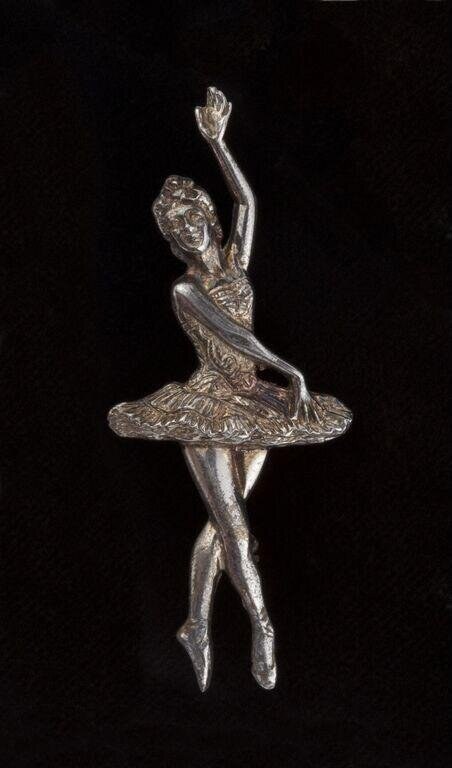
A silver-toned sculptural brooch depicts a female ballet dancer in mid-performance, captured in a moment of classical elegance. The figure stands en pointe on one leg, the supporting foot rendered in the characteristic pointed position of ballet, while the free leg extends upward in a controlled arabesque or attitude position. Her body demonstrates the characteristic S-curve alignment of classical ballet, with her torso held upright and her raised arm extended gracefully overhead. She wears a classical tutu—rendered with fine linear detail to suggest the layered skirt—and her hair is styled in a period arrangement atop her head. The figure is mounted on a small base, making this a three-dimensional object designed to be worn. The metalwork is highly detailed: the face shows careful modeling, the musculature of the extended leg is articulated, and the tutu's construction is suggested through engraved and relief work.
The dancing
A single female dancer occupies the composition. Her weight is entirely supported on her upstage foot, held in the turned-out en pointe position fundamental to classical ballet technique. The free leg rises in a high extension, either arabesque or attitude derrière, suggesting advanced technical proficiency. Her arm alignment follows classical convention: one arm overhead in a graceful curve, suggesting port de bras in fifth position or similar upper-body carriage. The overall frame is vertical and elongated, emphasizing the lengthened line and ethereal quality the ballet tradition valorizes.
The dance depicted
This brooch depicts classical ballet—specifically, the romantic or neoclassical idiom that dominated the nineteenth century and persisted well into the twentieth. The tutu, the en pointe technique, the controlled extensions, and the overall aesthetic all point unambiguously to ballet of the European concert tradition. The pose itself—a high extension performed en pointe with controlled upper-body alignment—reflects the technical aspirations and visual language of romantic and neoclassical ballet as practiced in the nineteenth and early twentieth centuries. Without date or attribution, we cannot identify a specific dancer or production, but the work clearly celebrates the technical achievement and visual ideality of this tradition.
How it was made
This is a brooch of cast or chased silver (or silver-toned metal), designed to be worn as jewelry. The three-dimensional modeling allows the artist to render anatomical detail and the layered structure of the tutu with precision. The technique suggests professional jewelry-making practice, with careful attention to proportional balance and surface finish. Such objects were typical of the late nineteenth and early twentieth centuries, when ballet imagery appeared across decorative arts, from jewelry to figurines to architectural ornament. The small scale and wearability suggest this was created for a market that valued ballet as a symbol of refinement and artistic aspiration.
About this work
This silver brooch captures the quintessential image of classical ballet: a soloist dancer en pointe, in graceful extension, dressed in the canonical tutu of the tradition. It is a miniature three-dimensional sculpture, designed to be worn close to the body—an intimate object that brought the dancer's image into daily life. The work belongs to a widespread practice of depicting ballet dancers across the decorative and applied arts, especially from the 1880s through the 1950s. Ballet imagery was deployed across jewelers' catalogs, fashion accessories, and ornamental objects because it carried associations with refinement, aspiration, and ideal beauty. This brooch is one small example of how deeply ballet—as both a technical practice and a cultural ideal—penetrated European and North American visual and material culture during the modern period.
How to look at it
Observe the precise positioning of the feet and legs: the brooch artist has understood and conveyed the turned-out, en pointe stance that defines classical ballet technique. Note the careful balance of the composition—all weight on one leg, the body held vertical and controlled despite the extension of the free limb. The raised arm and the alignment of the head reinforce the vertical orientation. The detail of the tutu—rendered through linear marks suggesting its layered construction—shows the artist's attention to the visual specificity of ballet costume. This is not a generic 'dancing figure' but a representation of ballet specifically, rendered with technical knowledge.
The period
The brooch dates to an era when ballet occupied an unprecedented position in European and North American culture. The late nineteenth century saw the full codification of classical technique in the Russian Imperial tradition, the rise of Sergei Diaghilev's Ballets Russes (1909–1929), and the widespread dissemination of ballet imagery through photography, illustration, and commercial reproduction. The ballet dancer became a stock figure in decorative arts, symbolizing grace, technical mastery, and cultivated beauty. Silver jewelry and ornamental objects bearing ballet dancers were manufactured in quantity, suggesting a substantial market among educated, fashion-conscious consumers. The elegant realism of this brooch's modeling is consistent with the high-quality jewelry production of this period.
Where it lives
The object is recorded as a brooch in the collection identified as 'va' in the source field, which likely refers to the Victoria and Albert Museum (London). No accession number, donor information, or acquisition date is provided in the catalogue record.
Dance in this work
Questions about this work
What dance style is depicted?
Classical ballet. The figure's en pointe stance, the tutu, the controlled line of the body, and the upraised arm all conform to the conventions of European concert ballet as codified in the nineteenth century.
When was this brooch made?
The catalogue record provides no date. However, the style of the brooch and the aesthetic of the ballet figure it depicts suggest manufacture in the late nineteenth or early twentieth century, when ballet was at peak prestige in European decorative arts.
Who made this and for whom?
The maker is not recorded. The brooch was created for the jewelry market—a consumer good intended to be worn by people who admired ballet and wished to display that taste through personal adornment.
Why was ballet imagery so common in jewelry and decorative objects?
Ballet was associated with refinement, aspiration, and ideal beauty in the early twentieth century. Depicting a ballet dancer on a piece of jewelry communicated the wearer's cultivation and taste.
More dance artwork





