49 works in this view — arrow keys or swipe to move between them.
Dance in Art
Print Collection
Chalon, Alfred Edward
- Collection:
- Source:
- Victoria and Albert Museum
- Rights:
- Rights vary by item — check the source record before reusing this image. Source record ↗
- Recorded as:
- V&A — check rights per item
The print documents the visual language of Romantic ballet at the moment of its greatest popularity and cultural influence. For dancers and historians, it shows what mid-nineteenth-century spectators actually saw and valued: not technical virtuosity but ethereality, symmetry, and an almost sculptural idealization of the female body. The work is also a rare artifact of the commercial ballet print industry that sustained fandom and memory around ephemeral performances.
What you are looking at
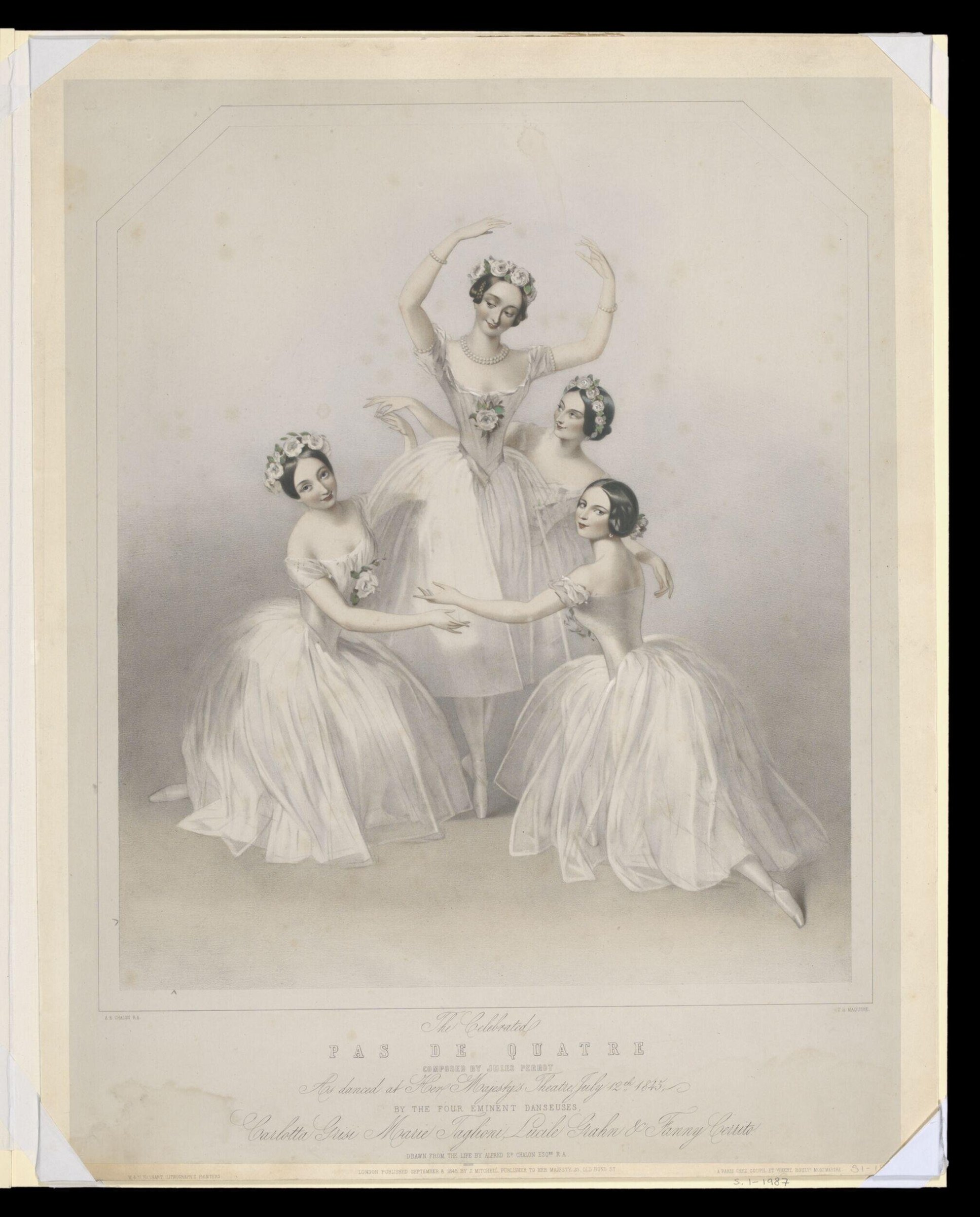
A Romantic-era ballet scene depicting four female dancers in diaphanous white tutus arranged in a pyramidal composition. A central dancer stands elevated with her arms raised in a classical port de bras, while three others in graduated heights surround her—one kneeling at left holding flowers, one standing at mid-right, and one seated or in a lower position at right. All wear wreaths or coronets in their hair and pearl necklaces. The setting is ethereal and cloud-like, rendered in soft grays and whites that blur the boundary between figure and background. The lighting is diffuse and romantic, with no visible floor or architectural elements—the dancers appear suspended in an atmospheric void. The composition and styling are characteristic of mid-nineteenth-century Parisian ballet imagery, where the corps de ballet or allegorical figures were arranged in graceful, symmetrical formations to suggest weightlessness and transcendence.
The dancing
The central figure anchors the composition with a classical épaulement—shoulders held square, arms raised to frame the head in a refined, statuary pose suggesting apotheosis or a moment of revelation. The surrounding dancers are arranged to support rather than echo this gesture; their gaze is directed upward or inward toward the central figure. The kneeling figure at left holds flowers in both hands, a conventional attribute of beauty or virtue in Romantic imagery. All four figures maintain an upright carriage and elongated line typical of ballet training, with legs concealed by full skirts that fall to mid-calf. The overall effect is of a carefully composed tableau rather than a moment of dynamic movement.
The dance depicted
This is a print documenting a scene from a Romantic-era ballet, most likely from the 1840s Paris Opéra tradition. The composition—particularly the pyramidal arrangement of figures, the ethereal setting, and the symbolic gesture—suggests an allegorical or divertissement moment rather than narrative action. The elevated central figure and worshipful positioning of the others may depict a scene of homage to a principal dancer or a supernatural encounter characteristic of Romantic ballet subjects (sylphs, spirits, or virtues). Without the specific ballet title visible in the inscription, the precise narrative cannot be confirmed, but the visual language—flowers, wreaths, weightlessness, female groupings—is diagnostic of Romantic ballet spectacle.
How it was made
This is a lithographic print, established from the soft, grayscale tonal modeling and the characteristic stone-texture visible in the background. Lithography allowed for precise rendering of facial features and delicate drapery while maintaining the spontaneity of chalk or crayon drawing—ideal for capturing the ethereal quality Romantic ballet audiences desired. The technique also enabled mass production and distribution to a broad audience of subscribers and theater enthusiasts. The bordered framing with decorative rules and the presence of an inscription at bottom are typical of mid-nineteenth-century theatrical prints intended for collection and display in the home.
About this work
This is a lithographic print documenting a scene from a Romantic-era ballet, likely from the Paris Opéra in the 1840s. It captures the visual language that defined Romantic ballet for its contemporary audience: ethereal female forms in white tulle, allegorical or supernatural subjects, and careful compositional symmetry. The print was produced as part of a commercial circulation of ballet imagery—souvenirs for theater-goers and subscribers—and serves as documentary evidence of how these performances were understood and marketed.
For dance historians, the work is valuable precisely because it distills the conventions of Romantic ballet spectatorship into a single, static image. The composition does not depict the mechanics of movement but rather the idealized *appearance* of Romantic ballet—weightlessness, grace, virtue, and the cult of the principal dancer. As such, it reveals the period's aesthetic priorities and the gendered visual culture of theatrical dance.
How to look at it
Note the deliberate stillness of this composition—despite its title suggesting narrative content, no two dancers are in the same position or gesture, suggesting a posed tableau rather than a captured moment of choreographic action. The eye is drawn upward to the central figure by the converging lines of the surrounding bodies and their upward gazes. The atmospheric, cloud-like background is not decorative but functional: it erases the floor and sense of ground, creating the illusion of suspension or transcendence that was central to Romantic ballet's appeal. Look closely at the hands and feet: they are rendered with anatomical precision, suggesting Chalon understood ballet technique, even as the overall effect is one of idealization rather than documentation.
The artist
Alfred Edward Chalon (1780–1860) was a prolific Swiss-born painter and lithographer based in London and Paris, celebrated for his society portraiture and theatrical scenes. He was commissioned extensively by the theater world and royal courts, and his prints of dancers and operatic subjects were among the most sought-after theatrical imagery of the era. Chalon's style combined precise anatomical observation with romantic idealization—he flattered his subjects while maintaining convincing detail—making him the visual chronicler of Romantic-era entertainment for elite and middle-class audiences.
The period
The 1840s were the apogee of Romantic ballet in Europe, with works like *La Sylphide* (1832) and *Giselle* (1841) establishing the genre's aesthetic: supernatural heroines, pointe work, aerial illusions, and the cult of the ballerina primadonna. Lithographic prints of famous dancers and scenes were a major industry, distributed through subscription networks and sold as souvenirs at theaters. The ephemeral nature of live performance made these prints crucial documents—often the only visual record that survived performance runs. For audiences, collecting ballet prints was a form of fandom and a way to extend the theater experience into the domestic sphere.
Where it lives
The work is from a print collection held in the V&A Museum (source code 'va'). It is one of thousands of theatrical prints produced in the nineteenth century as commercial products for public consumption, not unique artworks. The presence of an inscription and border indicates it was sold individually or as part of a bound album of ballet imagery.
Dance in this work
Questions about this work
What ballet is this from?
The inscription is not fully legible in the image, so the specific ballet cannot be confirmed from visual inspection alone. However, the style, subject matter (four female dancers in a pyramidal arrangement with allegorical or supernatural attributes), and dating to 1845 suggest it depicts a scene from a major Romantic ballet in the Paris Opéra repertory, such as a divertissement or vision scene from *La Sylphide*, *Giselle*, or a similar work of that era.
Did these dancers actually look like this?
Chalon was a skilled observer of ballet, but this image is an idealized portrait, not documentary photography. The dancers are flattered; their features are regularized and softened. The composition is deliberately artificial—no actual moment of choreography would arrange four dancers in this exact pyramidal formation with identical upward gazes. What the image does convey accurately is the silhouette of Romantic ballet costume and the period's aesthetic values: whiteness, verticality, symmetry, and otherworldliness.
Why were so many prints made of ballet scenes?
Romantic ballet was live performance and therefore ephemeral; audiences could not revisit a performance once it closed. Prints allowed theatergoers to commemorate what they had seen and to circulate images of celebrated dancers within social networks. They were also commercial products: theaters and publishers made money selling them to subscribers and the general public, creating a fan culture around individual dancers and works—a precursor to modern celebrity culture.
What technique was used to make this print?
This is a lithograph, a process that allowed artists to draw on a prepared stone surface and then print the image. Lithography was faster and cheaper than engraving or etching, and it allowed for subtle tonal gradations—ideal for capturing the soft, atmospheric effects that Romantic ballet imagery demanded. The result could be hand-colored or distributed in grayscale, as here.
More dance artwork





