49 works in this view — arrow keys or swipe to move between them.
Dance in Art
Portrait of Pavlova
Kallmus, Dora
- Collection:
- photograph
- Source:
- Victoria and Albert Museum
- Rights:
- Rights vary by item — check the source record before reusing this image. Source record ↗
- Recorded as:
- V&A — check rights per item
Pavlova was the most globally celebrated dancer of her era, and portraits like this one shaped how she was understood by audiences across Europe and the Americas. Kallmus was one of the few photographers trusted to capture theatrical subjects with both technical refinement and psychological insight, making this an important document of early 20th-century theatrical photography and of how a major dancer chose to be seen.
What you are looking at
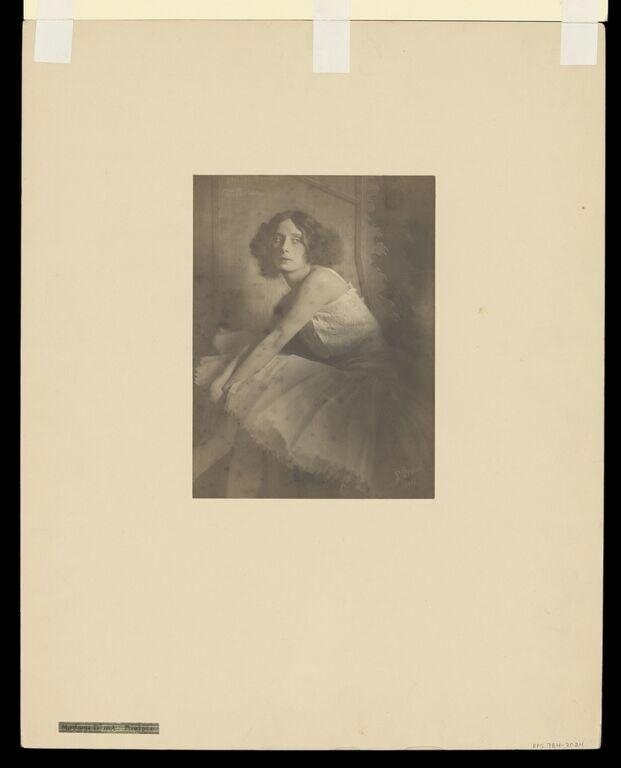
A woman in early 20th-century dress sits in a contemplative pose, her body angled away from the viewer yet her gaze directed back over her shoulder. She wears a high-necked white or cream blouse with puffy sleeves and a dark skirt, her dark hair arranged in the fashionable waves of the 1910s. The photograph is softly lit from the side, creating subtle gradations of tone across her face and fabric; the background is plain and diffused, keeping focus on the figure. Her left arm is bent and raised, her hand near her shoulder, while her body curves in a pose that suggests both repose and alertness—the kind of moment a dancer might hold at rest between movements.
The dancing
A single female figure occupies the composition. Her torso is twisted, her weight settled onto one hip, creating an S-curve through her spine and limbs. The raised left arm and the angle of her head—turned back to address the viewer—convey a sense of introspection or sudden awareness rather than active motion. Her posture is controlled and formally composed; there is no sense of strain or exertion, but rather the deliberate stillness of a body trained in movement.
The dance depicted
This is a portrait of Anna Pavlova, the Russian prima ballerina of the Imperial Ballet, at the height of her fame. The pose and formal dress suggest a moment of theatrical repose rather than active choreography—the kind of portrait made during or just after her performing career. The backward glance and the curved line of the body are consistent with the romantic, lyrical aesthetic of early 20th-century classical ballet, in which the body was presented as an object of lyrical beauty. Without visible pointe shoes or tutu, this reads as a formal studio portrait rather than a dance action, but it documents a dancer whose technique and bearing defined the period.
How it was made
This is a photographic print, likely a gelatin silver or platinum print given the soft tonal range and the date. The photographer, Dora Kallmus (known professionally as Madame d'Ora), was one of the leading society and theatrical photographers of Vienna and Europe in the early 20th century, known for subtle lighting and refined composition. The softness of the image and the delicate gradation of tones are characteristic of pictorialist photographic practice—a technique that emphasized beauty and mood over documentary clarity. Such portraits were made for reproduction in periodicals and for the dancer's own professional use.
About this work
This is a formal studio portrait by the Viennese photographer Dora Kallmus of Anna Pavlova, the Russian prima ballerina, made around 1912. It is not a record of choreography but an image of a dancer at rest, composed and controlled, her body arranged to emphasize the graceful line and inward focus that defined her public presence. The photograph is a document of how Pavlova presented herself to the world—elegant, introspective, formally trained, and aware of the camera. It belongs in a gallery of dance imagery because it records not a step or a gesture but the persona and bearing of one of the most influential dancers of the early 20th century.
How to look at it
Observe the direction of the gaze and the twist of the torso: the viewer is being invited into a moment of private reflection, even though the pose is formally composed. The raised arm and angled head recall the vocabulary of classical ballet but are presented without active motion—this is how a trained body holds itself at rest. Notice the photographer's use of light to model the face and fabric without harsh shadow: the softness is deliberate, a technical choice that conveys both beauty and a sense of interiority. The plain background and centered composition focus all attention on the figure, presenting her as both public icon and private self.
The artist
Dora Kallmus (1884–1978), known as Madame d'Ora, was an Austrian-American photographer and pioneer of the profession. She opened her studio in Vienna in 1907 and became the preferred photographer of the Austro-Hungarian imperial court and Vienna's cultural elite. She specialized in theatrical portraiture and fashion photography, working with dancers, actresses, and musicians. Her work is characterized by soft focus, elegant composition, and an intuitive understanding of how to reveal character and beauty in a single image. She was among the first women to establish an independent, internationally recognized photographic practice.
The period
In the early 1910s, Anna Pavlova was at the apex of her fame, having danced the lead role in Michel Fokine's *The Dying Swan* (1905) and established herself as the prima ballerina of the Ballets Russes. Classical ballet was becoming an international art form, with dance companies touring extensively. Theatrical photography was simultaneously evolving as an art form—no longer a purely documentary medium but one that could capture personality and presence. Studio portraits of dancers were widely reproduced in journals, programs, and popular magazines, and formed an essential part of a dancer's professional identity and public marketing.
Where it lives
The photograph is held by the Victoria and Albert Museum (noted in the source field as 'va'). It is part of the museum's extensive collection of theatrical and fashion photography from the early 20th century.
Dance in this work
Questions about this work
Is this a photograph of Pavlova dancing?
No. This is a formal studio portrait made at rest, not a record of choreography. Pavlova is posed to emphasize the graceful line and control of her trained body, but she is not executing any step or movement. Such portraits were essential to a dancer's professional identity and public presence in this era.
Who was Dora Kallmus?
Kallmus (known professionally as Madame d'Ora) was a pioneering Austrian photographer born in 1884 who opened her Vienna studio in 1907. She became one of the most celebrated theatrical photographers of the early 20th century, specializing in portraits of dancers, actors, and society figures. She was one of the first women to establish an independent, internationally recognized photographic practice.
Why was Pavlova so important?
Anna Pavlova (1881–1931) was the most globally celebrated dancer of the early 20th century. She created the role of the Dying Swan, became the prima ballerina of the Ballets Russes, and toured internationally, bringing classical ballet to audiences across Europe, the Americas, and Asia. She was instrumental in establishing ballet as a major international art form.
What technique is the photographer using?
This is likely a platinum or gelatin silver print made using pictorialist technique—an approach that emphasizes soft focus, subtle tonal gradation, and mood over documentary clarity. The soft lighting and refined composition are characteristic of the finest theatrical photography of the period.
More dance artwork





