49 works in this view — arrow keys or swipe to move between them.
Dance in Art
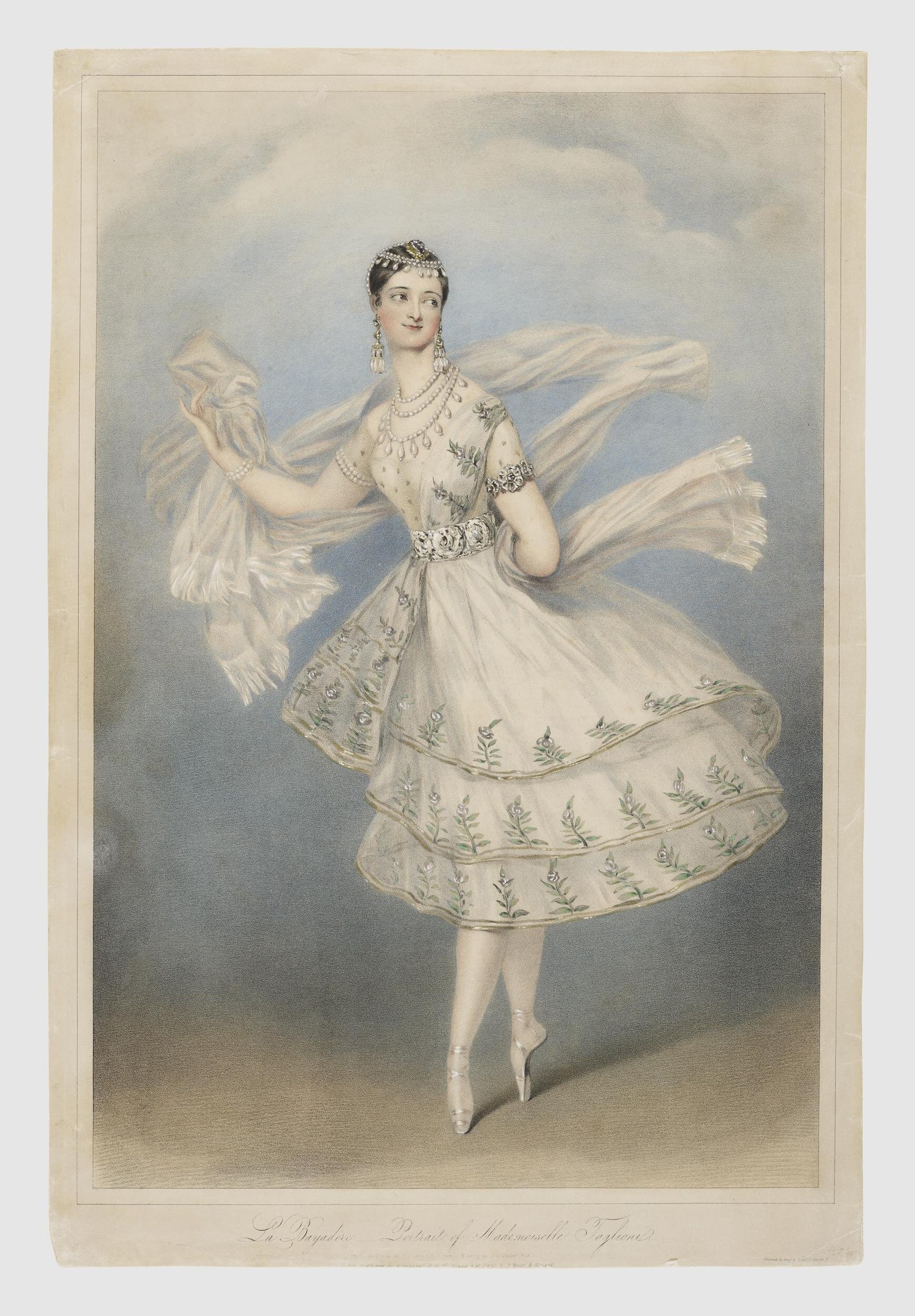
La Bayadère - Portrait of Mademoiselle Taglioni
Chalon, Alfred Edward (RA)
- Collection:
- Source:
- Victoria and Albert Museum
- Rights:
- Rights vary by item — check the source record before reusing this image. Source record ↗
- Recorded as:
- V&A — check rights per item
Marie Taglioni was the first superstar of the modern dance world, and this portrait captures her at the moment of her greatest fame and influence. The work documents not just her likeness but the visual language through which her art was understood and celebrated—the ethereal dress, the impossible lightness, the exotic character. For historians of Romantic ballet and of dance imagery, it is primary evidence of how the period's most admired dancer was seen and marketed.
What you are looking at
A young woman in Romantic-era dress stands alone against a soft, clouded background in a pose of balletic grace. She wears a pale cream or ivory tulle dress with a fitted bodice decorated with embroidered sprigs and a deep V-neckline, the skirt falling to mid-calf in multiple layers with a hem embroidered in a delicate botanical pattern. A decorative belt cinches her waist. She is adorned with jewelry—a tiara, long drop earrings, and multiple strands of beads or pearls—all suggesting a character of rank and refinement. Most strikingly, she holds aloft a large, diaphanous shawl or scarf of white muslin that billows dramatically behind and to either side of her body, caught mid-flutter as if suspended in motion. Her pose is one of controlled elegance: she stands on pointe or demi-pointe on her right leg, her left leg extended or lightly bent, her body turned three-quarter to the viewer, her gaze directed away toward the middle distance. The composition is frontal and formal, typical of theatrical portraiture of the period.
The dancing
A single figure, a ballerina, demonstrates the extended, weightless quality prized in Romantic ballet. Her supporting leg is engaged, lifting her body to near full height; her free leg is fluid and extended. Her arms frame the floating drapery with one arm raised and the other holding the fabric. There is no visible strain in her posture—the impression is of effortless elevation and control. The body is turned in a way that displays both the front of the costume and its profile, maximizing the visual drama of the embroidered skirt and the airborne drapery.
The dance depicted
This is a portrait of a Romantic ballet dancer, most likely Marie Taglioni, the legendary dancer of the 1820s–1840s who revolutionized ballet technique and became the embodiment of the ethereal, supernatural characters that defined Romantic aesthetics. The work is titled La Bayadère—a reference to the exotic, often semi-improvised character dances that were part of the Romantic ballet vocabulary—though it is titled as a portrait of Taglioni herself. The billowing drapery, the pointe work, and the turned-out stance are signatures of the Romantic ballet idiom. Taglioni was famous for her lightness, her ability to sustain positions of apparent weightlessness, and her mastery of the illusion of effortless flight—all qualities captured here. The character costume and the theatrical drapery suggest this may depict her in a specific role, likely a sylph or spirit character.
How it was made
This is a hand-colored lithograph or engraving, executed with considerable technical refinement. The print medium allowed for wide circulation of theatrical portraiture and dance imagery across Europe and beyond, making Taglioni's image available to audiences who could not see her perform. The soft modeling, the careful rendering of fabric texture and the play of light, and the subtle use of color—pale blues and grays in the background, cream and pale green in the dress—are characteristic of high-quality theatrical prints of the 1820s–1830s. The technique allowed the artist to capture both the precision of the dancer's line and the ethereal, almost dreamlike quality of Romantic ballet aesthetic. The inscription at the base is in French, indicating a Continental (likely Paris-based) production and circulation.
About this work
This is a theatrical portrait of the Romantic era's most celebrated dancer, rendered as a hand-colored print that served as both a souvenir of her performances and a visual record of her artistry. It captures the Romantic ballet ideal: a solitary, weightless figure in exotic costume, floating in a timeless space, her body achieving positions that seemed to defy gravity. The work combines precise observation of balletic technique—the pointe position, the turnout, the carriage—with the idealized, dreamlike aesthetic that Taglioni herself embodied and that made her the defining figure of Romantic dance. As a print, it belongs to the history of theatrical commerce and fame; as an image, it is a manifesto of Romantic ballet values: femininity, otherworldliness, technical virtuosity deployed toward the appearance of spontaneous grace.
How to look at it
Attend first to the moment chosen: the dancer is not in a step or a turn but in a suspended pose, as if floating. The artist has frozen not a movement but an attitude—a pose held for effect. The drapery is central to the composition; it is not incidental but is as carefully arranged and rendered as the body itself, creating a framing and an aura around the figure. Notice how the pose conveys weightlessness: the supporting leg is hidden or minimized, the free leg is light, the arms do not grip or strain but simply guide the fabric. The exotic costume—the tiara, the jewelry, the embroidered botanical motifs—signals character rather than realism. The background is abstract and timeless, not a stage set but an idealized space. The entire image is designed to suggest that this is not a real woman but a supernatural being.
The artist
Alfred Edward Chalon (1780–1860) was a prolific British painter and printmaker celebrated for his society portraits and especially for his theatrical portraiture. He was a founding member of the Society of Painters in Water Colours and held the post of painter to the Queen. Chalon made numerous portraits of leading theatrical performers of his day, particularly dancers, and was especially known for his ability to capture both likeness and the theatrical character or role. His lithographs and colored prints of dancers and performers were highly sought after and widely circulated, making him one of the primary visual documenters of Romantic-era performance.
The period
This work dates to the height of the Romantic movement in art and dance, when the supernatural, the exotic, and the ethereal were the dominant aesthetic ideals. Marie Taglioni's debut in Jean Aumer's La Sylphide (1832) crystallized these values and made her the most celebrated dancer in Europe. Lithographic print technology, perfected in the 1820s, allowed theatrical portraiture to reach a mass audience for the first time, creating a new form of celebrity image. Ballet itself was being rapidly transformed: pointe work, which had been a technical novelty, became standardized; narratives shifted from mythological allegory to narratives of enchantment and otherworldliness; and the ballerina became the central figure, displacing the male dancer. Taglioni embodied all these shifts. Her image, reproduced in prints like this one, became iconic across Europe and circulated as widely as a photograph might today.
Where it lives
The work is held by the Victoria and Albert Museum (indicated by the source code 'va') as a print in the collection. It is one of many theatrical portraits in the museum's collection documenting 19th-century performance and celebrity.
Dance in this work
Questions about this work
Who was Marie Taglioni?
Marie Taglioni (1804–1884) was a Swedish-born ballerina who became the most celebrated dancer of the Romantic era. She revolutionized ballet technique, popularized dancing en pointe, and became the embodiment of Romantic ideals of ethereal femininity and otherworldliness. Her performance in La Sylphide (1832) made her an international superstar and defined the aesthetics of Romantic ballet for decades.
What is a bayadère?
In 19th-century ballet, a bayadère was a female dancer character, often depicted as Indian or exotic, known for virtuosic technique and sensual or improvised movement. The term was borrowed from the French word for devadasi (temple dancer). Bayadère characters were popular in Romantic ballet ballets and in the divertissements that concluded many full-length works.
Is this a painting or a print?
This is a hand-colored lithograph or engraving, a reproductive print technology that allowed theatrical portraits to be produced and distributed widely. The soft modeling and careful rendering suggest a lithograph, which offered greater tonal subtlety than engraving.
Why is the fabric so important to the image?
In Romantic ballet, the costume and its movement were integral to the visual effect and meaning. The floating, billowing drapery here is not decorative but expressive: it creates the illusion of weightlessness and otherworldliness that was central to the Romantic ballerina ideal. It also extends the dancer's line and creates a visual aura around the figure.
More dance artwork





