49 works in this view — arrow keys or swipe to move between them.
Dance in Art
Aurora's Wedding
Reiniger, Lotte
- Collection:
- Silhouette
- Source:
- Victoria and Albert Museum
- Rights:
- Rights vary by item — check the source record before reusing this image. Source record ↗
- Recorded as:
- V&A — check rights per item
Lotte Reiniger's silhouette work is foundational to 20th-century animation and graphic art, and dance was a recurrent subject in her practice. This image shows her translating a canonical ballet—one of the most performed works in the classical repertory—into her distinctive visual language, revealing what the silhouette form could convey about the balletic body: poise, line, and the geometry of classical technique. For dance historians, it documents both the enduring cultural presence of The Sleeping Beauty and the visual methods by which modernist artists engaged with classical ballet.
What you are looking at
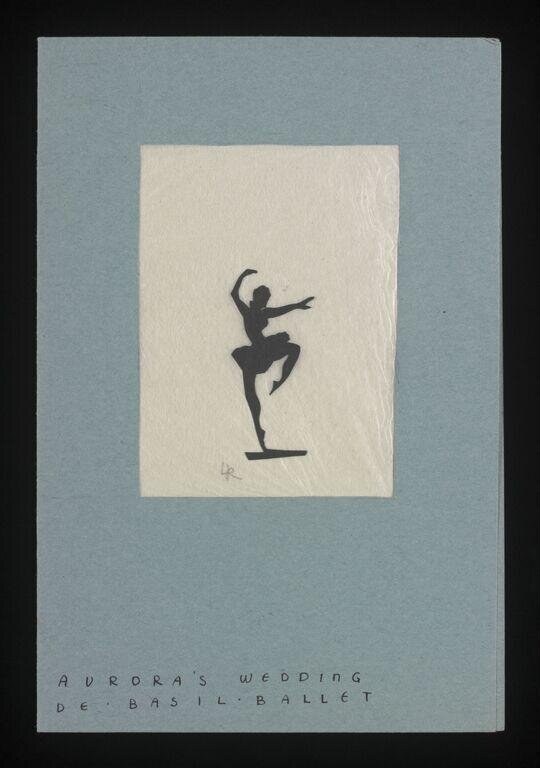
A single dancer in silhouette against a cream-colored panel mounted on a blue-gray backing. The figure is caught mid-leap in a balletic pose—one leg extended high and bent, the other supporting from a narrow base, arms curved expressively overhead. The silhouette is rendered in solid black, creating a stark graphic image. The dancer appears almost to be balanced on or emerging from a thin horizontal line at the base, which grounds the composition. The overall effect is one of lightness and elevation despite the heaviness of the silhouette form.
The dancing
A single female dancer in a distinctly balletic frame. The supporting leg appears nearly straight, with the body lifted and elongated; the raised leg is bent at the knee in what might be an attitude derrière or similar classical position. The arms are held aloft in a rounded, expressive port de bras. The pose suggests a moment of suspension—the body appears weightless even within the constraints of the silhouette medium. The geometry is elegant and deliberately posed rather than candid.
The dance depicted
This is classical ballet, almost certainly Romantic or early classical vocabulary. The pose—the lifted torso, the bent raised leg, the expressive arm carriage—are characteristic of 19th-century academic ballet technique. The title *Aurora's Wedding* refers to the wedding of Aurora (Princess Aurora) from *The Sleeping Beauty*, most famously choreographed by Marius Petipa with music by Tchaikovsky in 1890. This work would likely depict a dancer from that ballet, possibly a variation or moment from the wedding act. The silhouette technique eliminates any record of footwork or precise technical detail, but the pose itself declares the classical vocabulary.
How it was made
This is a silhouette—a figure rendered in solid black against a lighter ground. The technique appears to be cut paper or possibly ink wash; the catalogue lists the collection as 'Silhouette,' confirming the medium. Silhouettes were popular in the 18th and early 19th centuries as a form of portraiture and theatrical documentation, and continued as a graphic art form into the 20th century. The technique is ideally suited to capturing pose and gesture while stripping away all costume detail, musculature, and facial expression, leaving only the essential line of the body. This is mounted on a backing suggesting a presentation as a framed artwork or portfolio piece. The mounted presentation and professional execution suggest this was made for exhibition or publication.
About this work
This is a silhouette of a classical ballet dancer in a moment of elevation, created by Lotte Reiniger and titled *Aurora's Wedding*. Reiniger is recognized for pioneering the silhouette animation technique in the 1920s, and this work sits at the intersection of her graphic practice and her deep engagement with theatrical and dance material. The work captures a canonical moment from The Sleeping Beauty—one of the most iconic ballets of the 19th century—in a form that isolates and celebrates the pure geometry of the balletic body.
The piece belongs in a gallery of dance in art because it documents both a specific choreographic moment (the wedding celebration of Aurora) and a particular moment in the history of dance visualisation. By the 1930s, when this was made, Reiniger's silhouette technique was the dominant visual language of her artistic practice, and it served her precisely because it could render the human figure in motion with both clarity and grace. The work stands as evidence of how dance has been a central subject for visual artists, and how the techniques of visual art have evolved to capture movement.
How to look at it
Attend to the precise moment Reiniger has chosen: not a leap in progress, but a moment of suspension, where the dancer appears briefly weightless. The bent knee of the raised leg and the rounded arms create a sense of grace within geometric constraint. Observe how the silhouette form forces the eye to read the figure as pure line and shape, stripping away all spectacle of costume, skin, and expression—you see only the dancer's body as it occupies space. This is characteristic of silhouette portraiture from this period: the elimination of detail in service of capturing the essential gesture. The narrow base and elongated torso emphasize the balletic ideal of vertical lift.
The artist
Lotte Reiniger (1899–1981) was a German silhouette animator and graphic artist, pioneering the silhouette animation technique beginning in the early 1920s. She is best known for her feature films using cut-paper animation—notably *The Adventures of Prince Achmed* (1926)—but she also created silhouette artworks in multiple media throughout her career. Dance and theatrical subjects recur throughout her work, and she had a documented interest in classical ballet. Her silhouette technique was partly inspired by traditional shadow theatre and Chinese paper-cut art, but she developed it into a modernist graphic form that could convey both narrative and abstraction. This work dates to the period when her silhouette practice was mature and widely exhibited.
The period
The Sleeping Beauty, created in 1890, was revived and performed frequently throughout the early 20th century and remains central to classical ballet today. In the 1930s, when this work was made, the ballet was not only established as a cornerstone of the classical repertory but also an accessible subject for visual artists and the educated public. Simultaneously, graphic modernism was advancing rapidly in Germany and across Europe; silhouette and paper-cut techniques were experiencing renewed interest as a bridge between folk art, avant-garde practice, and commercial graphic design. Reiniger's work sits at this intersection—modernist in form, classical in content, and engaged with dance as a serious subject for visual art.
Where it lives
The work is held in the collection as a silhouette, part of what appears to be a documentation or portfolio of Reiniger's work. The mounted presentation on blue-gray backing suggests this may be a gallery print, a portfolio piece, or a page from a larger compilation. The inscription 'AURORA'S WEDDING / DE' BASIL BALLET' at the foot indicates association with the Ballets Russes de Monte Carlo (de Basil's company), suggesting this may document a dancer or production from that company.
Dance in this work
Questions about this work
What is the technique used for this silhouette?
This appears to be a cut-paper or inked silhouette—a figure rendered in solid black against a lighter backing. The technique was favored in the 18th and 19th centuries and was revived by modernists in the early 20th century. It requires precise understanding of how the human body reads in profile and in pure outline, eliminating all interior detail. Reiniger mastered this form and used it throughout her career in both animation and fine art.
Who is Aurora and why was her wedding important?
Aurora is the protagonist of *The Sleeping Beauty*, a ballet created in 1890 by choreographer Marius Petipa with music by Tchaikovsky. The wedding is the finale of the ballet, in which the curse is broken and Aurora marries the Prince. This is one of the most performed moments in classical ballet, and the wedding act contains some of the most famous variations in the repertory. The title of this work indicates it documents a dancer from a production of this ballet.
Why would an artist make a silhouette of a ballet dancer?
Silhouettes capture the essential line and gesture of the body in a way that other techniques cannot. For dance, which is fundamentally about how the body occupies and moves through space, the silhouette isolates the shapes and positions the dancer makes. Reiniger's silhouettes are not merely portraits but records of movement and pose—they show how a dancer stands, leaps, and gestures with a clarity that serves the study of technique and choreography.
Is this an animation still or a standalone artwork?
This appears to be a standalone framed or mounted silhouette artwork, not a frame from an animated film. However, Reiniger often created silhouettes both as animation frames and as independent artworks using the same technique. The mounted presentation and inscription suggest this is a finished artwork in its own right, possibly exhibited or published as a portfolio piece.
More dance artwork





