49 works in this view — arrow keys or swipe to move between them.
Dance in Art
The Kirov Ballet
Crickmay, Anthony
- Collection:
- Poster
- Source:
- Victoria and Albert Museum
- Rights:
- Rights vary by item — check the source record before reusing this image. Source record ↗
- Recorded as:
- V&A — check rights per item
The poster is a primary document of how classical ballet was presented to British audiences during the height of the Cold War, when Soviet cultural exports were tools of state prestige. It also captures the visual codification of the classical ballerina as an ideal type—the extended line, the turned-out leg, the controlled port de bras—and shows how that image sold tickets.
What you are looking at
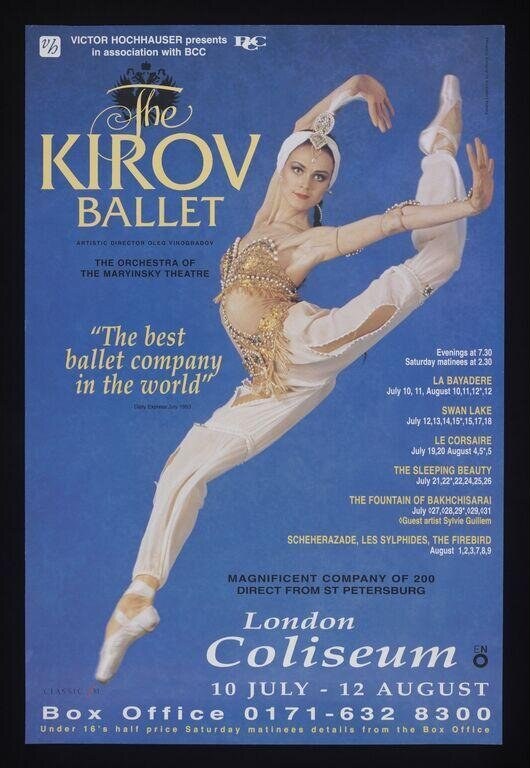
A theatrical poster advertising the Kirov Ballet's London season at the Coliseum, July–August (year not specified). The composition is dominated by a single female dancer in a classical ballet pose, shot against a rich deep blue background. She wears a golden costume with beaded ornamentation across the bodice and hips, and white tights and pointe shoes. Her body is extended in a dynamic arabesque or attitude devant, with her supporting leg straight and her working leg raised high behind or to the side, her torso inclined forward slightly, and her arms arranged in classical port de bras—one arm extended upward and forward, the other held in profile. The pose captures a moment of sustained balance and control. The dancer's blonde hair is arranged in a classical bun topped with a jewelled tiara or headdress. The poster lists five ballet titles in the season: La Bayadère, Swan Lake, Le Corsaire, The Sleeping Beauty, and The Fountain of the Peristyle, plus works by Petipa. Typography is formal and gold-foil lettering announces "The best ballet company in the world" as a critical quotation. The box office telephone number and matinée pricing information appear in smaller type at the base.
The dancing
A single ballerina occupies the frame in a classical fifth-position arabesque or attitude, her supporting leg fully extended and turned out, her working leg raised in a balletic line. Her upper body is held upright with classical port de bras—the arms are placed with precision in the manner taught in the Vaganova or Cecchetti academies, one arm lifted and forward, one arm extended or held in profile. Her weight appears fully committed to the supporting leg; there is no sense of strain or artificial positioning. The dancer's frame is elongated and the pose conveys the technical control and aesthetic refinement associated with Russian Imperial training.
The dance depicted
This is a poster for the Kirov Ballet, the state ballet company of the Soviet Union (now the Mariinsky Theatre), and it advertises a London season of classical Russian ballet. The five works listed—La Bayadère, Swan Lake, Le Corsaire, The Sleeping Beauty, and The Fountain of the Peristyle—are all hallmarks of the 19th-century Imperial Russian repertory, works choreographed by Marius Petipa and Lev Ivanov or staged in their tradition. The dancer's pose and costume are entirely consistent with classical romantic and classical Russian ballet as codified in the Vaganova method. The quotation "The best ballet company in the world" reflects the Kirov's international prestige during the Cold War era.
How it was made
This is a printed theatre poster, most likely a lithograph or offset lithograph, as indicated by the smooth colour gradations in the blue background and the crisp registration of the gold foil typography. The technique allowed for bold colour fields and the reproduction of photographic or airbrushed imagery alongside letterpress type, making it an economical and effective medium for mass distribution to London theatregoers. The poster's design is characteristic of mid-20th-century commercial theatre marketing in Britain—formal, legible at a distance, and weighted toward a single iconic image of the company's principal asset: the virtuosic female classical dancer.
About this work
This is a mid-20th-century commercial theatre poster advertising a season by the Kirov Ballet at the London Coliseum. It is a primary document of Cold War cultural diplomacy and the global circulation of Soviet state ballet companies in the post-1945 period. The poster presents classical ballet as spectacle and prestige, embodied in the figure of a single ballerina in perfect fifth-position arabesque. It belongs in a gallery of dance imagery because it shows how ballet was marketed to the public, how the form was understood and valued at a particular moment, and because the singular image of the classical ballerina became the dominant visual symbol of 'ballet' itself in the Western imagination of the twentieth century. The poster also documents the Kirov's repertory—a canon of nineteenth-century Russian Imperial works that defined what ballet meant after 1917.
How to look at it
The viewer should note the deliberate stillness and control in the dancer's pose—the extended line of the leg, the precision of the arm placement, the unflinching balance on one foot. This is not a moment of movement caught in passing, but a held, perfected position designed to embody the ideals of classical ballet technique: turnout, verticality, control, and beauty. The golden costume and tiara mark the dancer as a classical heroine from the Petipa era, and the deep blue background isolates her as an icon, not a character in a narrative. The poster uses the language of high fashion and luxury (gold foil, jewel tones, professional airbrushing) to market ballet as an elite experience.
The artist
The poster credits Anthony Crickmay as the designer. Crickmay (1919–2008) was a prolific British theatrical photographer and poster designer who worked extensively with dance companies in the mid-twentieth century, particularly the Kirov and other visiting ballet companies. He was known for glamorous, large-format colour photography and design. His work helped establish the visual aesthetic of ballet promotion in Britain during this period.
The period
The poster dates to a period when the Soviet Union actively exported its state ballet companies as instruments of Cold War soft power. The Kirov (renamed the Mariinsky in 1991) toured Western Europe and North America in the 1950s–1970s to demonstrate Soviet artistic achievement and the superiority of socialist culture. At the same time, the classical ballet vocabulary inherited from Imperial Russia—the Vaganova method, the Petipa repertory—had become the global standard for ballet training and performance, enshrined in academies from London to New York. The poster's quotation ("The best ballet company in the world") reflects the Kirov's standing as the guardian of this classical tradition.
Where it lives
This is a theatrical poster held in the Victoria & Albert Museum's collection of dance and theatre ephemera (source label: 'va'). The poster was issued by Victor Hochhauser, a London impresario and ballet promoter who arranged Soviet and Eastern European ballet tours to Britain. The Coliseum was one of London's largest theatres and a major venue for touring companies.
Dance in this work
Questions about this work
Why does the poster show only one dancer?
The single dancer serves as the visual anchor and selling point for the entire company. By the mid-twentieth century, the classical ballerina had become the iconic image of ballet itself, and Hochhauser's marketing strategy emphasized the virtuosity and glamour of the corps de ballet and soloists. The isolated figure also makes the poster work at a distance—legible and memorable as a graphic object.
What is the dancer wearing?
She wears a classical tutu-style costume in gold with beaded embroidery, typical of the classical Russian ballet repertory. The costume is not specific to any single role—it is a generic 'classical heroine' outfit that evokes the Imperial Russian tradition. Her pointe shoes and tights are white, and her headdress is a tiara, all conventions of 19th-century Petipa ballet.
What does 'Kirov' mean?
The Kirov Ballet was named after Sergei Kirov, a Soviet Communist leader, when the company (formerly the Imperial Ballet of St. Petersburg) was renamed in the 1930s. It is now known as the Mariinsky Ballet. The name reflected Soviet appropriation of the Imperial Russian cultural legacy as a trophy of the revolution.
When was this poster made?
The exact date is not recorded, but based on the typography, printing technique, and the reference to the Coliseum season, it was likely produced in the 1950s–1960s, when the Kirov made several tours to London during the Cold War.
More dance artwork





