Vaganova Method
Also known as: Russian Method, Vaganova system, Leningrad school, Russian school of classical ballet
History & Cultural Context
Agrippina Vaganova (1879-1951) danced at the Mariinsky under teachers from three competing traditions and spent her performing career being told her technique was inconsistent; she turned that frustration into a teaching problem. Appointed to the Leningrad Choreographic Technicum in 1921, she set out a graded eight-year curriculum in which every exercise has a stated purpose and nothing appears before the body can support it, publishing her account of it in 1934 as Fundamentals of the Classical Dance. Her successors, notably Vera Kostrovitskaya, extended the written syllabus after her death, and the school in Rossi Street was renamed for her in 1957. The method spread with Soviet cultural exchange from the 1950s onward and was adapted locally in Cuba, China, Eastern Europe and later across Western Europe and North America. It remains the dominant academic training in Russia and is widely taught elsewhere, though what is sold abroad as Vaganova training is often much looser than the Russian state syllabus.
Cultural Significance
The method was formalised inside a Soviet institution that had inherited the Imperial school and had to justify it to a new state, and it was defended on the grounds that classical technique was a national asset to be improved rather than a relic to be discarded. It served the nineteenth-century Petipa repertoire and then the Soviet dramatic ballets of the 1930s and after, which demanded stamina, large travelling steps and legible acting. From the 1950s the Soviet touring companies made this training the international image of ballet virtuosity, and state-funded academies exported it as cultural diplomacy.
Characteristic Movement & Technique
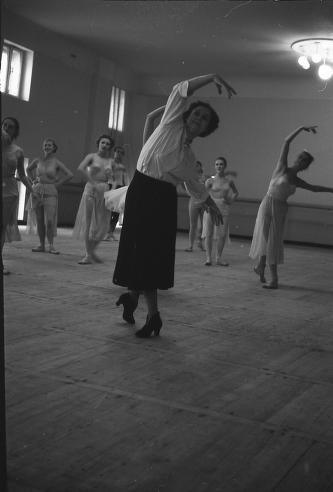
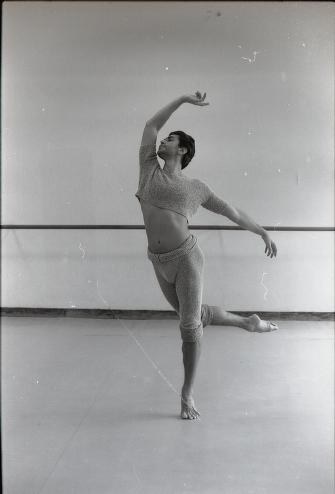
The back is treated as the origin of movement rather than a column to hold still, so the torso inclines, twists and yields into arabesque and into the preparation for a jump. Épaulement is strong and constant, arms move through defined positions with the elbow supported and the wrist unbroken, and the head follows a prescribed relationship to the working arm in each pose. Turnout is worked from the hip with the pelvis kept square, aplomb on the vertical axis is drilled before anything is added, and jumps are coordinated so that the arms and upper body carry the dancer up rather than being carried along.
Partnering Dynamics
Pas de deux is taught as a separate examined subject with its own syllabus, beginning in the middle years of training and progressing through supported turns, lifts and overhead work. Nikolai Serebrennikov's course at the Leningrad school became the standard text for it. The approach favours large lifts and sustained supported balances, and expects the woman to hold her own placement rather than be corrected by the man.
Competitive Context
Vaganova training has no examination board in the Western sense; assessment happens as annual state examinations inside the academy, with elimination at each year. Its graduates dominate the classical prizes at Varna, Moscow and the Prix de Lausanne, and the standard nineteenth-century competition variations are drilled in the school repertoire classes. The Vaganova Prize and the academy's own graduation performances function as the internal equivalent of a competition circuit.
Regional Variations
Moscow and St Petersburg are not the same: the Bolshoi academy works from a related syllabus with its own bravura emphasis, and Russians distinguish the two readily. Cuban training under Fernando and Alicia Alonso took the Vaganova frame and combined it with Italian and French elements into a recognisably separate school, and Chinese, Korean and Eastern European academies each adapted it. Much Western teaching labelled Vaganova is a partial borrowing of arm positions, arabesque numbering and terminology rather than the eight-year state syllabus.
Common Misconceptions
It is not simply the Imperial Russian tradition handed down unchanged; it is a twentieth-century synthesis that deliberately corrected what Vaganova considered failures in the teaching she received. The very high extensions and hyperextended lines now read as Russian are a later drift, not something her book asks for, and her own writing is insistent about restraint and correct placement. Her book is a manual for teachers explaining principles, not a fixed set of exercises to be copied.
Peak Popularity
Signature Figures
- Numbered arabesques one through four
- The back and shoulders as the source of movement
- Épaulement in every pose
- Coordinated arms in grand allegro
- An eight-year progressive syllabus
Notable Codifiers
- Agrippina Vaganova
- Vera Kostrovitskaya
- Nadezhda Bazarova
- Varvara Mey
- Nikolai Serebrennikov
Who governs Vaganova Method
Federations, councils and examining bodies with a recorded role in this style. No single organisation can tell you this — each one knows only itself.
Legends of Vaganova Method
Dancers, choreographers and teachers whose work shaped this style.
Vaganova Method in performance
3 staged works in the Limelight catalogue contain Vaganova Method, 1841–1877 — 1 of them in a named act or number.
- Giselle1841Ballet · Jean Coralli, Jules PerrotAct I · Pas de deux des jeunes paysans (Peasant pas de deux)
Act I, the Peasant pas de deux — A solo variation, originally made for Emma Bessone in 1887 and unused for decades, was reinstated into the Peasant pas de deux as part of the Kirov Ballet's Vaganova-era staging and has remained there since. Source: "Agrippi…
- Le Corsaire1856Ballet · Joseph Mazilier
Le Corsaire pas de deux, as staged in the Kirov Ballet's 1936 production — A specific 1931 choreographic revision of the pas de deux made for a graduation performance and later incorporated into full-length stagings, representing the codified Vaganova train…
- La Bayadère1877Ballet · Marius Petipa
Agrippina Vaganova's 1932 revival of Nikiya's variations for the Kirov Ballet — Vaganova rebuilt the ballerina's solos around triple pirouettes sur la pointe and fast piqué turns en dehors for her pupil Marina Semenova, revisions that outlasted the producti…
Every claim above is quoted from a cited source and names where in the work the style appears. Claims we could not place or could not quote are held back from this list and shown on the work’s own page instead. Browse the full performance catalogue →
Sources & Further Reading
Cultural & Historical Context
Vaganova Method emerged from Leningrad, Soviet Union during 1934—present day. Understanding the cultural roots, musical traditions, and social circumstances of this era enriches appreciation for the dance's characteristics and significance.
Formative Influences
Codifiers & Standardizers:
Agrippina Vaganova, Vera Kostrovitskaya, Nadezhda Bazarova, Varvara Mey, Nikolai Serebrennikov
Signature Movement Vocabulary:
Numbered arabesques one through four, The back and shoulders as the source of movement, Épaulement in every pose, Coordinated arms in grand allegro, An eight-year progressive syllabus
Primary Source Documents
The Library of Dance contains public-domain primary sources for dance history. Copyrighted modern syllabi are indexed with purchase links to their respective copyright owners. Search by dance name or codifier to discover primary source documents.
Last reviewed: September 2026 — This dance profile synthesizes historical research, cultural documentation, and contemporary practice knowledge to provide authoritative context.
More in Ballet
Ballet de Cour (Court Ballet)
The aristocratic court spectacle from which ballet grew, danced by nobles (including Louis XIV) and codified into the five positions and turnout under Beauchamp at the Académie Royale de Danse (1661).
Romantic Ballet
The early-19th-century era that introduced pointe work, the ethereal 'white ballet,' and the ballerina as central figure, exemplified by La Sylphide (1832) and Giselle (1841).
Classical Ballet
The full-evening story-ballet style perfected by Marius Petipa in Imperial Russia—Swan Lake, The Sleeping Beauty, The Nutcracker—that defines the core ballet repertory and codified virtuoso classical technique.
Neoclassical Ballet
The 20th-century style—pioneered by George Balanchine with Apollo (1928)—that retained classical technique while stripping narrative and scenery for speed, line, extension, and pure response to music.
Contemporary Ballet
The late-20th-century-onward fusion of classical ballet technique with modern and contemporary dance, associated with choreographers such as William Forsythe and Jiří Kylián.
Pre-Ballet & Creative Movement
The early-childhood foundation class that introduces rhythm, spatial awareness and basic ballet vocabulary through imaginative, imagery-led movement rather than formal syllabus work.
Cecchetti Method
A training method rather than a style of choreography, built on a fixed weekly cycle of set exercises so that the whole vocabulary is covered every six days and no muscle group is overworked. Enrico Cecchetti taught it to a generation that included Pavlova, Nijinsky and Karsavina; it was written down by his London pupils and admirers in the 1920s. Its concern is anatomical economy: strength built without strain, and the same effort available on the sixth day as on the first.
Royal Academy of Dance (RAD) Method
A graded teaching and examination syllabus rather than a technical school descended from one master, assembled in 1920 by teachers of five different national traditions who wanted a common standard for ballet teaching in Britain. Its structure is a ladder of examined levels, each with set exercises, taken by children and by vocational students. It is now the most widely examined ballet syllabus in the world.
Balanchine Method
A way of training dancers for a specific body of choreography, developed by George Balanchine at the School of American Ballet from 1934 and refined over five decades to serve New York City Ballet. It prizes speed, clarity at high tempo, extreme range of movement and a willingness to go off the vertical and recover. Unlike the older European schools it was never written into a syllabus by its founder, and is transmitted by teachers who danced for him.
Bournonville Method
The training developed by August Bournonville for the Royal Danish Ballet, built to serve his own ballets and preserved in Copenhagen long after the French style it descends from had disappeared in Paris. It trains a jump that appears to cost nothing, intricate beaten footwork, and an upper body that stays modest while the legs do difficult things. It is the closest surviving link to early nineteenth-century French classroom practice.
Vaganova Method in art
Browse the gallery →Works our catalogue identifies as depicting vaganova method.
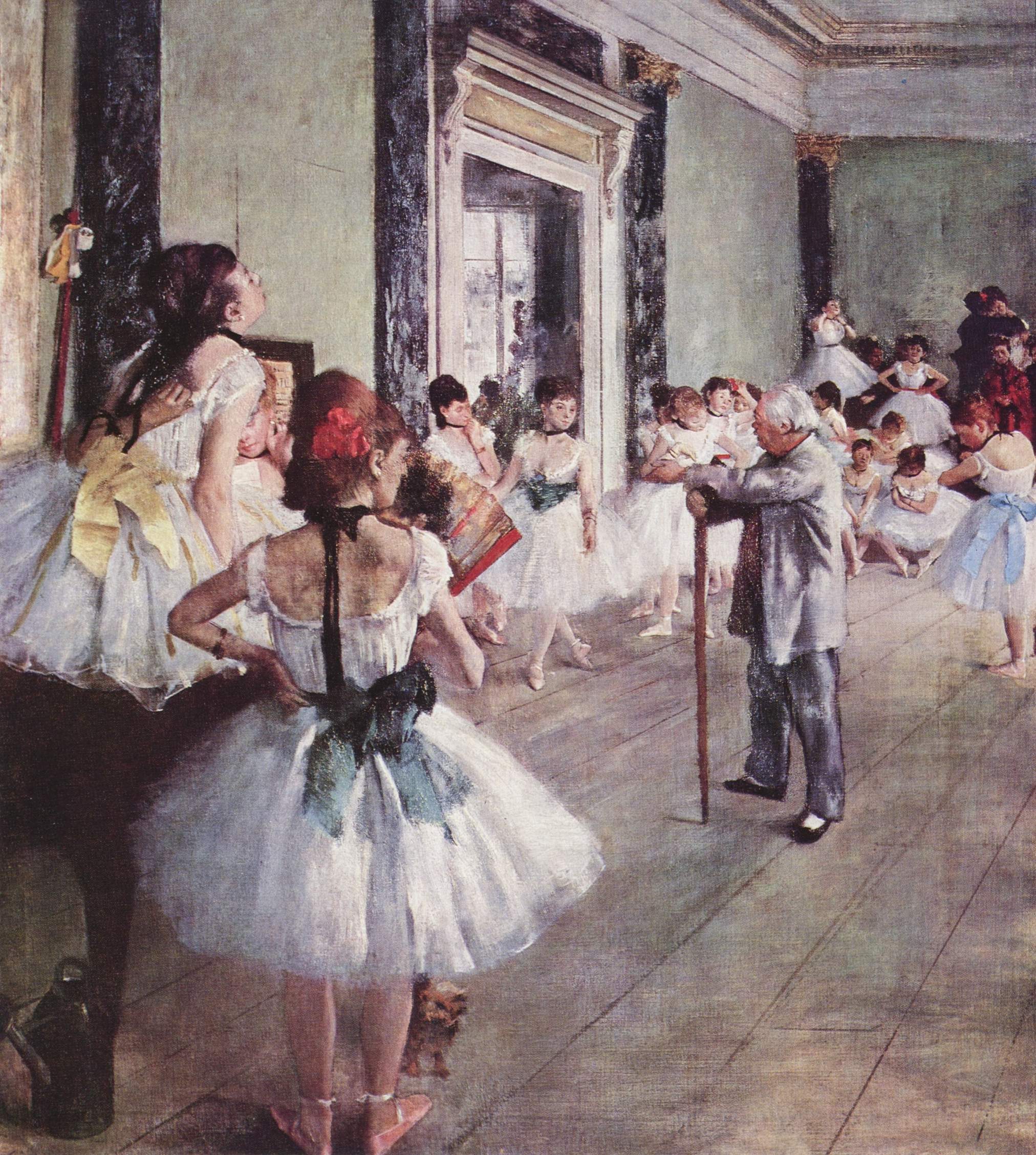
Edgar Germain Hilaire Degas 021
Edgar Degas · 1875
Public Domain
Continue Exploring
Lineage of Dance
500 years of dance evolution
Champions of Dance
Winners of marquee national & world titles
Language of Dance
161 dance terms & translations
Listening of Dance
Tempo, timing & musicality tools
Gallery of Dance
5,700+ artworks from museum collections
Attire of Dance
Evolution of dance dress across eras
Keep the thread going
Dance history, technique, and the occasional rabbit hole — in your inbox. Thoughtful, infrequent, unsubscribe anytime.
Free. No spam. One click to leave.