49 works in this view — arrow keys or swipe to move between them.
Dance in Art
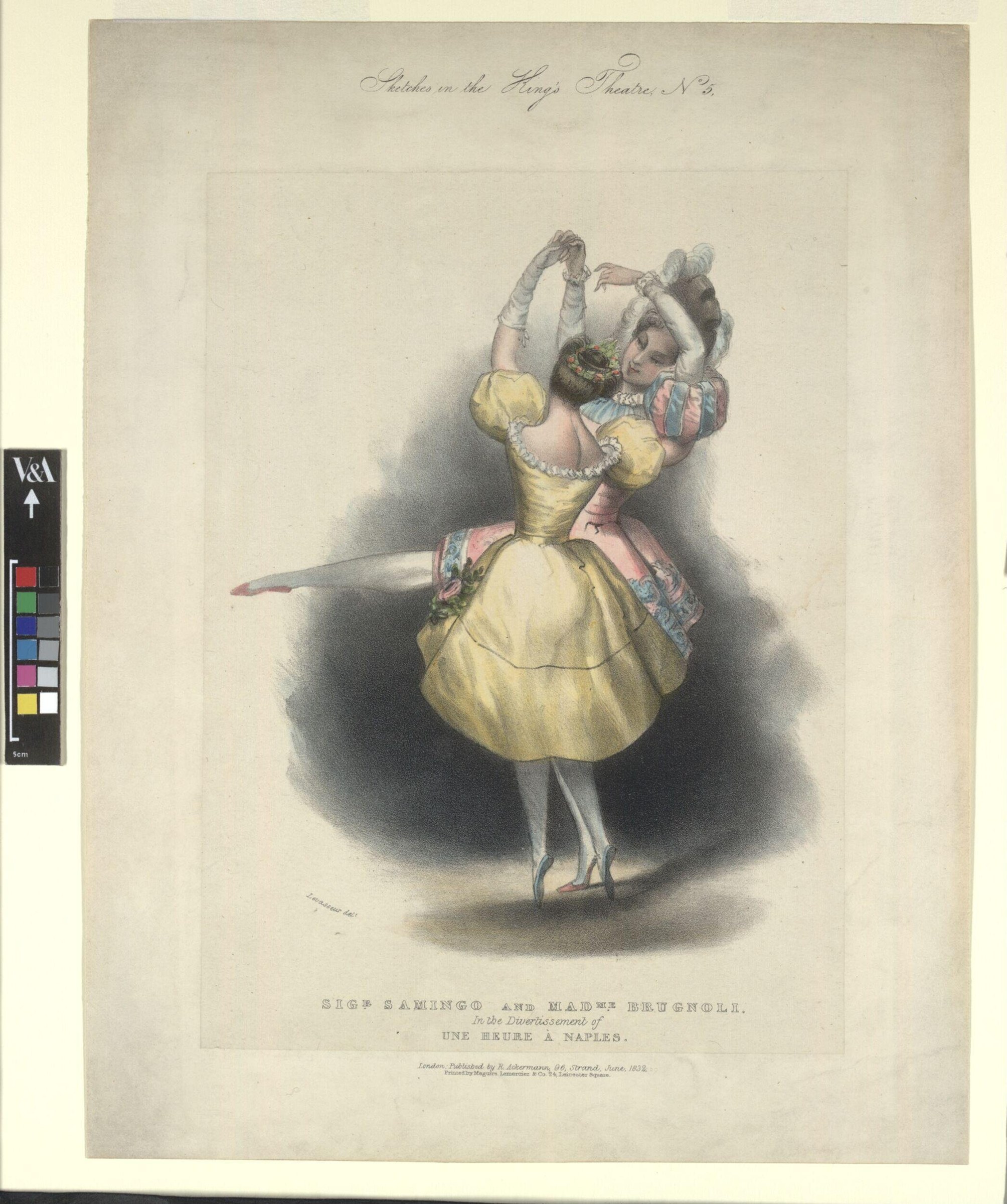
'Paolo Samengo and Amalia Brugnoli in Une Heure à Naples (Sketches in the King's Theatre, No. 5)'
Levasseur
- Collection:
- Source:
- Victoria and Albert Museum
- Rights:
- Rights vary by item — check the source record before reusing this image. Source record ↗
- Recorded as:
- V&A — check rights per item
This is a historical record of how a virtuoso dancer moved and was seen. Brugnoli was a major figure in the introduction of the Italian technical school to London audiences in the 1820s–30s, and this print preserves the exact moment—the body position, the dress, the theatrical lighting effect—that the audience paid to witness. For historians of Romantic ballet, it is evidence of turnout, port de bras, and the scale of skirts actually worn in performance; for dance history more broadly, it shows how ballet was sold to audiences as a visual and technical spectacle.
What you are looking at
A single female dancer in a pale yellow dress dominates the composition, frozen mid-arabesque or high développé against a neutral ground with subtle shadow work suggesting stage lighting. She wears a fitted bodice with short puffed sleeves trimmed in gold, a deep pink silk sash at the waist, and a full skirt that balloons dramatically from the hips—the skirt's volume and construction are the image's most striking feature, suggesting the considerable technical skill required to move in such weight of fabric. Her arms are raised above her head in a graceful port de bras, with her gloved hands holding a decorative object (possibly a fan or small prop). The dancer's back leg is extended high and straight, her body arched in the characteristic elongation of Romantic-era technique. The colour work is delicate: the contrast between the pale yellow dress, the blush-toned skin, and the carefully rendered grey shadow creates volume and three-dimensionality. This is a portrait of a virtuoso moment—the suspended, weightless instant the Romantic ballet valued.
The dancing
A single female dancer in the classical turned-out position, with one leg extended high behind her in arabesque or à la seconde. Her arms frame her head in fifth position en haut, or slightly forward in an open port de bras suggesting movement through space. Her torso is held upright with the proud carriage characteristic of ballet training of the 1820s–30s; her weight is carried over the supporting leg with control. The extended line from her supporting foot through her raised leg to her fingertips reads as effortless elevation—exactly what the Romantic vocabulary demanded. Her posture and the geometry of her limbs show understanding of academic ballet technique.
The dance depicted
This is a souvenir or 'sketch' from *Une Heure à Naples*, a ballet-pantomime staged at the King's Theatre (Her Majesty's Theatre, Haymarket, London). The work belonged to the Romantic ballet repertory: a light, narrative piece built on a popular scenic subject (the streets and pleasures of Naples) rather than mythological or courtly material. Amalia Brugnoli was a celebrated Italian dancer specialising in virtuosic technique and the brilliant, rapid footwork that the 1820s–30s audience craved; Paolo Samengo was a principal dancer and choreographer. This image captures Brugnoli in a moment of pure classical poise—a held arabesque or développé that showcases the line, turnout, and balletic grammar she was known for. The work is typical of theatre prints: a record of a celebrated performer in a celebrated role, sold as a keepsake to the audience who had watched the live performance.
How it was made
This is a hand-coloured engraving or aquatint; the soft tonal modelling in the shadow under the dancer and the careful stippled highlights in the fabric suggest aquatint or soft-ground work, while the fine detail in the dress and facial features indicates engraving. The colour is applied by hand in transparent washes—yellow for the dress, pink for the sash, grey for shadow—in the manner standard for London theatre prints of the 1830s. The technique allowed for rapid reproduction and hand-finishing, making the print affordable and collectible for theatre-goers. The signature or publishing mark at lower left (partially visible) would identify the engraver and/or publisher; London publishing houses such as those of Rudolph Ackermann dominated the market for coloured dance prints. This medium was the primary way most people encountered dancers they had seen on stage.
About this work
This is a coloured engraving commemorating a moment from the 1832 King's Theatre production of *Une Heure à Naples*, showing the Italian dancer Amalia Brugnoli in an arabesque. It is both a technical document—a record of how a celebrated dancer of the Romantic era held her body—and a commercial product, printed and hand-coloured for sale to theatre audiences. Brugnoli was known for brilliant technique and the rapid, precise footwork of the Italian virtuosic school; this print captures her in a moment of serene elevation, held perfectly in the turned-out, lengthened line that defined Romantic ballet aesthetics. The image sits at the intersection of theatre history, print culture, and the codification of ballet technique in the early 19th century.
How to look at it
Notice the geometry of the pose: the perfect turnout of both feet, the extended line of the raised leg, the lifted ribcage, the control visible in the gloved arm position. The artist has chosen to freeze a moment of maximum extension and balance—not a travelling step or a leap, but a held position that reads as effortless and serene. The pale yellow dress, rendered with careful tonal gradation, is the visual engine of the image: its volume and the contrast between the fitted bodice and the billowing skirt emphasise the upward reach of the dancer's body and make the arabesque read as an ascent. The grey shadow under the dancer's supporting foot grounds her while suggesting the theatrical lighting that would illuminate the stage. This is a portrait of technique, not personality: Brugnoli's face is present but incidental; what matters is the body's geometry and control.
The artist
Levasseur was a London-based engraver specialising in theatre prints in the 1820s–30s. The name appears frequently on hand-coloured engravings of ballet dancers and opera singers, particularly prints commemorating performances at the King's Theatre and Theatre Royal Drury Lane. Levasseur worked in the commercial print trade serving theatre audiences; such prints were issued quickly after a performance was staged and advertised in playbills and theatrical newspapers. The artist's practice was one of rapid, high-volume production for a mass market, but the technical quality and care taken with the rendering of fabric, light, and dancer anatomy suggest professional training in figure engraving.
The period
The 1830s saw the height of Romantic ballet in London: a moment when Italian virtuosi (Brugnoli, Maria Taglioni after 1832, Fanny Elssler) challenged the dominance of French technique and the court-derived classical vocabulary. Brugnoli arrived in London in 1824 and became famous for speed, precision, and an athletic directness that contrasted with the weightless, ethereal quality French dancers cultivated. She was associated with bravura ballets that featured spectacular choreography—rapid turns, brilliant footwork, and the kind of sustained arabesque shown here. At the same time, hand-coloured theatre prints were at the height of their commercial success: lithography was still new and expensive, and engravings remained the dominant medium for recording stage performance for consumption by the theatre-going public. This print belongs to a vast genre of Romantic-era dance souvenirs.
Where it lives
The V&A Museum holds this print in its Theatre Collection, where it belongs to the holdings of 19th-century theatre prints, many of them documentary records of famous dancers and celebrated performances. Such prints were issued as commercial products and circulated widely among theatre audiences; the holding institution's copy is one of likely dozens or hundreds printed and hand-coloured.
Dance in this work
Questions about this work
Who was Amalia Brugnoli?
Brugnoli (1807–1850) was an Italian prima ballerina celebrated for virtuosic technique, rapid footwork, and the precise, athletic style of the Italian school. She danced in London, Paris, and Milan and was a major influence on 1820s–30s Romantic ballet. She was known for bravura choreography and the brilliant execution of difficult technical passages, quite different from the ethereal weightlessness French dancers cultivated. She retired to become a teacher and choreographer.
What is an arabesque?
An arabesque is a foundational position in ballet in which the dancer stands on one leg with the other leg extended behind the body, turned out at the hip. The torso remains upright and long; the raised leg is held at or above hip height in a straight line with the supporting leg. It is one of the classical positions used to display turnout, control, and the lines that ballet technique cultivates.
Why was *Une Heure à Naples* performed?
The ballet was a light, scenic comedy belonging to the genre of ballet d'action or ballet pantomime. Popular Romantic ballets were set in exotic or picturesque locations (Naples, Spain, the Scottish Highlands) and told simple stories through a mixture of dancing and mime. *Une Heure à Naples* (One Hour in Naples) celebrated Neapolitan street life, music, and dancing; it gave dancers opportunities for both classical ballet and character or folk-inspired choreography. Such works were entertaining, visually spectacular, and featured celebrated dancers in roles that suited their technical strengths.
What are theatre prints for?
Theatre prints were commercial products issued during the run of a successful play or ballet. They served as keepsakes for audience members who wanted to remember the performance or take home an image of a celebrated performer. Prints were sold in the theatre lobby, advertised in playbills, and sometimes distributed to critics and patrons. They were also collected and displayed at home, and became a visual record of theatrical fashion, scenery, and the bodies of famous dancers.
More dance artwork





