49 works in this view — arrow keys or swipe to move between them.
Dance in Art
Illustration
Avery, Claire
- Collection:
- Illustration
- Source:
- Victoria and Albert Museum
- Rights:
- Rights vary by item — check the source record before reusing this image. Source record ↗
- Recorded as:
- V&A — check rights per item
This is a rare example of ballet imagery circulating through the mass-produced greeting card market, where it reached audiences far beyond concert halls or theaters. It shows how ballet's classical vocabulary became a visual shorthand for elegance and grace in popular commercial art.
What you are looking at
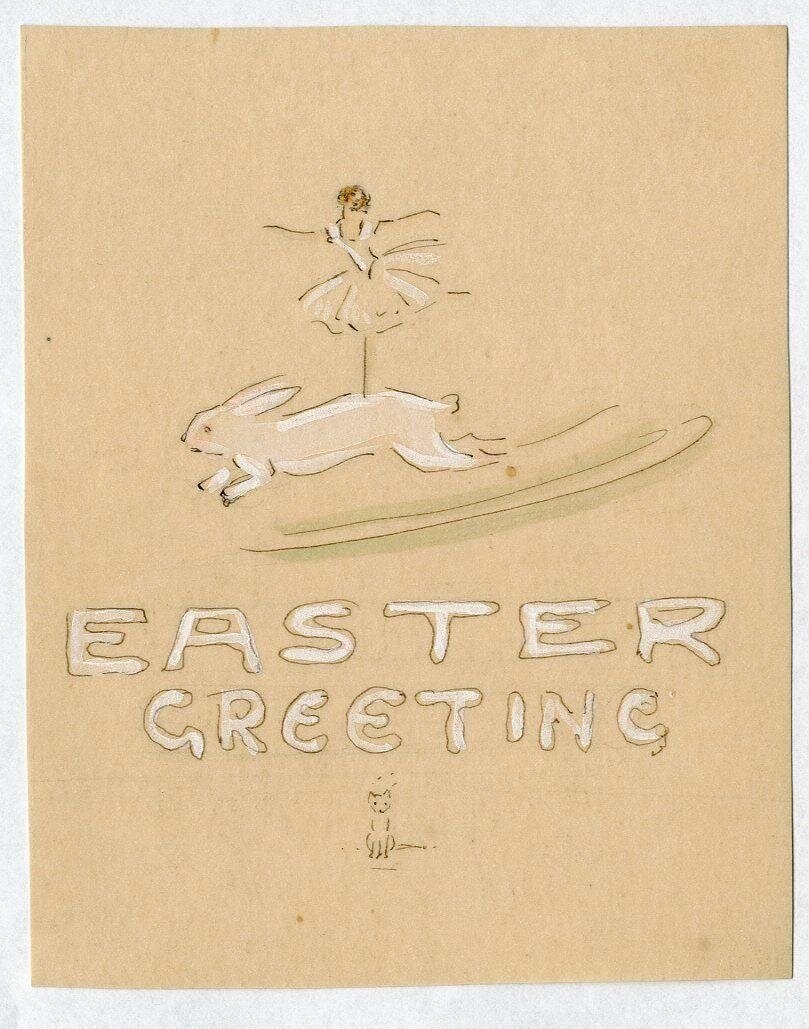
A delicate pen-and-ink illustration on aged paper shows a young female dancer en pointe at the apex of the composition, her body nearly vertical with arms extended outward in a classical ballet pose. Below her, a white rabbit leaps or runs to the left, and beneath the rabbit a curved line suggests ground or a stage edge. The entire composition is spare and economical—no scenery, no other figures, no indication of music or setting. The text 'EASTER GREETING' appears below in outlined letters, with a small cat face sketched at the bottom. The drawing style is quick and assured, with light pen strokes defining the figures; the ballet dancer's tutu is suggested by radiating lines rather than solid shading, and the rabbit is rendered in simple profile with minimal anatomical detail.
The dancing
The dancer stands in a vertical line with feet together in relevé or en pointe, arms extended at shoulder height in a classical port de bras—neither overhead nor lowered. The pose is weightless and elongated, suggesting an impossible balance or a moment caught mid-movement. The rabbit, by contrast, is horizontal and dynamic, its body stretched in a running leap. The two figures occupy the same compositional space without obvious scale relationship, suggesting symbolic rather than naturalistic arrangement.
The dance depicted
This is ballet, almost certainly Romantic or early twentieth-century theatrical ballet in the classical idiom. The dancer's silhouette—tutu, en pointe work, raised arms—is unambiguous. The Easter context and the pairing with the leaping rabbit suggests this is a decorative greeting card rather than a study from a specific ballet, but the movement quality is genuine: the dancer's pose has the lifted, ethereal quality of Romantic ballet vocabulary. The work may reference Romantic themes of lightness and transcendence, or it may be an invention for the card's occasion.
How it was made
This appears to be pen and ink or brown ink on laid paper, likely drawn by hand rather than reproduced mechanically. The line is confident but economical; shading is minimal and achieved through line work (as in the tutu) rather than wash or tone. The paper has aged to a warm buff or cream color. The technique suggests the work was made for reproduction—as a greeting card design or illustration for print—rather than as a finished artwork for display.
About this work
This is a pen-and-ink Easter greeting card illustration centered on a ballet dancer in classical pose. The image pairs balletic elegance with playful Easter symbolism (the rabbit), using the economy of line and the clarity of the dancer's silhouette to create a composition that is both sophisticated and whimsical. The work belongs to a tradition of commercial illustration in the early twentieth century in which dance—particularly classical ballet—carried associations of grace, femininity, and the ethereal that made it a natural choice for decorative greeting cards.
How to look at it
The viewer should attend to the vertical grace of the dancer's pose—the way the artist has used a single, nearly straight line to suggest both the body's elongation and its weightlessness. The contrast between the dancer's stillness (or suspended balance) and the rabbit's dynamic leap is the key to the composition: one suggests the ethereal and controlled, the other the natural and playful. The outlining of the text 'EASTER GREETING' in the same linear vocabulary unifies text and image.
The artist
The catalogue identifies the artist as Claire Avery, but no further biographical information is provided. The quality of the line work and the sophistication of the composition suggest a practiced hand, likely a professional illustrator or commercial artist working in the early twentieth century. Without additional research, the scope of Avery's practice cannot be established.
The period
The early twentieth century saw an explosion of illustrated greeting cards as a commercial medium, particularly for holidays and seasonal occasions. Ballet was experiencing a renaissance in artistic and popular culture during this period, especially after the 1909 Paris debut of Diaghilev's Ballets Russes; classical ballet imagery became fashionable in decorative arts and commercial design. The spare, linear style of this illustration is consistent with Art Nouveau and Art Deco aesthetics of the era, which favored simplified form and elegant line.
Where it lives
The work is held in a collection identified in the record as 'Illustration' with source noted as 'va.' The designation suggests it may be part of a larger collection of commercial or decorative illustrations, though the holding institution is not specified in the available record.
Dance in this work
Questions about this work
Is this from a specific ballet?
Almost certainly not. The composition and the pairing with the Easter rabbit suggest this is an original design for a greeting card rather than an illustration of a scene from a known ballet. However, the classical ballet vocabulary is precise and genuine, so the artist was familiar with ballet idiom.
What was ballet imagery used for in the early twentieth century?
Ballet was a subject of intense cultural fascination in the decades after 1909, and its elegant vocabulary—en pointe work, tutus, lifted arms—became shorthand for grace, femininity, and refinement in advertising, decoration, and commercial art. Images of ballet dancers appeared on greeting cards, in magazines, on costume patterns, and in product design.
Why pair a ballet dancer with an Easter rabbit?
Both carry associations of lightness, beauty, and renewal. The juxtaposition creates a playful conversation between human elegance (the dancer) and natural vitality (the rabbit), appropriate to Easter's themes of spring and resurrection. The composition suggests a kinship rather than a narrative relationship.
More dance artwork





