49 works in this view — arrow keys or swipe to move between them.
Dance in Art
The Snow Queen
Brotherston, Lez
- Collection:
- Costume design
- Source:
- Victoria and Albert Museum
- Rights:
- Rights vary by item — check the source record before reusing this image. Source record ↗
- Recorded as:
- V&A — check rights per item
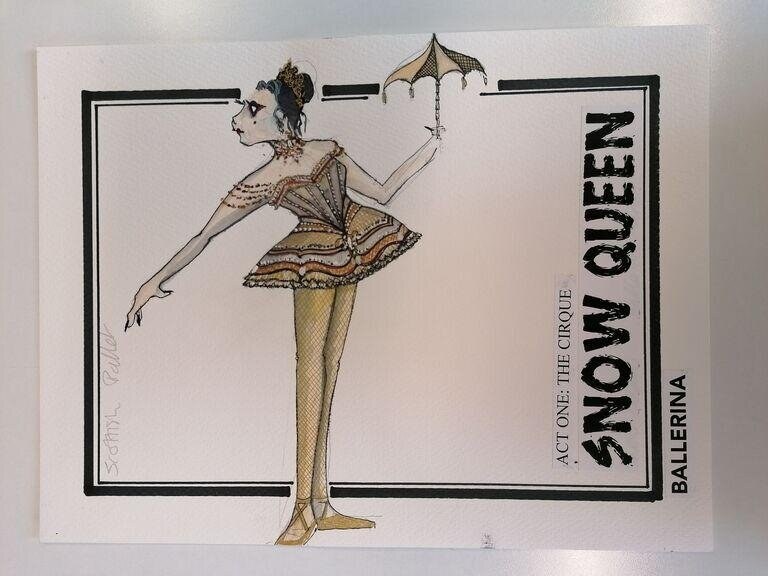
Costume design is often invisible in the critical discussion of ballet, but it is inseparable from how a dancer moves and how an audience reads the narrative. This drawing shows a designer thinking through the practical and theatrical problems simultaneously: How does the tutu move when the dancer extends? How does the parasol signal character and mood? What colors and ornament will read from the audience? Seeing the design drawing—the designer's thinking made visible—reveals ballet as a collaborative art form that integrates costume, music, choreography, and the dancer's body into a unified theatrical whole.
What you are looking at
A slender figure in profile stands alone against a plain ground, turned sharply to the left. The dancer wears a short, tiered tutu in warm gold tones with patterned detailing, the skirt's layered structure catching light in a way that emphasizes its geometry. The costume includes a fitted bodice with ornate beading or embroidery. Most strikingly, the dancer holds aloft a delicate parasol with a patterned canopy, angling it elegantly overhead—an unusual and whimsical prop that transforms the pose from pure dance into theatrical narrative. The figure's posture is elongated and balletic: one leg appears to support the body while the other extends subtly, the arms are raised with graceful extension, and the head is held in classical alignment. The drawing is rendered in a linear, illustrative style with careful attention to the costume's decorative elements, against a simple framing border in black. This is a costume design rendered with the precision and elegance expected of professional theatre documentation.
The dancing
The single figure is presented in a three-quarter profile view, weight supported on what appears to be a strongly pointed foot. The raised arm and extended line of the body suggest balletic training and alignment—the torso is long and lifted, creating the vertical emphasis characteristic of classical ballet technique. The parasol is held at an angle, requiring control and spatial awareness. The figure's proportions are characteristically balletic: elongated legs, a small head, and an emphasis on the line from hip through extended arm. There is a delicate, almost gossamer quality to the pose, suggesting a dancer who must move with control and poise while managing the costume's volume and the parasol's position.
The dance depicted
This is costume design for a classical ballet role. The title *The Snow Queen* points toward narrative ballet, most likely relating to Hans Christian Andersen's tale, which has inspired multiple ballet adaptations. The tutu, pointe-work suggestion, and balletic port de bras are unambiguous markers of theatrical ballet, probably from the Romantic or classical era of ballet tradition (though the design itself appears to be from 2019). The parasol is a storytelling element: it locates the character not in an abstract ballet realm but in a theatrical narrative space. The figure's pose suggests a moment of arrival or discovery rather than virtuosic display, consistent with character-driven narrative ballet rather than pure classical technique.
How it was made
This is a costume design drawing, executed with pen or fine ink line and watercolor or gouache in gold, ochre, and neutral tones. The clarity and precision of the rendering—the careful delineation of the tutu's tiers, the decorative pattern-work on the bodice, the parasol's delicate canopy structure—indicate that this is a professional design document meant for construction purposes. The illustrative style and the bordered frame suggest this belongs to a series of costume designs, likely created by the designer in dialogue with a choreographer. The technique allows the designer to show both the overall silhouette and important decorative details, essential for a costume maker to execute the design accurately.
About this work
This is a costume design for a classical ballet character—a role in a production of *The Snow Queen*. It documents both the balletic line the costume must support and the theatrical narrative the character inhabits. The parasol is a crucial element, anchoring this figure to a specific character and moment in a story rather than to the abstract world of pure dance. The designer has rendered the figure with understanding of how fabric and structure support a dancer's movement while advancing the theatrical narrative. This is a working drawing in a tradition of ballet costume design documentation that stretches back to the nineteenth century, and it belongs here because it shows how design and dance technique must collaborate: the costume must allow the dancer to move in the balletic vocabulary while supporting the character and story the ballet tells.
How to look at it
Attend to the line of the body first: notice how the tutu is shaped to extend the leg's line, how the bodice lifts the torso, how the arm reaches upward in a way that is both naturalistic (holding the parasol) and balletic (maintaining the classical port de bras). The parasol is not ornamental—it is structural to the pose and the character. Notice also the costume's ornament: the patterning on the bodice and the tiered detailing of the tutu are rendered precisely because they are essential to how the costume will be made and how it will look on stage under lights. The designer's careful delineation of these details is the designer's way of communicating with the costume maker, the dancer, and ultimately the audience.
The artist
Lez Brotherston is a renowned British theatre designer and artist known for work across ballet, opera, and contemporary theatre. His approach to costume and scenic design is marked by a commitment to historical research, technical precision, and visual poetry. He has designed for major ballet companies and has a particular interest in narrative ballet and the Romantic repertory. His costume designs are characterized by close attention to the interplay between the dancer's body, the fabric's movement, and the overall composition of the stage picture.
The period
Classical ballet costume design in the twenty-first century draws on centuries of accumulated tradition while responding to contemporary choreographic practice. The tutu and pointe-work vocabulary are stable elements of classical ballet, inherited from the nineteenth century. However, contemporary designers often revisit and reimagine classical stories—as in new stagings of *The Snow Queen*—and create new visual languages while preserving the balletic line. In 2019, when this design was created, ballet was actively engaged with questions of narrative, character psychology, and the relationship between historical tradition and contemporary sensibility. The parasol as a narrative prop suggests a designer interested in the specificity of character and the way objects can carry meaning on stage.
Where it lives
This design drawing is held in the Victoria and Albert Museum's Theatre Collection, a comprehensive archive of theatre design documentation spanning centuries and theatrical traditions. The collection preserves design drawings, models, photographs, and related materials that document how theatrical visions are realized on stage.
Dance in this work
Questions about this work
Is this a drawing of an actual dancer or an idealized figure?
This is a costume design drawing, not a portrait of a specific dancer. It presents an idealized balletic figure—the body proportions are stylized to show the line the costume will create—but it is drawn with precision so that a costume maker can understand the garment's structure and construction. The figure embodies how the designer imagines the costume will look on a dancer's body in motion.
Why is the parasol important?
The parasol anchors this figure to a narrative and a character. In a story-ballet like *The Snow Queen*, objects carry meaning: they establish setting, mood, and character identity. The parasol suggests outdoors, elegance, a specific moment in the story—perhaps arrival, contemplation, or vulnerability. It is both a practical prop and a storytelling tool.
How does costume design relate to choreography in ballet?
The costume must allow the dancer to move in the ballet vocabulary while also expressing character and advancing the story. A tutu's weight, volume, and structure affect how the dancer moves; the designer must understand balletic technique in order to create a costume that supports rather than hinders movement. The design is a collaboration between designer, choreographer, dancer, and costume maker.
What tradition of ballet design does this represent?
This design draws on the classical ballet tradition that developed in the nineteenth century, particularly the Romantic era and the classical period (Petipa and beyond). The tutu, pointe shoes, and the narrative use of costume are all part of that tradition. A contemporary designer like Brotherston works within this tradition while also bringing contemporary sensibility and visual language to classical stories.
More dance artwork





