49 works in this view — arrow keys or swipe to move between them.
Dance in Art
Petrushka
Valentine Gross
- Collection:
- Drawing
- Source:
- Victoria and Albert Museum
- Rights:
- Rights vary by item — check the source record before reusing this image. Source record ↗
- Recorded as:
- V&A — check rights per item
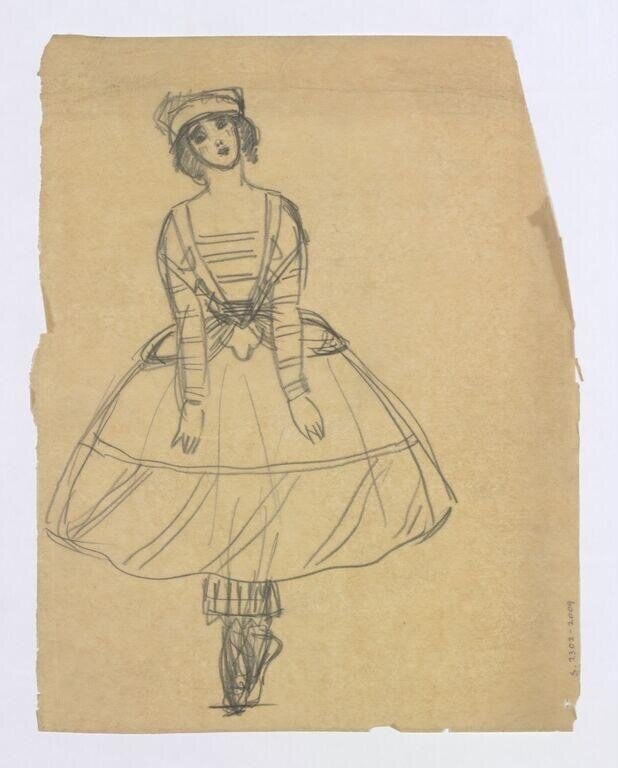
Gross's sketches of the Ballets Russes are primary documents of early 20th-century dance, made by an eyewitness who understood both theatrical design and movement. This drawing shows us exactly what Fokine's fairground scenes looked like—not idealized, but observed—and how costume and character were inseparable from the choreography itself.
What you are looking at
A single figure dominates this sketch: a young woman in early 20th-century dress, drawn in quick, confident pencil strokes. She wears a structured jacket with horizontal striping across the torso and a voluminous skirt that billows outward in bold, angular lines suggesting movement or the weight of heavy fabric. A small, tilted hat sits atop her head. Her pose is arrested mid-gesture—one arm hangs at her side while the other is positioned across her body, and her gaze is directed upward and to the side, creating a sense of theatrical attention. The artist has rendered her legs and feet with particular emphasis, including detailed cross-hatching that anchors the figure to the page. The drawing is loose and gestural, capturing a moment of performance or character rather than anatomical precision. The paper is aged, slightly creased, and the overall effect suggests this is a quick study made during or shortly after witnessing a theatrical performance.
The dancing
The single dancer is shown in a contrapposto stance with her weight shifted, one leg supporting while the other is slightly extended. Her upper body twists slightly, with her arms held away from her torso in a pose suggesting either a pause in movement or a held theatrical attitude. The upward tilt of her head and the specificity of her gaze suggest she is performing character or emotion rather than executing a technical step. Her posture is neither balletic nor strictly classical—the weight sits more naturally through her body than in a lifted épaulement, and the dress accommodates a broader range of movement than a classical tutu.
The dance depicted
This is a costume study for *Petrushka*, the 1911 Igor Stravinsky ballet with choreography by Michel Fokine, premiered by the Ballets Russes. The figure appears to be a character dancer or secondary role—likely one of the fairground performers or vendors in the Shrovetide Fair scene that frames the ballet. The dress is consistent with Fokine's aesthetic: realistic enough to place the character in the Russian setting, yet stylized and animated to convey theatrical character. The pose captures the kind of held, observant stillness that often precedes or follows Fokine's naturalistic but expressive gestures.
How it was made
This is a graphite pencil drawing on aged paper, executed with speed and confidence. The artist worked primarily in line, with areas of cross-hatching used for emphasis and shadow, particularly in the rendering of the lower legs and skirt. The technique allows for rapid capture of pose and silhouette, and the loose handling suggests this was made as a working document for costume or staging rather than as a finished artwork. The lack of color or detail in areas like the face reinforces its function as a practical theatrical study, probably made in a theater or rehearsal space.
About this work
This pencil sketch documents a moment in the creation of *Petrushka*, the 1911 Ballets Russes sensation that transformed how Western Europe experienced Russian dance and design. Valentine Gross was among the most significant visual chroniclers of the Ballets Russes, and her drawings preserve both the appearance and the energy of Fokine's revolutionary choreography. This particular sketch captures not a dance step but a character—a figure in the crowded fairground world of the ballet, frozen in a moment of theatrical presence. The work belongs in a dance history because it shows us how choreography was imagined and communicated before film, and because it demonstrates the central role of visual artists in shaping how dance was understood by the public.
How to look at it
Look at the pose: the figure is not in a classical ballet position, nor is she frozen in a purely realistic stance. Instead, she occupies a space between—theatrical enough to be expressive, natural enough to be believable. The artist has caught her at a moment of observation or anticipation, her gaze directed upward and away. Notice how the skirt is rendered: not as the ethereal tulle of a classical tutu, but as weighted fabric that moves and settles differently. The cross-hatching in the lower half of the figure gives it substance and ground. This is how Fokine's revolution looked: characters with bodies that inhabited real space, rather than ethereal beings floating in an abstract world.
The artist
Valentine Gross (1880–1953) was a French painter, illustrator, and designer who became one of the official visual chroniclers of the Ballets Russes from its inception in 1909. She attended rehearsals and performances, sketching dancers and choreographers, and her work was instrumental in circulating images of Fokine's revolutionary company beyond those who could see the performances in person. She later married the painter Jean Cocteau and collaborated with him on theatrical designs. Her sketches combine the fluid line of a trained draftsperson with the immediacy of documentary observation, making her one of the most reliable visual sources for understanding early modern dance.
The period
In 1911, when this sketch was made, the Ballets Russes had already transformed European dance and visual culture. Fokine had begun dismantling the rigid hierarchy and aesthetics of 19th-century imperial ballet, creating roles for men as central characters and choreography that drew on character, pantomime, and national idiom rather than pure technique. *Petrushka*, with music by Stravinsky and designs by Alexandre Benois, premiered in June 1911 and was among the company's greatest successes. The fairground setting allowed Fokine to choreograph a diverse ensemble of character roles—vendors, soldiers, showmen—that demanded a different kind of theatrical presence than the abstract corps de ballet of classical ballet. Gross's sketches, made in this moment of radical reinvention, capture how modernism in dance was inseparable from modernism in design and visual representation.
Where it lives
The drawing is held in a collection marked as "va" in the source record, suggesting it may derive from the Valentine Gross archive or a related collection. It is catalogued as a drawing, consistent with its medium. The aging and creasing of the paper, and the marks visible at the edges, suggest this is an original working document rather than a later reproduction.
Dance in this work
Questions about this work
What is Petrushka?
*Petrushka* is a 1911 ballet with music by Igor Stravinsky, choreography by Michel Fokine, and designs by Alexandre Benois. It was premiered by the Ballets Russes and tells the story of a puppet who comes to life during a Shrovetide Fair in St. Petersburg. The ballet is considered one of Fokine's masterpieces and a watershed moment in modern dance, because it treated character dancers and ensemble roles as seriously as it treated principal roles, and because Fokine's choreography drew on Russian popular culture and pantomime rather than pure classical technique.
Who was Valentine Gross?
Valentine Gross (1880–1953) was a French painter and illustrator who became the principal visual documenter of the Ballets Russes. She attended rehearsals and performances from the company's founding in 1909 and made hundreds of sketches and paintings of dancers and choreography. Her work circulated widely and was instrumental in shaping how European audiences understood the company's visual and choreographic innovations. She later worked as a costume and set designer in her own right.
Why is this sketch important?
This sketch is a primary historical document of how Fokine's choreography was visualized and communicated. It shows us what a character dancer in *Petrushka* looked like in performance, in real time, as observed by an eyewitness. Before film documentation of dance, drawings like this were crucial ways that choreography was preserved and understood. The sketch also reveals how inseparable costume, character, and movement were in Fokine's aesthetic.
What was Fokine trying to do?
Michel Fokine was a choreographer who rejected what he saw as the artificiality and rigidity of late 19th-century academic ballet. He believed choreography should be expressive and dramatically motivated, should involve the whole body (including arms and face), should treat all dancers as individuals rather than interchangeable corps members, and should draw on the music and themes of each work rather than following a standardized vocabulary. *Petrushka* exemplifies this: the fairground setting gave him license to create a diverse ensemble of character roles, and the choreography emphasized pantomime, naturalistic gesture, and dramatic narrative.
More dance artwork





