49 works in this view — arrow keys or swipe to move between them.
Dance in Art
Raymonda
unknown
- Collection:
- Photograph
- Source:
- Victoria and Albert Museum
- Rights:
- Rights vary by item — check the source record before reusing this image. Source record ↗
- Recorded as:
- V&A — check rights per item
The Raymonda role remains one of the great classical female leads, and this photograph is documentary evidence of how the ballet was staged and danced in the early twentieth century. For historians of theatrical costume and dance photography, it is a record of studio practice and the conventions of dance portraiture during a crucial period. For dancers, it demonstrates the technical and artistic standard expected of principal dancers in the classical repertory at this time.
What you are looking at
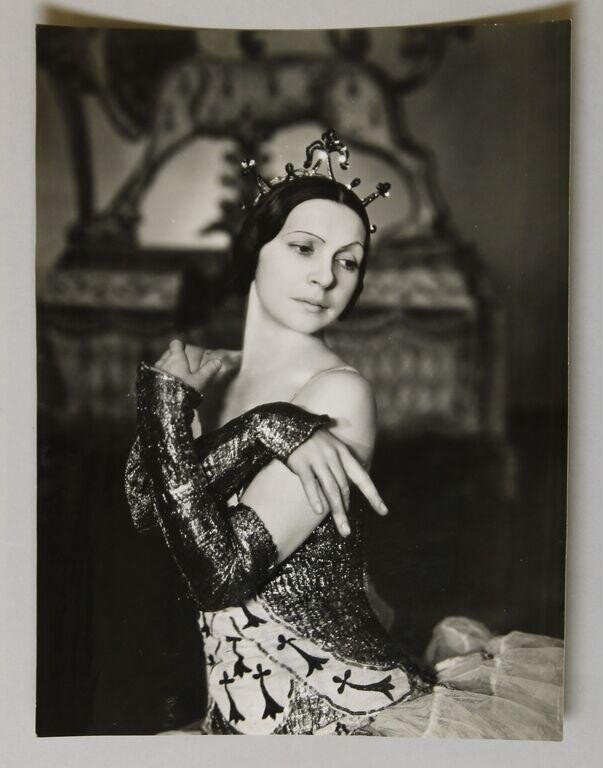
A formal studio portrait photograph captures a single female dancer posed in classical ballet attire against an ornate backdrop. She stands in a three-quarter turn facing the camera, her body angled gracefully to the right. She wears a richly decorated dark tunic or bodice with metallic embroidery or beading that catches the light, worn off one shoulder in the manner of Romantic-era ballet costume. Her lower half is dressed in a patterned skirt—possibly tulle or silk with dark patterning—that falls to mid-calf or below. A jeweled tiara or headdress crowns her dark hair, adding regal authority to the pose. Her left arm drapes elegantly across her body; her right hand rests gently on her hip or torso. Her gaze is direct and poised, meeting the viewer with the composed confidence of a principal dancer. The studio lighting is dramatic and directional, casting soft shadows that model her features and emphasize the sculptural quality of her pose. Behind her, blurred interior furnishings suggest a formal aristocratic setting—perhaps a palace or grand interior—reinforcing the classical or royal narrative the costume implies.
The dancing
The dancer stands in a contrapposto pose with her weight settled on her back leg, her front leg relaxed but not extended. Her frame is upright and dignified, the torso held with the erect carriage essential to classical ballet technique. The arms are arranged gracefully without tension—one folded inward, the other positioned to suggest fluid movement arrested mid-gesture. Her shoulders remain level and relaxed; her neck is elongated. The pose suggests a moment of stillness within a dance rather than a static position, the kind of arrested action Romantic ballet favored in portraiture. The dancer's physical control and the careful arrangement of limbs demonstrate professional training.
The dance depicted
This is a studio portrait of a classical ballet dancer, almost certainly from a principal role in a Romantic ballet. The costume—the ornate tunic, the tiara, the patterned skirt, and the off-shoulder draping—is characteristic of 1930s interpretations of early-nineteenth-century ballet style. The title *Raymonda* refers to the 1898 Petipa ballet, but the 1935 date and the photographic style suggest this may be a promotional or cast portrait from an early twentieth-century revival or production. The pose and costuming are consistent with a lead female role in classical ballet, though without additional documentation it is impossible to identify the specific dancer or production definitively. The portrait style and theatrical costume place this firmly within the European classical ballet tradition of the early twentieth century.
How it was made
This is a black-and-white studio photograph, likely gelatin silver print, produced with professional studio lighting and formal composition. The photographic medium allowed for intimate portraiture at a scale and with a subtlety that painting could not easily achieve, making it ideal for theatrical promotion and documentation. The careful control of light—dramatic side-lighting that models the face and body while emphasizing the texture of the costume—is characteristic of 1930s theatrical photography. The slightly soft focus and tonal range suggest a studio negative printed on high-quality paper, the standard for professional dance photography of the period. Such portraits circulated within the dance world as promotional materials, cast records, and documents of dancers' careers.
About this work
This 1935 photograph documents a classical ballet dancer in costume as *Raymonda*, the Petipa ballet first staged in 1898 and continuously revived throughout the early twentieth century. It is a formal studio portrait—the kind of image that theaters and dancers used for publicity, press materials, and archival documentation of productions and performances. The image preserves the appearance of a particular dancer and role at a specific moment in the long history of the ballet. The photograph is valuable not as a record of live performance (it is a posed studio image) but as evidence of how the Raymonda role was costumed, presented, and promoted to audiences in the 1930s. It shows us what the ballet looked like when it was danced, the conventions of classical costume of the period, and the way professional dancers were documented and marketed at that time.
How to look at it
Observe the stillness of the pose and the way the dancer's training is visible in the controlled placement of her body—the lifted spine, the alignment of the head, the ease of the arms. Notice how the photograph captures not dynamic movement but the moment of composure and presentation essential to the Romantic and classical ballet tradition. The costume detail—the embroidery, the tiara, the carefully arranged skirt—is rendered with the clarity and precision that studio photography allowed, making the garment as much a subject as the dancer. The direct gaze and composed expression were conventions of theatrical portraiture; this is a dancer presenting herself as a character and as a professional.
The period
The 1930s were a period of intense revival and reinterpretation of nineteenth-century classical ballet across Europe. The Russian Imperial Ballet had been dispersed after the Revolution, and ballet companies across Europe and America were reconstructing and re-staging the great classical works from memory, notation, and imagination. *Raymonda* in particular was popular as a showcase for technically accomplished ballerinas—the role demands virtuosity in adagio, variations, and ensemble work. Studio photography had become the standard medium for theatrical documentation by the 1930s, and such portraits were essential to the machinery of theatrical publicity. The costume in this photograph—the ornate, heavily embellished tunic and tiara—reflects 1930s ideas about classical ballet aesthetic: luxurious, formal, and strongly narrative.
Where it lives
The photograph is held in the VA (Virginia) collection. It is a professional studio portrait, likely created for or retained by a theater company, ballet school, or the dancer herself as a record of a particular role and production.
Dance in this work
Questions about this work
Is this a photograph of an actual *Raymonda* performance?
No. This is a studio portrait, taken in controlled lighting conditions against a studio backdrop. It documents the appearance of the dancer in costume and the style of the role, but it is not a photograph of the dancer performing on stage. Such studio portraits were created for publicity, archival documentation, and promotional use.
What is *Raymonda*?
*Raymonda* is a three-act classical ballet choreographed by Marius Petipa to music by Alexander Glazunov, first staged at the Imperial Theatre in St. Petersburg in 1898. It is a story ballet set in a medieval French castle, telling of the heroine Raymonda's love for Jean de Brienne and her trials and triumph. The role remains a standard part of the classical ballet repertory, particularly valued for its technical demands and opportunities for display.
Can we identify the dancer or the production?
Without additional documentation such as markings on the back of the photograph, a playbill, or records from the holding collection, it is not possible to identify the specific dancer or the theater company that produced this portrait. The photograph is catalogued only by title and date.
What does the costume tell us about the ballet?
The costume—an ornate, heavily embellished tunic worn off one shoulder, paired with a patterned skirt and a tiara—represents 1930s interpretation of a medieval-romantic narrative. Raymonda is costumed as a noblewoman in a historical (or imagined historical) setting. The richness of the embroidery and the formality of the headdress signal both the character's status and the production's investment in spectacle and luxury.
More dance artwork





