49 works in this view — arrow keys or swipe to move between them.
Dance in Art
Lydia Kyasht
Hoppé, Emil Otto
- Collection:
- Photograph
- Source:
- Victoria and Albert Museum
- Rights:
- Rights vary by item — check the source record before reusing this image. Source record ↗
- Recorded as:
- V&A — check rights per item
This photograph documents the international circulation of Russian Imperial Ballet technique and the star system that surrounded it before the Russian Revolution. It shows how a dancer's body and costume were marketed and consumed as cultural product in the early twentieth-century West. For dance historians, it is evidence of the technical standard and aesthetic vocabulary that influenced ballet in Britain and Europe in this critical period.
What you are looking at
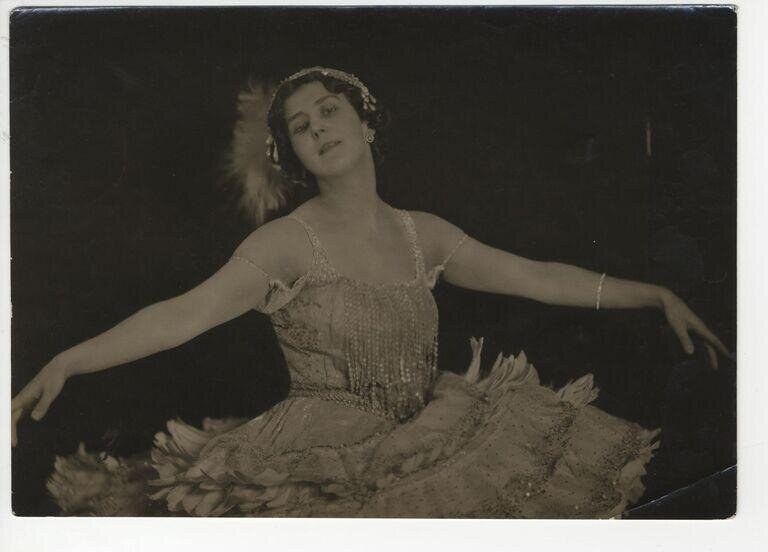
A solo female dancer is shown in a moment of suspended grace against a deep black background, her body caught in an arabesque or similar classical pose. She wears an ornate, heavily beaded or sequined tunic-style costume in light fabric that catches the photographic light, creating a luminous quality. Her dark hair is arranged with what appears to be a decorative headpiece or jewelled ornament. Her right arm extends horizontally at shoulder height while her left arm hangs with gentle downward curve; her torso is lifted and composed. The pose suggests the middle of a movement rather than a held position—there is a quality of arrested motion, as though the photographer has frozen a moment of flight. The stark lighting and dark surround create an intimate, theatrical intimacy despite the abstraction of the setting.
The dancing
The dancer stands in a single leg supporting position with the working leg extended behind in a line that carries through from her torso—the classical arabesque line. Her upper body is held upright with apparent ease; the working arm reaches forward horizontally while the supporting side remains long and open. The extension shows the turned-out control characteristic of classical ballet training. Her head is turned slightly upward, with the gaze lifted, following the direction of the forward arm. This is a body trained in the vocabulary of academic ballet and comfortable sustaining extension without apparent strain.
The dance depicted
This is a portrait of a classical ballet dancer in a moment of signature vocabulary. The arabesque is the fundamental classical pose, and the costume—the beaded, orientalist-styled tunic—suggests a role from the classical Russian or European ballet repertory, likely a character from the turn-of-the-twentieth-century theatrical ballet tradition. Kyasht (1885–1959) was a Russian prima ballerina who performed with major European and American companies in the early 1900s and was known for both classical technique and character roles with orientalist and exoticist themes. The photograph documents the high technical standard of Russian Imperial Ballet training as it existed in Western European dance circles in the early 1910s.
How it was made
This is a photograph, most likely a studio portrait made under controlled conditions. The deep black background is typical of theatrical photography of the period, created either through studio backdrop or in-camera technique. The lighting is focused and sculptural, illuminating the costume and the dancer's form while rendering the background as void. This technique served both theatrical documentation and circulation as promotional imagery—photographs of star dancers were collected, exchanged, and published in theatrical journals and programmes. The chemical photographic process of 1912 and the choice of a standing pose suggest this was made specifically for reproduction and distribution as a celebrity portrait.
About this work
This is a professional portrait photograph of a Russian classical ballet dancer, Lydia Kyasht, captured by the British photographer Emil Otto Hoppé at the height of her performing career in 1912. The image documents both the physical achievement of classical ballet technique at the Imperial standard and the commercial culture of ballet stardom in the early twentieth century. Kyasht was a significant figure in bringing Russian Imperial technique to Western European audiences during the pre-Diaghilev era, and this portrait is a record of the aesthetic—the turned-out line, the lifted carriage, the orientalist costume—that defined theatrical ballet in this period.
The photograph sits within the broader category of dance portraiture and celebrity documentation. Hoppé (1876–1972) was a leading society and theatrical photographer, and his dance portraits are among the most refined examples of early twentieth-century dance photography. This image has the compositional sophistication and tonal control of a master portraitist: the dancer is not frozen in an awkward laboratory moment, but rather presented as a composed performer aware of the camera, yet absorbed in the gravity of her art.
How to look at it
Look first at the pose itself: the arabesque is not a resting position, but one of the fundamental achievements of ballet training, and the ease and length of line Kyasht displays here demonstrates the standard of the Russian Imperial Ballet school. Notice how the photographer has caught the pose without collapse or strain—her supporting leg is straight, her working leg is high and turned out, and her upper body has not compensated or lost its lift. Look next at the costume and the way it is lit: the beads and sequins catch light and create volume and texture, suggesting both the weight of the garment and the theatrical spectacle of the stage. The dark background is a studio convention, but it serves to isolate the dancer and the moment as precious and separate from the everyday. The composition and lighting are in dialogue with the dancer's own training and presentation—they are not documenting a casual moment, but rather creating a formal record of technical achievement.
The artist
Emil Otto Hoppé (1876–1972) was a German-born photographer who established himself as one of London's most fashionable and technically accomplished studio photographers. He was celebrated for his theatrical portraiture, his society work, and his international commissions, and his photograph collection is among the most extensive and important records of early twentieth-century performance. Hoppé worked with dancers, actors, musicians, and visual artists, and his dance photography in particular is recognised for its compositional refinement and its sensitivity to the body in motion. His work was widely published and his studio was a destination for international performers seeking prestigious portraiture.
The period
In 1912, Russian Imperial Ballet was at the height of its international prestige, following the London debut of the Ballets Russes in 1909. However, many dancers, including Kyasht, had established independent performing careers in Western Europe before Diaghilev's company was founded, and they continued to perform in London, Paris, and Berlin in both classical and character roles. This was the era of the prima ballerina as international celebrity—dancers' photographs were traded like postcards, published in theatre programmes and journals, and served as models of technique and beauty. The costume Kyasht wears here—beaded, orientalist in style—reflects the widespread taste for 'exotic' choreography and the aesthetic colonialism of turn-of-the-century theatrical dance. Classical ballet itself was being repackaged for Western European audiences as a Russian art form, despite its French origins, and the star system surrounding Russian dancers reinforced this narrative.
Where it lives
This photograph is held in the Victoria and Albert Museum's Dance collection (source: VA). It is a vintage print from Hoppé's archive and represents the professional studio portraiture that served both as theatrical documentation and as celebrity merchandise in the early twentieth century.
Dance in this work
Questions about this work
Who was Lydia Kyasht?
Lydia Kyasht (1885–1959) was a Russian prima ballerina trained at the Imperial Theatre School in St Petersburg. She performed internationally throughout her career, including major roles in classical and character ballet in London, Paris, and other European cities. She was known for both her technical accomplishment in classical roles and her interpretations of orientalist and national character dances, which were fashionable in early twentieth-century theatre.
What is an arabesque and why does it matter?
An arabesque is one of the five fundamental positions of classical ballet, in which the dancer stands on one leg with the other leg extended behind the body in a long line. It is a test of balance, strength, turnout, and line—all core achievements of ballet training. The arabesque appears in nearly every classical ballet and is one of the most widely recognised poses in dance. A dancer's ability to hold a clean, high arabesque without compensating with the torso is considered a mark of excellent training.
Why does the costume look orientalist?
In the early twentieth century, Western European ballet was fascinated by 'exotic' aesthetics, and choreographers and dancers routinely created roles with orientalist costumes and themes. These roles borrowed visual and musical elements from non-European cultures, usually in highly stylised and inaccurate ways. Kyasht's costume here—beaded, loose-fitting, with a jewelled headpiece—is typical of this aesthetic and suggests she performed in roles designed to appeal to Western audiences' fantasies of Asia, the Middle East, or Russia itself.
How does a photograph like this differ from seeing the dancer in person?
A photograph freezes a single moment and removes the flow, momentum, and lived duration of dance. It shows the line and position, but not the breath, the quality of arrival or departure from the pose, or the spatial relationship between the dancer and the audience. This photograph is a portrait and a document, not an experience—but it allows us to study the body in ways the theatre does not, and it served as the primary way audiences encountered their favourite dancers between performances.
More dance artwork





