49 works in this view — arrow keys or swipe to move between them.
Dance in Art
Raymonda
unknown
- Collection:
- Photograph
- Source:
- Victoria and Albert Museum
- Rights:
- Rights vary by item — check the source record before reusing this image. Source record ↗
- Recorded as:
- V&A — check rights per item
Raymonda is one of the cornerstones of classical ballet technique and narrative structure, and this photograph documents how the role was presented and visualized in the early 20th century—the headdress, the costume design, the emotional registers of the pose. For historians of ballet costume, stagecraft, and the Imperial Russian tradition, this image is direct evidence of production practice and the physical and visual culture surrounding one of the repertory's most significant works.
What you are looking at
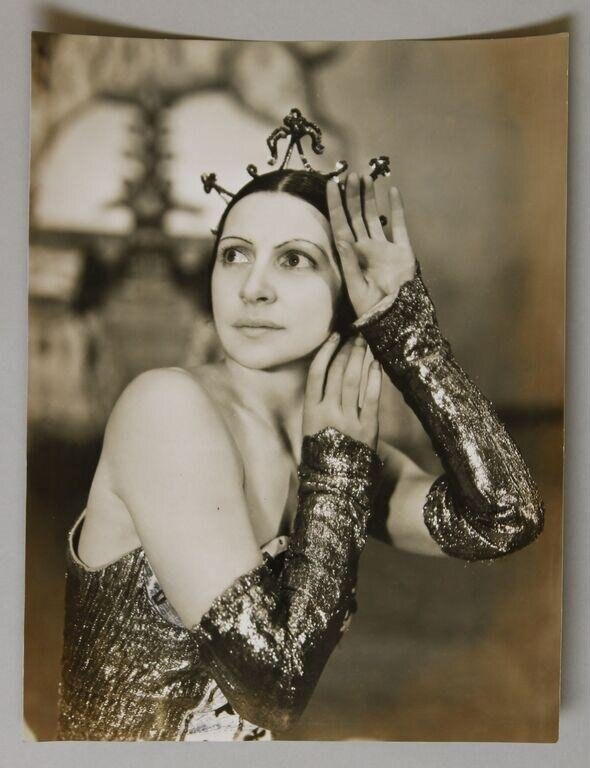
A woman in elaborate theatrical costume gazes upward and to the side in a moment of reverie or spiritual aspiration. She wears a heavily sequined or beaded long-sleeved garment that catches and reflects light dramatically, creating a shimmering surface across her arms and torso. Her dark hair is crowned with an ornate headdress featuring small figurative sculptures—possibly depicting a narrative or mythological scene—that sits prominently atop her head. Her bare shoulder and the elegant line of her neck are exposed. The photograph is sepia-toned with soft focus in the background, emphasizing the figure and creating an intimate, dreamlike quality. The setting appears to be a theatrical interior, with draped fabric and architectural elements barely visible behind her. The pose is one of emotional intensity and nobility, suggesting a moment of transformation or heightened feeling within a narrative.
The dancing
The dancer's body is shown in three-quarter view, weight settled into a moment of pause rather than active locomotion. Her raised hand is brought to her head in a gesture of reflection, reverie, or distress—a classic romantic theatrical pose. The arm frame is soft and expressive rather than geometric. Her gaze is lifted and directed away from the viewer, creating an inward emotional focus. The exposed shoulder and the line from hip through extended arm create an elongated, graceful silhouette characteristic of early 20th-century theatrical presentation.
The dance depicted
This is a photograph of a principal dancer in the classical ballet *Raymonda*, choreographed by Marius Petipa to music by Alexander Glazunov and premiered at the Mariinsky Theatre in St. Petersburg in 1898. The headdress identifies this as Raymonda, the heroine, in one of the ballet's key dramatic or dream sequences—possibly the famous vision scene. The pose and costume suggest a moment of romantic yearning or supernatural encounter. The sequined costume and theatrical lighting were standard for this repertory in the early 20th century, and the photograph documents how Petipa's narrative ballet was staged and experienced in theatrical production.
How it was made
This is a studio photograph, likely a silver gelatin print. The soft focus background, selective lighting on the figure, and controlled studio setting are consistent with professional dance photography of the 1930s. The technique allowed the photographer to isolate the dancer and moment, creating a portrait-like image suitable for publicity, archival documentation, or circulation among theatre patrons and within the dance press. Photography democratized access to dance imagery and created a new form of dance documentation distinct from painting or engraving.
About this work
This photograph documents a moment in the classical ballet *Raymonda*, one of the cornerstone works of the Imperial Russian ballet repertory. It captures a principal dancer in the role of Raymonda, the heroine, in a moment of emotional intensity—likely during one of the ballet's dramatic or vision scenes. The elaborate headdress, sequined costume, and soft theatrical lighting exemplify the production values and visual language of early 20th-century classical ballet. The photograph is both a record of a specific performance tradition and a piece of promotional or archival documentation from a major ballet institution, showing how audiences of the era experienced one of Petipa's most celebrated narratives.
How to look at it
Attend to the headdress as the key to identifying the narrative moment: its sculptural detail and prominence suggest a dream, vision, or supernatural encounter rather than a realistic scene. The pose—head raised, hand at face, weight settled—freezes a moment of emotional climax. Notice how the sequined costume catches light, creating a shimmering, almost ethereal surface that reinforces the romantic or visionary quality of the scene. The soft focus background removes any specific spatial reference, placing the viewer in an intimate, theatrical space focused entirely on the dancer's internal state.
The period
Raymonda premiered in 1898 and became a staple of the Imperial Mariinsky Theatre repertory. By 1935, when this photograph was taken, the ballet had been performed for nearly four decades and was already considered a classic. The photograph dates to an era when classical ballet was the dominant theatrical dance form in Europe and Russia, and when photography had become the primary means of documenting and circulating images of dancers and productions. This was also the period in which ballet was beginning to be codified through photographs, film, and written notation.
Where it lives
The photograph is held in a collection identified as 'va' in the catalogue record. It is a professional studio photograph, likely produced as part of theatrical documentation or publicity related to a major ballet production.
Dance in this work
Questions about this work
What is the headdress and why is it so ornate?
The headdress is part of the costume design for Raymonda and includes small figurative sculptures, possibly depicting narrative elements central to the ballet's plot. In classical ballet, the headdress often functioned as both decoration and narrative symbol, signaling the character's status, origins, or the emotional register of the scene. The ornament and sculptural detail would have been visible to the audience from a distance in the theatre.
When was Raymonda created and what is it about?
Raymonda was choreographed by Marius Petipa with music by Alexander Glazunov and premiered in St. Petersburg in 1898. It is a three-act narrative ballet set in medieval France, telling the story of Raymonda's betrothal to Jean de Brienne. The ballet includes dream scenes, visions, and elaborate ensemble sequences, and is considered one of the masterworks of classical ballet technique and narrative structure.
What does this photograph tell us about how classical ballet was performed in 1935?
The photograph documents several key aspects: the elaborateness of costume and headdress design, the use of theatrical lighting and soft-focus photography to enhance the romantic or supernatural mood, and the emphasis on the dancer's emotional expression and upper body rather than footwork or spatial movement. It shows that classical ballet in this era was understood as a visual and emotional spectacle as much as a technical achievement.
More dance artwork





