49 works in this view — arrow keys or swipe to move between them.
Dance in Art
Raymonda
unknown
- Collection:
- Photograph
- Source:
- Victoria and Albert Museum
- Rights:
- Rights vary by item — check the source record before reusing this image. Source record ↗
- Recorded as:
- V&A — check rights per item
This photograph documents the classical ballet tradition at a moment when it was being actively preserved through photography and touring performance. The costume and pose tell us how *Raymonda* was staged and danced in the 1930s, a decade in which the ballet was performed across Europe by multiple companies. For historians of ballet costume, of Petipa's work, and of the role of publicity photography in dance, this image is a primary source.
What you are looking at
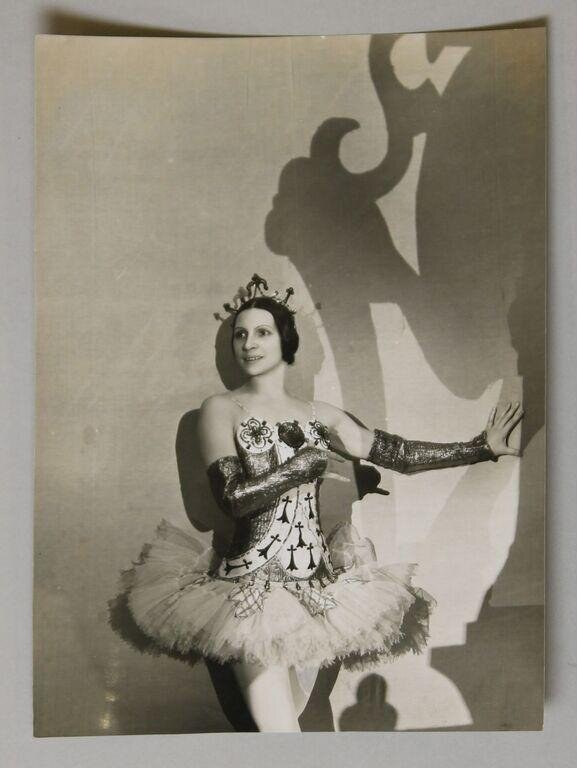
A single female dancer poses before an elaborate theatrical backdrop in a studio or stage setting. She wears a jeweled bodice in gold and ornate patterning over a voluminous white tulle tutu with fur trim at the hem, and a decorative tiara. Her pose is statuary and formal: she stands with weight on one leg, the other subtly bent, her torso upright, one arm extended forward with a gesture of presentation or acknowledgment, the other at her side. The lighting is theatrical and dramatic, casting strong shadows that define the form of her body and the sculptural folds of the tutu. Behind her, a monumental silhouette in grey suggests architectural or abstract scenic elements—possibly a stylized set piece or prop. The composition is symmetrical and frontal, with the dancer centrally placed, creating a portrait of the dancer rather than a narrative scene.
The dancing
The dancer stands in a formal, turned-out position characteristic of classical ballet: legs in ballet alignment with one leg supporting and the other gently flexed, hips level, torso lifted and squared to the camera. Her arms frame the body—one extended forward in a welcoming or presentational gesture, palm visible, the other held at her side. Her head is lifted, her gaze direct and forward, suggesting a moment of acknowledgment or salutation. The tiara and jeweled costume indicate a role of rank or nobility. There is no partnering or interaction with another dancer; this is a soloist portrait.
The dance depicted
This is almost certainly a photograph of a principal dancer from a production of the classical ballet *Raymonda*, a three-act narrative ballet first choreographed by Marius Petipa in 1898. The jeweled bodice, tulle tutu, tiara, and formal presentational pose are consistent with the costume and vocabulary of the Awakening or Grand Vision scene, in which the title character dances as a central figure. The 1935 date would place this in the period when *Raymonda* was actively performed in European opera houses and touring companies. The photograph captures a moment of formal address—likely the opening of a solo variation or the acknowledgment of the character's revelation to the knight Abimelek.
How it was made
This is a gelatin silver print photograph, a medium dominant in dance documentation from the 1920s through 1950s. The photograph was likely taken in a studio with controlled theatrical lighting, as evidenced by the strong directional light source and carefully composed backdrop. Studio portraiture of this kind allowed for close study of the dancer's line and costume detail, and such images circulated widely in programmes, press archives, and dance periodicals. The sepia tone and contrast typical of the period suggest this is an original or first-generation print.
About this work
This is a studio portrait photograph of a principal dancer in full costume from a 1935 production of *Raymonda*, Petipa's classical ballet. The image documents both the soloistic role and the visual vocabulary of early 20th-century classical ballet performance—the silhouette, the jeweled court dress, the formal pose that conveys nobility and control. The photograph was created during a period of intense documentation of ballet through publicity photography, when images like this served as the public face of the art form in programmes, newspapers, and fan collections. It belongs in a gallery of dance because it captures not a moment of movement but a moment of presentation—the dancer's stillness and bearing are themselves part of the theatrical language of classical ballet.
How to look at it
Attend to the precision of the dancer's posture: every muscle appears aligned and controlled, the turnout complete, the carriage noble. The photograph captures a moment of formal presentation rather than of movement in progress. Note how the costume—the tiara, the jeweled bodice, the white tutu—creates a silhouette that reads as a complete visual statement, a synthesis of the dancer's body and the character's rank. The backdrop is deliberately abstract and theatrical, not a realistic setting; it frames the dancer rather than placing her in a narrative scene. This is a publicity image, designed to convey the grandeur and technical mastery of classical ballet to a broad public.
The artist
The photographer is unknown. The image comes from what appears to be a dance archive or press collection, and the professional quality and studio lighting suggest it was created either by a theatre photographer or a commercial portrait studio working with dance companies. Such photographs were often credited to studios or archives rather than individual photographers, and many original prints were separated from their credits over time.
The period
In the 1930s, classical ballet was undergoing a period of intensive international touring and documentation. Sergei Diaghilev's Ballets Russes had transformed European perception of ballet in the 1920s, and in response, traditional imperial ballets like *Raymonda*, *Swan Lake*, and *The Sleeping Beauty* were being restaged and kept in active repertory by companies across Europe. Photography became a crucial marketing and archival tool; dance companies relied on studio portraits of their stars and signature roles to publicize performances and build audiences. The jeweled, romantic aesthetic of *Raymonda* aligned with the theatrical modernism of the era, which valued visual spectacle and the dancer as a glamorous public figure. At the same time, this photograph represents the last moment before ballet would be displaced in the popular imagination by film and other media.
Where it lives
The photograph is held in a dance archive or photograph collection (source: VA, likely a European archive such as the Victoria and Albert Museum or a similar institution). It is part of a larger documentary record of 1930s ballet performance and touring production.
Dance in this work
Questions about this work
What is Raymonda?
*Raymonda* is a three-act classical ballet choreographed by Marius Petipa and premiered at the Mariinsky Theatre in St. Petersburg in 1898. It tells the story of a crusader knight and his beloved, and was a signature role for ballerinas throughout the 20th century. The ballet is known for its jeweled aesthetic, its intricate variations, and its synthesis of classical technique with court spectacle.
How was this photograph used?
Studio portraits like this were used in theatre programmes, publicity materials, newspapers, and fan collections. Dance companies distributed them to press and to audiences as a way of publicizing their stars and performances. In the era before widespread film documentation, photographs were the primary visual record of how ballets were danced and costumed.
Can you identify the dancer?
No. While this is clearly a principal dancer from a significant production, the photograph has been separated from its original credit or label. The archive record does not identify her by name. Without additional documentation, it is not possible to determine which dancer performed this role in 1935.
Why is the pose so formal?
The pose reflects both the classical ballet vocabulary and the conventions of studio portraiture. In classical ballet, the dancer's standing position—turned out, lifted, balanced—is itself a performance mode conveying nobility and control. The photographer has chosen a moment of presentation or salutation, allowing the full costume and the dancer's line to be read clearly and completely.
More dance artwork





