49 works in this view — arrow keys or swipe to move between them.
Dance in Art
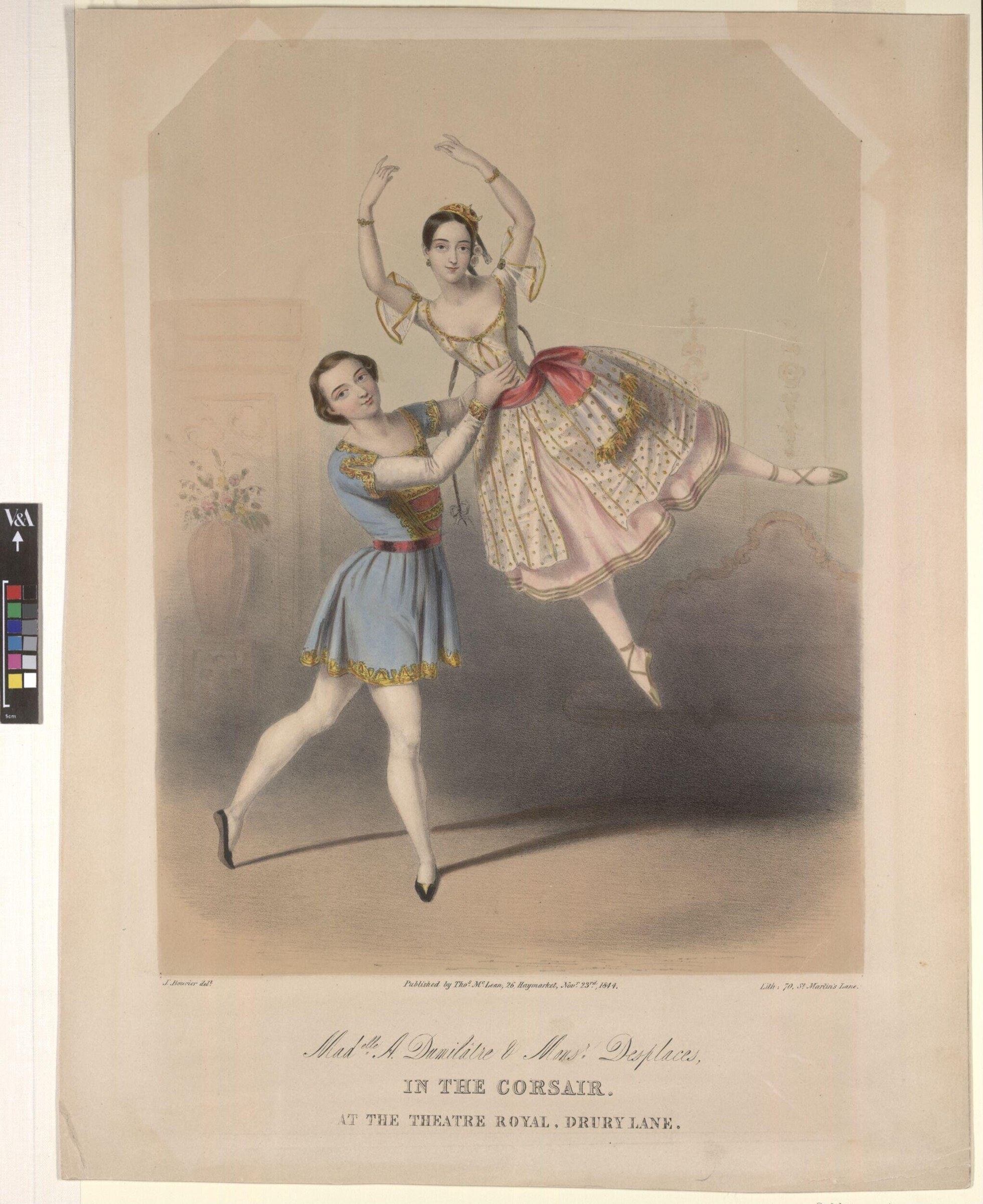
Adele Dumilâtre and Henri Desplaces in The Corsair
Bouvier, Jules
- Collection:
- Source:
- Victoria and Albert Museum
- Rights:
- Rights vary by item — check the source record before reusing this image. Source record ↗
- Recorded as:
- V&A — check rights per item
This print is direct visual testimony to the practice and aesthetic of romantic ballet in the 1840s—the actual bodies, clothing, staging, and partners—rather than a later reconstruction or written description. For historians of dance technique, it provides a rare record of how the arabesque and port de bras were actually held and displayed in performance, and evidence that the romantic ballet's iconic pose was not invented by later photographers but was the deliberate visual vocabulary of the live theatre.
What you are looking at
Two female dancers are posed mid-performance against a pale, minimally detailed stage setting. The dancer in the foreground, at stage right, wears a pale pink tutu with a fitted bodice trimmed in gold, her arms raised in a classical port de bras position, her body in a controlled arabesque or attitude. Behind and slightly upstage, a younger dancer in a short blue skirt with gold trim supports her, both figures caught in a moment of theatrical grace. The composition emphasizes the principal dancer's elevation and control; her pointed foot extends behind her while the supporting dancer provides balletic assistance. The lithograph's soft handling of shadow and the dancers' pale, elongated limbs against the warm beige background create an ethereal stage effect typical of romantic ballet imagery. A small vase with flowers sits at stage left, a common prop indicating an interior or garden setting.
The dancing
The principal dancer's body demonstrates the fully extended line of classical ballet—her supporting leg is straight and vertical, her arabesque leg extended behind with a pointed foot, and her arms held in the raised, rounded port de bras that defines the period's aesthetic. Her head turns slightly away, a gesture of classical repose. The secondary dancer plants her feet firmly, providing physical support while maintaining her own balletic posture, their relationship one of principal and attendant rather than equal partnership. Both dancers' legs show the turn-out and elongation trained in the academic ballet technique of the 1840s. The composition emphasizes verticality and grace rather than dynamic movement or virtuosic display.
The dance depicted
This is a scene from the romantic ballet *Le Corsaire* (The Corsair), a work first choreographed in 1856 but known here through an 1844 image, suggesting either a precursor production or a documentation error in the catalogue. The ballet was a staple of the Romantic period, featuring exotic settings, a slight female principal, and the classical idiom. The pose shown here—the arabesque or attitude with a supporting dancer—is the fundamental vocabulary of romantic ballet, displayed as the aesthetic ideal of the era. Adele Dumilâtre and Henri Desplaces were principal dancers at the Theatre Royal, Drury Lane, London, where this was presumably performed; the inscription confirms the dancers' names and venue.
How it was made
This is a hand-coloured lithograph, a reproductive print medium that allowed wide circulation to London theatre-goers and dance enthusiasts. The soft crayon texture visible in the background shading and the delicate colour application—particularly the subtle gradations in the dancers' flesh tones and the pale pink tutu—are characteristic of the lithographic process when hand-finished with watercolour or gouache. The technique was ideal for capturing the ethereal, two-dimensional effect sought in romantic-era dance imagery, prioritising elegance and legibility over anatomical precision or dramatic movement. The finely drawn architectural framing at the top of the image and the printed caption below indicate a commercially produced theatrical print, the kind sold to commemorate notable performances.
About this work
This is a theatrical print documenting a scene from a romantic ballet at a major London venue, rendered as a hand-coloured lithograph in the mid-nineteenth century. It captures the visual and physical vocabulary of romantic ballet at the moment of its greatest international prestige: the elongated line, the ethereal poising, the partnership of principal and supporting dancer, and the exotic narrative setting. The image circulated as a souvenir of a particular production by named performers, making it evidence both of what was danced and of how dance was visually mediated for the paying public.
How to look at it
The artist has chosen the moment of perfect stillness and alignment—the arabesque held, the arms composed, the weight balanced—rather than a moment of transition or jump. This reflects the romantic ballet's aesthetic ideal: to appear effortless and posed, not straining or dynamic. Notice how the framing cuts off the stage setting to focus attention on the bodies and the interaction between them, and how the soft lithographic line and hand colouring create an ethereal, almost dreamlike quality that was central to how romantic ballet presented itself. The pose itself—the arabesque—was the signature image of romantic ballet, repeated in prints, paintings, and photographs, and became synonymous with ballet itself.
The artist
Jules Bouvier was an active theatrical lithographer in London in the mid-nineteenth century, specialising in prints documenting performances at major theatres including Drury Lane, Covent Garden, and others. His practice was typical of the commercial theatrical print industry: he worked from sketches or memory of live performances, producing plates that were then hand-coloured and sold to audiences as souvenirs. His work is a primary source for the visual history of London theatre and dance in this period, though little biographical detail survives.
The period
The 1840s were the height of romantic ballet in Europe. *La Sylphide* (1832) had established the aesthetic of ethereal, otherworldly female dancers in gas-lit theatres; *Giselle* (1841) had consolidated it; and works like *Le Corsaire* extended the formula to exotic and dramatic subjects. The romantic era emphasised the ballerina's illusion of weightlessness, the turn-out and line inherited from the academic technique, and the visual spectacle of the tutu and pointe shoes. London's theatre audiences in the 1840s had access to European dancers and works, and the commercial print industry capitalised on the craze. Lithographic theatrical prints were a new mass medium, cheaper and faster to produce than engravings, and fed a public appetite for images of celebrated dancers.
Where it lives
This is a commercial theatrical print, one of many produced by Jules Bouvier to document London theatre productions. It was issued for public sale as a souvenir of performances at the Theatre Royal, Drury Lane. The image is held in the Victoria and Albert Museum, the primary institutional repository for British theatrical and design ephemera of this period.
Dance in this work
Questions about this work
What is the arabesque pose shown here, and why is it so important in ballet?
The arabesque is a position in which the dancer stands on one leg with the other leg extended behind, body in a vertical line, arms in a classical port de bras. It became the iconic image of romantic ballet because it embodied the era's aesthetic ideals: elongation, verticality, weightlessness, and the illusion of effortless grace. The pose demanded extreme turnout, pointed feet, and control, and it appeared in nearly every significant work of the romantic period. For audiences and artists, seeing a dancer suspended in the arabesque became synonymous with what ballet was.
Who were Adele Dumilâtre and Henri Desplaces?
They were principal dancers at the Theatre Royal, Drury Lane in London in the 1840s. Dumilâtre was known for romantic roles and the refined classical technique the era demanded. Desplaces appears here in a supporting role, typical of male dancers in romantic ballet, whose primary function was to partner and display the ballerina. Without additional biographical sources, little more can be said, but their inclusion in a commercial print confirms they were celebrated enough to sell programmes and souvenirs.
When was *Le Corsaire* first choreographed, and what is this 1844 print showing?
The earliest known choreography of *Le Corsaire* dates to 1856, choreographed by Joseph Mazilier at the Paris Opéra. This print is dated 1844, which is a contradiction. It may document an earlier, now-lost production at Drury Lane; may reflect a precursor or variant work with the same title; or may be an error in the catalogue record. The visual evidence—the costume, the romantic aesthetic, the classical vocabulary—is entirely consistent with 1840s romantic ballet, regardless of the ballet's genealogy.
More dance artwork





