49 works in this view — arrow keys or swipe to move between them.
Dance in Art
Lydia Kyasht
Hoppé, Emil Otto
- Collection:
- Photograph
- Source:
- Victoria and Albert Museum
- Rights:
- Rights vary by item — check the source record before reusing this image. Source record ↗
- Recorded as:
- V&A — check rights per item
Kyasht was a significant figure in the international dissemination of Russian Imperial Ballet training and repertory, particularly in Britain, where she performed and taught. This photograph by a major society portraitist documents both her presence in London's artistic circles and the visual conventions through which classical ballet was presented to the public in the early 20th century.
What you are looking at
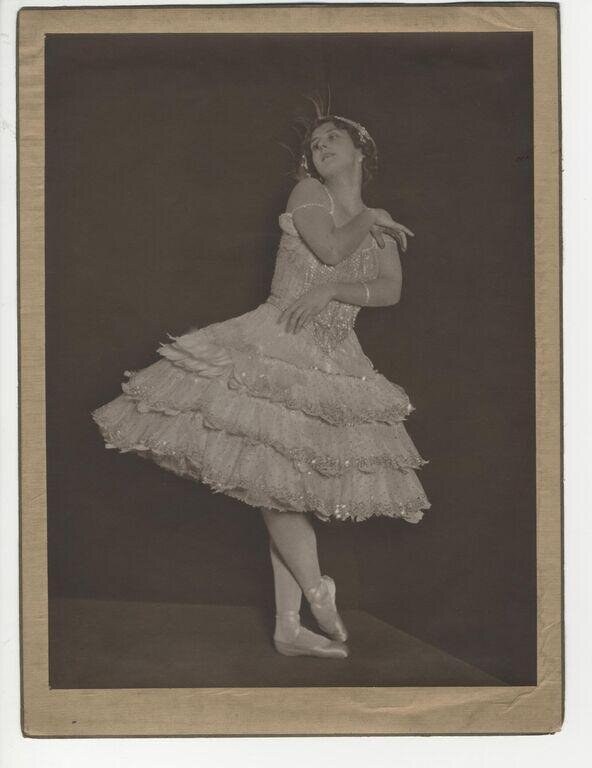
A young female dancer is photographed in isolation against a dark background, posed in a moment of arrested movement. She wears a layered, tiered dress of white or pale lace with short puffed sleeves, the skirt constructed from multiple ruffles that flare dramatically around her legs. Her posture is upright but fluid, weight shifted onto one leg, the other foot pointed and extended; her upper body is slightly twisted, her gaze directed upward and away from the camera. Her hair is styled in the fashion of the early 1910s, and she stands on a shallow platform or stage surface. The photograph is composed as a studio portrait with formal studio lighting that catches the texture of the lace and creates a sculptural quality to the figure.
The dancing
A single dancer is shown in three-quarter view, her weight clearly supported on her left leg while the right leg is extended with a pointed foot—a classical ballet position. Her arms are softly positioned, one raised, the other lower, creating a line of elegant extension through the body. Her torso shows the long, lifted carriage characteristic of ballet training, and her gaze is lifted, following the classical convention of the époque. The dress is constructed to emphasize verticality and the extension of the leg; the layered skirt moves with the body and would create dynamic visual effects in motion.
The dance depicted
This is a portrait of Lydia Kyasht, a Russian prima ballerina of the Imperial Ballet, captured in a pose recognizable as a classical ballet position—likely a preparation for or moment within a Romantic-era ballet variation. The tiered skirt, pointe shoes, and the formal portrait convention of early 20th-century dance photography establish this as theatrical ballet of the Romantic school. Kyasht was known for her performances in works of the late Imperial Russian repertory, including roles in ballets by Fokine and in classical variations. The stillness of the photograph captures what would have been a moment of dynamic performance on stage.
How it was made
This is a gelatin silver or platinum print photograph, a studio portrait made under controlled lighting. The photographer Emil Otto Hoppé was a leading portraitist of performers in London during the 1910s, known for theatrical and celebrity portraiture. The photograph was produced as a commercial studio print, likely for circulation to press, admirers, and within the theatrical profession. The formal framing, the tonal range from deep blacks to bright whites, and the precise focus on the figure are characteristic of high-end portrait photography of the period, suggesting this was either an authorized studio session or a professionally commissioned work.
About this work
This is a studio portrait photograph of the Russian Imperial Ballet dancer Lydia Kyasht, captured by the London society photographer Emil Otto Hoppé around 1912. The image freezes a single moment of classical ballet pose—a leg extension, lifted carriage, and ethereal bearing—and renders it as a formal portrait in its own right. The photograph documents not only a celebrated performer but also the aesthetic of early 20th-century Imperial ballet as it was experienced in Western European capitals; Kyasht was one of the dancers who helped establish the international reputation of Russian ballet in the years immediately before the Revolution. The work sits at the intersection of dance, theatre, and studio portraiture, capturing the professional image of a major classical dancer at the height of her career.
How to look at it
Attend to the precision of the pose: the extension of the leg is not accidental, but a carefully held classical position, and the photograph's stillness paradoxically emphasizes the control and training required to maintain it. Notice how the dress is constructed—the tiers and ruffles are not simply decorative but serve to articulate the line of the body and the movement of the leg. The studio lighting creates sharp edges on the figure against the dark ground, an effect that mimics stage lighting and emphasizes the dancer as a distinct visual spectacle. The gaze lifted away from the camera is a convention of dance portraiture: the dancer does not perform *for* the photograph, but rather is captured as if performing for an audience beyond the frame.
The artist
Emil Otto Hoppé (1878–1972) was a German-born photographer who became one of the most prominent portrait and theatre photographers working in London and internationally during the early 20th century. He was known for his elegant, formally composed studio portraits of stage performers, artists, and society figures, and his work was widely circulated in theatrical journals and society publications. His studio was a major destination for performers visiting or resident in London, and his portraits became the official images by which many dancers of the era were known to the public.
The period
This photograph was taken in 1912, during a pivotal period for Russian ballet in Western Europe. The Ballets Russes had premiered in Paris in 1909 to international sensation, and Russian dancers were increasingly in demand across European capitals. Kyasht had left the Imperial Ballet in St. Petersburg and was establishing herself as a performer and teacher in London, where she would remain throughout the early decades of the 20th century. Studio portraiture of dancers was a major industry and a primary means through which audiences encountered images of performance; photographs by Hoppé and his contemporaries circulated through theatrical journals, postcards, and programme notes, shaping public memory of dancers and roles.
Where it lives
This photograph is held in the V&A Museum collections (Victoria and Albert Museum, London). It is part of the museum's extensive holdings of theatrical and dance photographs documenting performance in Britain from the late 19th century onward.
Dance in this work
Questions about this work
Who was Lydia Kyasht?
Lydia Kyasht (1885–1959) was a Russian prima ballerina of the Imperial Ballet and a major figure in bringing Russian classical training and repertory to Western audiences. She danced principal roles in St. Petersburg and was one of the earliest exponents of Fokine's new ballets. After leaving Russia, she established herself as a performer and teacher in London, where she remained for much of her career and was instrumental in spreading knowledge of the Cecchetti method.
Is she wearing pointe shoes?
The photograph shows her in ballet dress and a classical position that requires pointe work, and the details visible—the pointed foot and the rigid extension—are consistent with dancing en pointe. However, the resolution and distance do not allow absolute confirmation of the shoes themselves from this image alone.
What style of ballet does this photograph show?
The costume, pose, and aesthetic are those of Romantic and Classical ballet of the late 19th and early 20th centuries, as performed in the Imperial Russian schools and exported internationally. The tiered white tutu and the formal portrait pose echo traditions established in the mid-19th century but remain current in the Imperial repertory of Kyasht's era.
Why photograph a dancer in a still pose rather than in action?
Studio portraiture of dancers served multiple purposes: it was a souvenir for admirers, publicity for performers, documentation for theatres and impresarios, and a permanent record of a performer's bearing and training. The still pose allowed the photographer complete control over lighting and composition, and paradoxically could emphasize the aesthetic and technical mastery of the dancer more effectively than a motion snapshot could.
More dance artwork





