49 works in this view — arrow keys or swipe to move between them.
Dance in Art
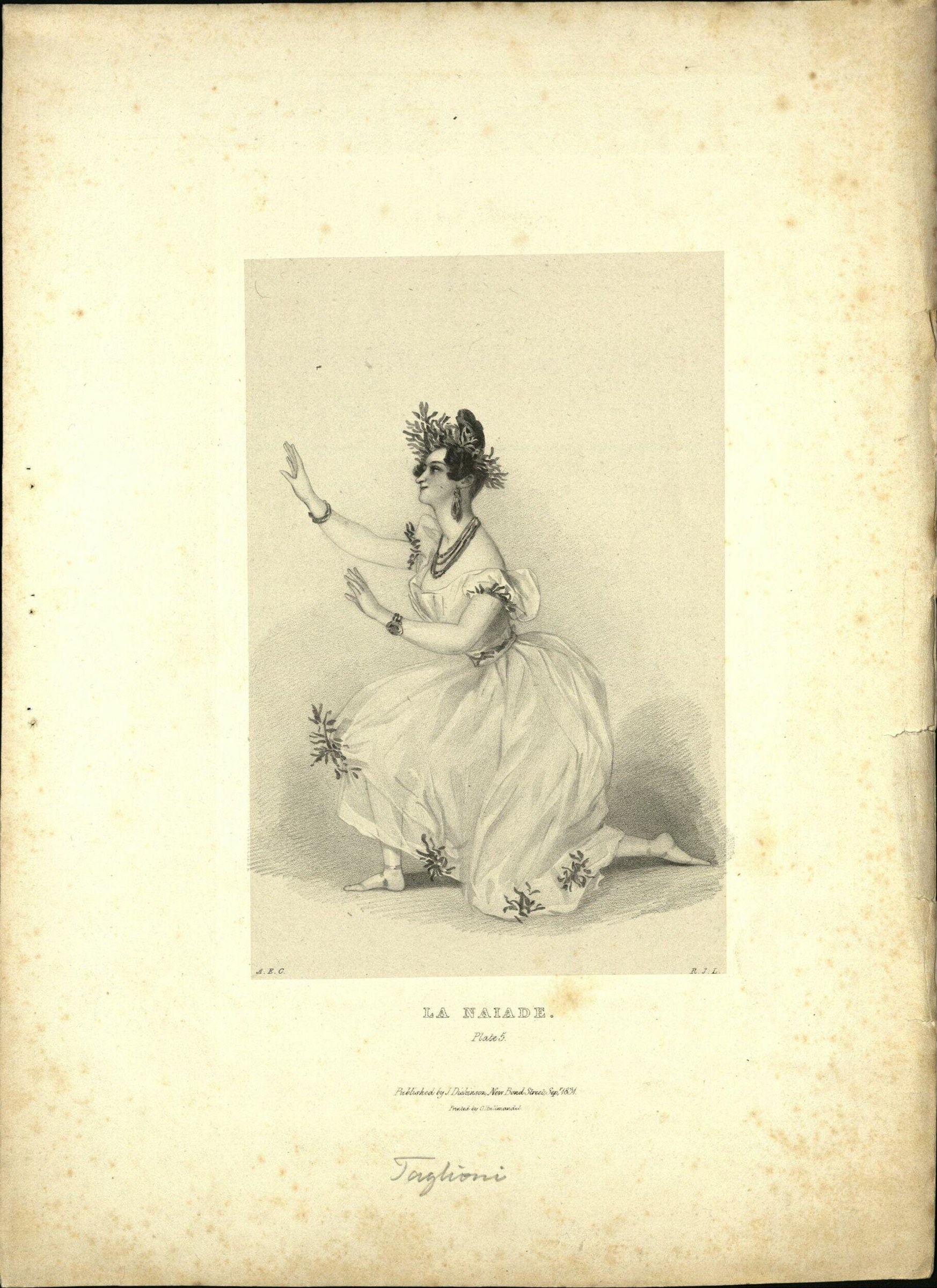
La Naiade
J. Dickinson
- Collection:
- Source:
- Victoria and Albert Museum
- Rights:
- Rights vary by item — check the source record before reusing this image. Source record ↗
- Recorded as:
- V&A — check rights per item
The image documents the visual language of Romantic ballet at its height—the vocabulary of the ethereal body, the costume, and the pose that defined the genre. For historians of dance and art, it offers concrete evidence of how the Romantic ideal was embodied and circulated, and of the nymph and water-spirit roles that were central to the repertory of the era. For dancers and students, it is a touchstone of an aesthetic ideal.
What you are looking at
A single female dancer is portrayed in a three-quarter view against a plain ground, her body caught in a moment of lyrical suspension. She wears a gossamer white empire-waist gown with a full skirt that billows around her legs, the fabric rendered with delicate shading to suggest lightness and movement. Her dark hair is styled up with what appears to be a decorative comb or ornament, and she wears a simple necklace. Her pose is one of buoyant grace: her left arm is raised in an elegant arc above her head, while her right arm extends outward at about shoulder height, both hands rendered with particular attention. Her torso twists slightly, and her body seems to float rather than stand—the very pose of a naiad, a water nymph. Small plant or flower sprigs are scattered across the hem of her skirt and appear near her feet, emphasizing the aquatic or pastoral character. The composition is intimate and focused entirely on the dancer against an empty background, rendered in fine line and careful shading.
The dancing
A single dancer occupies the frame in a suspended, weightless pose characteristic of early nineteenth-century Romantic ballet. Both arms are raised and gently curved, creating a frame around the upper body; the left arm is lifted higher, the right extended more laterally, both suggesting an upward, ethereal quality. The torso shows a gentle twist or contrapposto, and the legs appear to be in a position of balletic extension rather than grounded weight—the right foot seems to point, the left to support, though the overall impression is of levitation rather than contact with earth. The dancer's face is delicate and idealized, turned in profile or three-quarter view, serene and absorbed. The silhouette is unified and graceful, the body organized entirely toward an impression of buoyancy.
The dance depicted
This is a Romantic ballet figure, most likely depicting a naiad or water spirit—the title confirms the subject. The naiad appears in Romantic ballet as an ethereal, otherworldly character, and this image captures the essential aesthetic of that tradition: weightlessness, delicacy, an emphasis on the raised arm and arched back, and the costume of the era—the white tutu or gown that became synonymous with the Romantic heroine. The pose suggests the balletic vocabulary of the 1820s–1830s: port de bras of elegance and fluidity, a verticality that denies weight, the sense of a creature who belongs to water or air rather than earth. The scattered flowers or water plants at the hem reinforce the aquatic or magical nature of the character.
How it was made
This is an engraving or etching, rendered in fine black line on cream paper, with careful shading in the garment, particularly the skirt, to suggest volume and translucence. The technique allowed for fine detail in the face and hands, and for the subtle modeling of the fabric. The quality of line and the refined finish suggest this was a reproductive print, likely made for circulation among the theatre-going public or among dance enthusiasts; such prints were commonly published in the 1830s as souvenirs of celebrated roles or dancers. The medium implies both a refined audience and a work of some commercial success.
About this work
This is a keepsake print of a Romantic ballet role—the naiad—executed in the refined engraving technique of the early 1830s. It captures the essence of the Romantic ballet aesthetic: the ethereal female body, the emphasis on weightlessness and grace, the costume of the white gown, and the idealized, almost dreamlike quality of the pose. The work belongs to a tradition of theatrical prints that circulated among the public, commemorating celebrated dancers and roles. It is both a historical record of what Romantic ballet looked like and an object of artistic refinement in its own right—a small print that would have been kept, framed, or pasted into an album by a devoted follower of the dance.
How to look at it
The viewer should attend to the suspended quality of the pose—the way the artist has conveyed weightlessness and buoyancy through the curve of the arms, the tilt of the torso, and the gossamer rendering of the gown. Observe how the scattered flowers or plants at the hem and feet anchor the figure thematically while the body itself seems to float free of the ground. The face and hands are rendered with particular delicacy, as if to emphasize the refinement and idealization that the Romantic aesthetic demanded. Notice also how the plain ground isolates the figure, making the dancer herself the entire focus—a common convention of theatrical prints, which sought to record the dancer as an idealized figure rather than as part of a narrative or stage setting.
The artist
J. Dickinson is documented as an engraver and reproductive artist working in the early nineteenth century, likely based in London (the publication line mentions London). The name appears on theatrical prints of the 1820s–1840s, many recording celebrated dancers and roles. Little is known of Dickinson's biography, but the quality and refinement of this work suggest a trained and experienced hand, working within the commercial print trade that supplied the theatre-going public with souvenirs and records of celebrated performances.
The period
The 1820s–1830s were the height of Romantic ballet in Europe. The genre had emerged in the late 1810s with works like *La Sylphide* (premiered 1832), but the aesthetic—the ethereal female body, the supernatural subject, the white costume, the emphasis on verticality and weightlessness—was already well established in the visual culture and literature of Romanticism. Theatrical prints were a major form of circulation and publicity; dancers were celebrities, and their roles were commemorated in prints sold to the public. This print documents the moment when ballet had become the preeminent dance form in Europe, and when the image of the ethereal ballerina was crystallizing as a cultural ideal.
Where it lives
The print bears a publication line indicating it was published in London. It is catalogued as a print and held in a collection designated 'va' (likely Virginia, though the specific institution is not noted in the available record). The work is a commercial theatrical souvenir, one of many such prints produced in the 1830s.
Dance in this work
Questions about this work
Who was the dancer depicted in this print?
The catalogue record does not identify the dancer. The title *La Naïade* (The Naiad) refers to the character or role, not necessarily to a specific historical dancer. Many such prints were published without attribution to the performer, and it is possible that this print recorded a generic idealized version of the role rather than a particular famous dancer's interpretation.
What is a naiad in Romantic ballet?
A naiad is a water nymph or spirit, a supernatural female character central to the Romantic ballet aesthetic. Naiads and similar ethereal creatures—sylphs, undines, spirits—represented the Romantic fascination with the otherworldly and the magical, and they required dancers to embody weightlessness, delicacy, and an almost disembodied quality. The naiad role would have involved much use of pointe work, arm choreography emphasizing curves and lifts, and a costume designed to emphasize the illusion of floating.
How was this print made?
The image is an engraving or etching, a technique in which an image is cut or bitten into a metal plate and then inked and printed. The fine lines and careful shading visible in the reproduction suggest a skilled hand and multiple plates or careful working of a single plate. Prints like this were made in editions of hundreds or thousands, making them affordable and accessible to a broad theatre-going public.
What does the title 'Taglioni' mean at the bottom of the page?
This likely refers to Marie Taglioni or the Taglioni family, celebrated dancers of the era. However, the catalogue record does not confirm this attribution. 'Taglioni' may be a print series title, a dancer's name, or a publisher's mark. Without further documentation, it is not possible to assert a definitive connection.
More dance artwork





