49 works in this view — arrow keys or swipe to move between them.
Dance in Art
Chalon, Alfred Edward
- Collection:
- Source:
- Victoria and Albert Museum
- Rights:
- Rights vary by item — check the source record before reusing this image. Source record ↗
- Recorded as:
- V&A — check rights per item
For dancers and historians, this work is a primary visual document of how the Romantic ballet body was trained, dressed, and presented to public view. It shows the period's aesthetic preferences in line, posture, and expression with clarity and precision. As a mass-produced print, it also reveals the cultural machinery by which ballet dancers became celebrities and their image became a commodity, establishing patterns of dance promotion and fandom that persist today.
What you are looking at
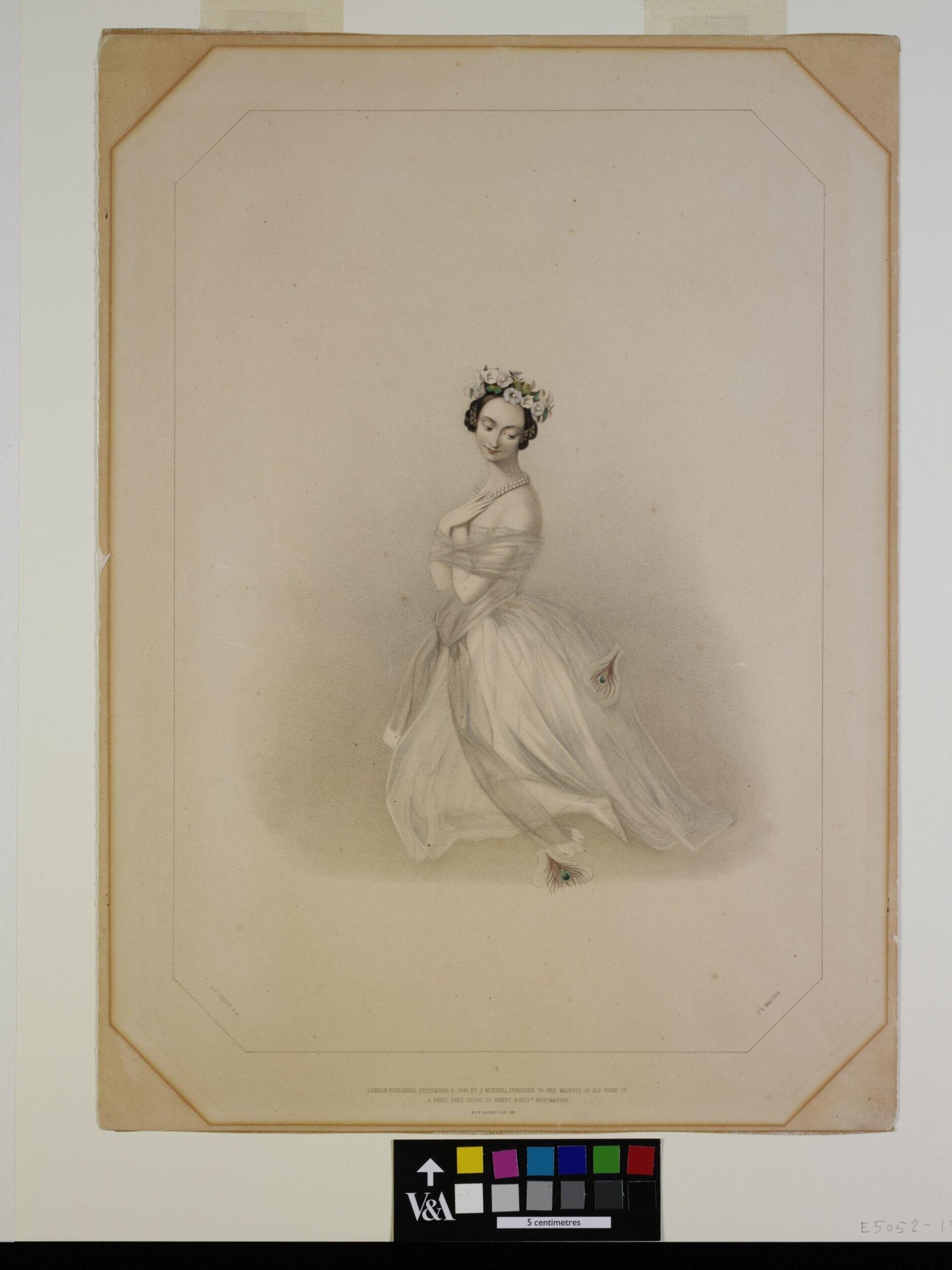
A young woman in Romantic-era court dress stands in three-quarter view against a plain background, her weight settled on her back leg in a pose of studied elegance. She wears a white ball gown with a fitted bodice and voluminous skirt caught mid-swirl, the fabric rendered with delicate shading to suggest movement and the weight of silk. A pearl necklace adorns her throat, and her dark hair is crowned with white flowers and feathers—a fashionable arrangement of the 1840s. Her right arm is extended gracefully, the hand positioned as if acknowledging an audience or partner; her gaze is directed downward and inward, in the demure, introspective manner typical of Romantic portraiture. The composition is framed by an elegant double-line border, suggesting this is a finished print ready for exhibition or sale.
The dancing
The dancer's frame is upright but softened, with the torso held in gentle contraposto. Her extended right arm is raised to about shoulder height, the elbow slightly bent and the hand relaxed—a gesture of openness and grace characteristic of the Romantic ballet vocabulary. The left arm sits closer to the body, enhancing the asymmetry. Her weight is clearly transferred to the back leg, allowing the front leg to be free and the skirt to drape and flow. The pose suggests a moment between steps rather than a locked position, which is consistent with the Romantic-era emphasis on effortless lightness.
The dance depicted
This is almost certainly a portrait of a Romantic ballet dancer, most likely a prima ballerina, captured in a moment of performance or rehearsal attire. The white dress, the pointe-readiness of the posture, the flower crown, and the downward-gazing introspection are all hallmarks of Romantic ballet's aesthetic—the ethereal, otherworldly quality that defined the genre in the 1830s–1850s. The absence of pointe shoes in the image is not unusual for prints of this period; artists often generalized or omitted technical details. The pose itself—the arm extension, the subtle weight shift, the elongated line of the body—speaks to a dancer trained in the classical vocabulary. Without an inscription or title, the specific identity of the dancer cannot be confirmed, but the work functions as a generic apotheosis of the Romantic ballerina ideal rather than a portrait of an individual.
How it was made
This is a hand-colored or tinted lithograph or engraving, executed with fine, precise line work and subtle tonal gradations achieved through careful stippling and cross-hatching. The medium allowed for the reproduction of a delicate drawing and distribution to a wide audience; such prints were sold individually to theater-goers and dance enthusiasts as souvenirs, keepsakes, or decorative objects for the parlor. The double-line border and the even handling of the background suggest a commercial print made for the mass market rather than a unique work. The fineness of the draughtsmanship and the elegance of the composition indicate a professional printmaker working from a drawing or painting by a named artist.
About this work
This is a portrait of a Romantic-era ballet dancer in performance dress, executed as a tinted engraving or lithograph circa 1845. The work captures the aesthetic ideals of Romantic ballet—ethereal grace, introspection, and the illusion of weightlessness—through the careful rendering of pose, costume, and expression. As a commercial print, it documents both the visual vocabulary of mid-19th-century ballet and the star-image culture of the theater, where dancers became objects of both artistic and commercial veneration. The work is significant as a record of how Romantic ballet was visualized and circulated to the public, and as evidence of the codified beauty standards that governed the genre.
How to look at it
Attend first to the pause in the movement: this is not the apex of an extension or the completion of a turn, but a moment of suspension between steps, where the dancer appears to be gathering herself. Notice how the artist has used the white dress to suggest the weight and flow of the skirt, and how the line of the legs beneath it implies readiness and control. The downward gaze is essential—it is not a realistic portrait of the dancer's eye line during performance, but a deliberate choice to suggest inwardness and the otherworldly quality that Romantic ballet prized. Compare the proportions and posture to paintings of classical ballet dancers from earlier decades: the elongation of the line, the softness of the frame, the prominence of the costume, and the ethereal quality of the presence are all signatures of the Romantic period.
The artist
Alfred Edward Chalon (1780–1860) was a London-based painter and lithographer of considerable reputation. He was known for his elegant society portraits and theatrical subjects, including numerous works depicting dancers and operatic performers. His output in the 1830s–1850s included both paintings and reproductive prints, many of which were hand-colored and circulated widely among the middle and upper classes. Chalon's style is characterized by refined draughtsmanship, attention to fabric and costume, and a romantic sensibility that aligned perfectly with contemporary taste. He worked in an era when printmaking was a major form of visual culture and when the theater—and ballet in particular—was a dominant subject of artistic and public interest.
The period
The 1840s were the height of the Romantic ballet era, a period when the ethereal, supernatural, and otherworldly became the dominant aesthetics of the art form. Marie Taglioni's triumph in *La Sylphide* (1832) had established the pointe shoe and the sylph-like body as the ideal of beauty, and the subsequent 15 years saw an explosion of ballets featuring sylphs, spirits, and mystical beings. At the same time, lithography and hand-colored engraving had become the dominant media for reproducing theatrical images, allowing producers and artists to create and sell portraits of dancers to an eager public. These prints served both as keepsakes of favorite performances and as instruments of the emerging star system, which made individual dancers into celebrities whose images could be possessed and admired at home. The scale and distribution of such works helped establish ballet as a mass-market entertainment and the dancer's body as an object of aesthetic and commercial interest.
Where it lives
This work is held in the Victoria and Albert Museum's print collection, a major holding of theatrical and dance-related works from the 18th and 19th centuries. As a commercial print, it was part of the mass circulation of ballet imagery in the mid-19th century and was likely sold through print shops, at the theater, or by subscription.
Dance in this work
Questions about this work
Is this a portrait of a specific dancer?
The catalogue record does not identify a subject, and the print bears no visible inscription. The work is best understood as a generic image of the Romantic ballerina ideal—a composite of the period's aesthetic values rather than a portrait of an individual performer. However, if this is indeed a Chalon print from the 1845 era, it may well be based on a famous dancer of the time; consulting archival records of Chalon's commissions or theater playbills could confirm a specific identity.
Why is the dancer not on pointe?
The dancer's feet are not clearly visible in the image, so it is impossible to say definitively whether she is en pointe. Even so, printmakers of the period often omitted or generalized technical details like pointe shoes in favor of emphasizing the overall line and grace of the figure. The posture and weight distribution are consistent with Romantic ballet training, whether on pointe or demi-pointe.
What does the flower crown signify?
The crown of white flowers and feathers was a standard ornament of Romantic ballet, worn by soloists and in ballet divertissements. It had no specific narrative meaning but rather signaled elegance, youth, and the ethereal beauty that the genre prized. Flower crowns appear in countless prints and paintings of mid-19th-century dancers.
How was this print made?
Based on the fine line work, the subtle tonal gradations, and the overall style, this appears to be an engraved or lithographed line drawing that was then hand-tinted with watercolor or other pigments. This was the standard method for producing colored theatrical prints in the 1840s, allowing for both precision and relatively affordable reproduction.
More dance artwork





