49 works in this view — arrow keys or swipe to move between them.
Dance in Art
Chalon, Alfred Edward
- Collection:
- Source:
- Victoria and Albert Museum
- Rights:
- Rights vary by item — check the source record before reusing this image. Source record ↗
- Recorded as:
- V&A — check rights per item
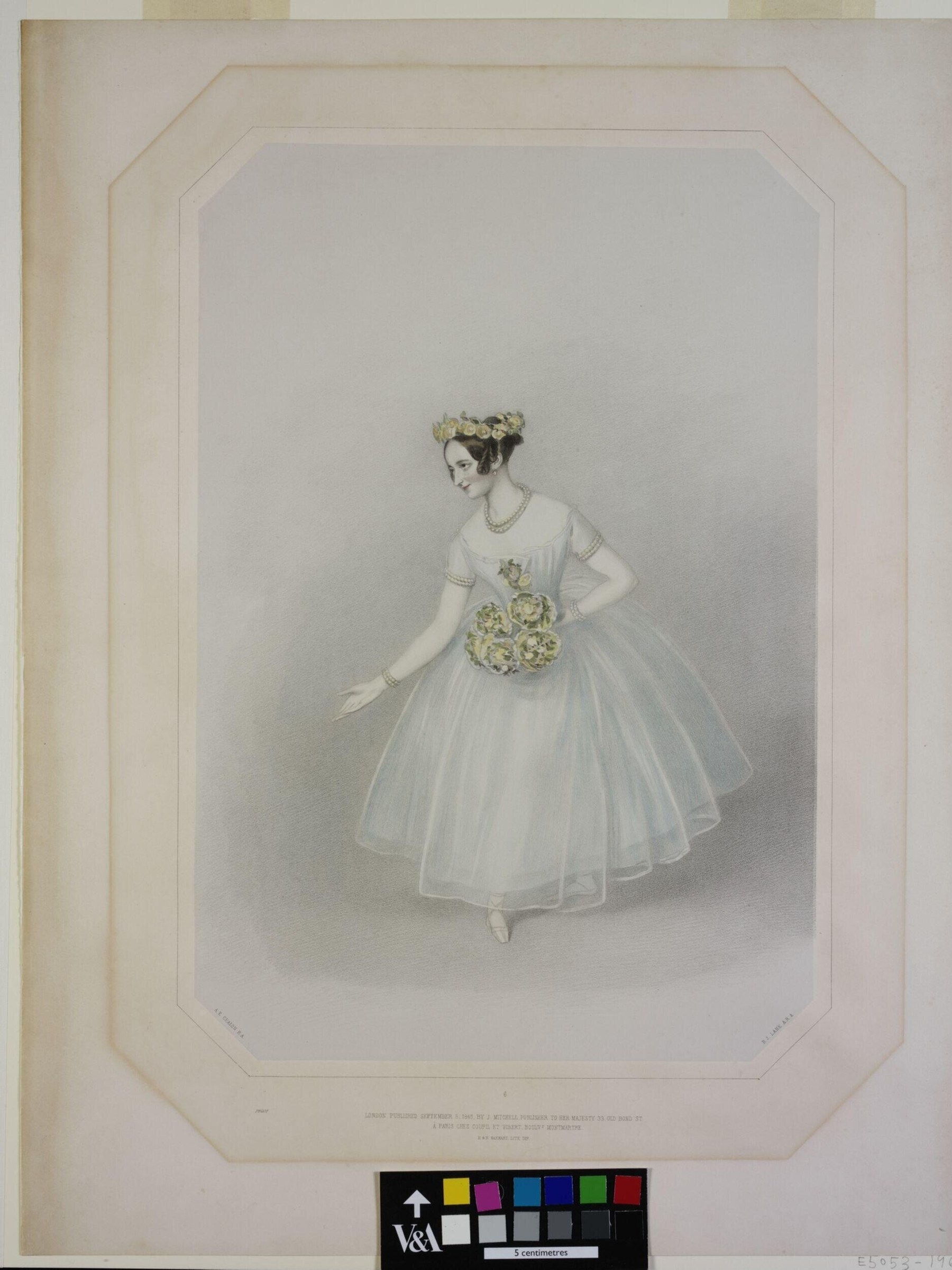
This image is a primary document of Romantic-era ballet aesthetics and of the visual culture surrounding professional female dancers in the nineteenth century. The work shows what Romantic ballet looked like to its contemporary audience—not through notation or later reconstruction, but through a moment consciously chosen for publication and sale. It records both technical detail (the cut of the costume, the position of the foot) and cultural aspiration (the idealization of feminine grace and otherworldliness).
What you are looking at
A young woman in white is posed in three-quarter view against a neutral background, turning slightly as if mid-movement. She wears a fitted white or pale silk bodice with short sleeves and a full skirt of white tulle that extends to mid-calf, caught in a graceful, slightly gathered line suggesting motion. Her dark hair is crowned with a garland of yellow or golden flowers, and she wears a delicate necklace. One arm rests lightly at her side while the other gestures outward and downward with refined ease, her hand extended in a gesture of presentation or invitation. She stands in a balletic posture on or near the ball of one foot. The composition is intimate and the figure fills most of the framed space within the elaborate border characteristic of early nineteenth-century prints. The rendering is delicate, with careful attention to the play of light on the tulle and the pale tones of her costume.
The dancing
A single female figure occupies the entire composition. Her weight is distributed with a dancer's refinement, appearing to rest primarily on one leg in a position suggesting turnout. Her upper body is upright but relaxed, with her shoulders open and her neck long. Both arms are positioned away from her torso—one extended to the side and slightly forward, the other resting naturally—creating an open, unselfconscious frame typical of early Romantic period aesthetic. The pose is neither rigid nor dramatically contorted, suggesting ease and grace rather than technical display.
The dance depicted
This appears to be a portrait of a Romantic-era ballet dancer, most likely in a moment from a theatrical performance or as a study of the dancer's characteristic pose and bearing. The white tulle skirt, pointe shoes (visible at the foot), delicate corseting, and floral crown are standard costume elements of Romantic ballet from the 1830s–1840s. The pose suggests a moment of stillness or transition within a choreographed piece rather than a fully supported balance or turning movement. The image documents the aesthetic ideal of the period: ethereal, weightless femininity expressed through an open, graceful posture.
How it was made
This is a hand-colored lithographic print, evident from the delicate tonal gradations and the characteristic soft edges and fine detail possible in that medium. The print has been carefully colored in pale hues—likely by hand or early color printing techniques—with particular attention to rendering the translucency of the tulle skirt and the warm tones of the floral crown. The decorative double border and the print's refined presentation suggest this was a product of significant commercial investment, likely part of a series of popular theatrical portraits circulated during the early Romantic period.
About this work
This hand-colored lithograph documents an iconic figure of Romantic ballet at its height of popular influence in the 1840s. The work captures the aesthetic of early Romantic choreography through a single dancer in a moment of poised stillness—a pose that conveys both technical training and the period's obsession with feminine ethereality and grace. The image is characteristic of the mid-nineteenth-century print trade in theatrical portraiture, when such images were collected avidly by the theatergoing public and served as records of celebrated dancers and their defining roles.
The work sits at the intersection of fine printmaking, commercial entertainment, and dance history. The skill of the lithographer lies not in capturing dramatic movement but in rendering the refined proportions and materials of Romantic ballet costume, and the psychological presence of a trained performer aware of her audience.
How to look at it
The print captures not a moment of explosive movement but a moment of poise—the dancer at rest but always ready, her body aligned and open. The viewer should attend to the precision of her posture: the way her weight is held, the placement of her arms, the line from head through spine. Notice also the extreme care taken to render the tulle skirt—how the lithographer used gradations of tone to suggest its transparency and weight. The floral crown and the delicate necklace reinforce the period ideal of the ballerina as a refined, almost decorative figure within a theatrical frame.
The artist
Alfred Edward Chalon (1780–1860) was a prolific English painter and lithographer specializing in theatrical portraiture and society subjects. He was much employed by the aristocracy and by theatrical management to produce likenesses of celebrated performers, and his lithographs enjoyed wide circulation. Chalon's work bridged fine art and commercial entertainment, and he was skilled at capturing both the individual likeness of his sitter and the idealized aesthetic of her role.
The period
By 1845, Romantic ballet was at the height of its influence and popularity in Europe. Dancers such as Marie Taglioni had become international celebrities, and prints and paintings of celebrated performers were major commercial products. The silhouette of the female dancer—narrow waist, bell-shaped tulle skirt, upright carriage—had become a recognizable symbol of refinement and fashionable taste. Lithography, a relatively new technology, made it possible to produce multiple copies of such images quickly and affordably, democratizing access to theatrical portraiture. The period was also the height of the fashion for pale, ethereal costume and the aesthetic of the ballerina as an otherworldly, almost supernatural figure.
Where it lives
This is recorded as part of the V&A (Victoria & Albert Museum) collection and is catalogued as a print. It is a work from the museum's holdings of theatrical portraiture and dance-related graphic material.
Dance in this work
Questions about this work
Is this a photograph or a drawing?
It is a hand-colored lithograph—a print made from a drawn image on stone. Lithography was a commercial printing technique that allowed artists to produce multiple copies; the hand coloring was added afterward to each print. This technique was common for theatrical portraits in the nineteenth century before photographic reproduction became standard.
Can you identify the dancer or the role?
The catalogue record does not identify the specific dancer or role. Based on costume and style, this is a Romantic-era ballet dancer, likely from the 1840s, but without inscription or further documentation we cannot identify which performer or which ballet this depicts. If you recognize the image, the museum would be interested in that information.
Why is she wearing flowers in her hair?
Floral crowns or wreaths were standard costume elements in Romantic ballet, used to suggest nature, innocence, or ethereality depending on the role. They were often integrated into elaborate headdresses and were part of the visual language that conveyed the character and mood of the ballet.
What is she standing on?
She appears to be on or near the ball of one foot, a position central to ballet technique. Whether she is en pointe (on the tip of the toe) or demi-pointe (on the ball of the foot) cannot be determined with certainty from the print, but her refined posture and the context make clear this is a trained dancer in a balletic position.
More dance artwork





