49 works in this view — arrow keys or swipe to move between them.
Dance in Art
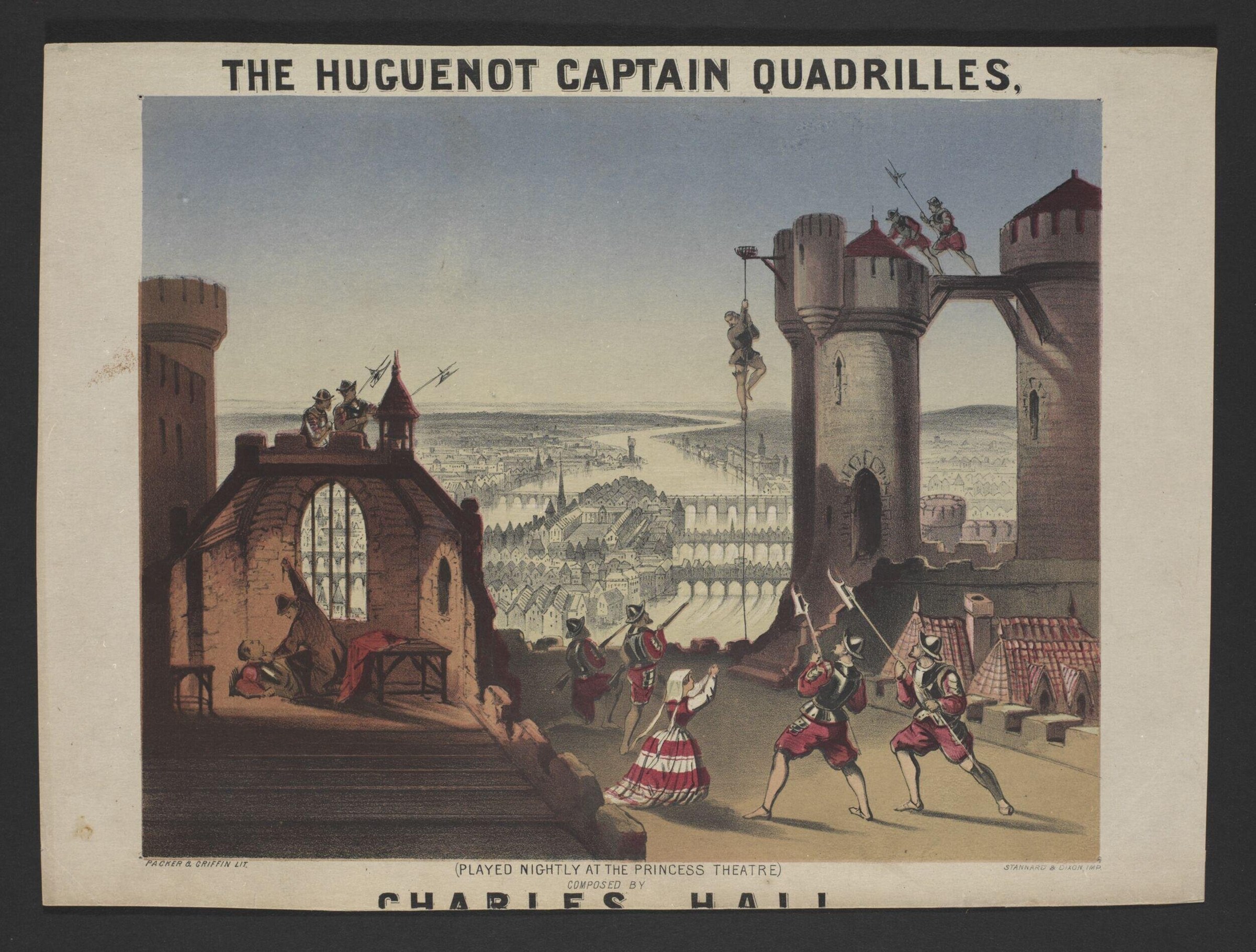
The Huguenot Captain Quadrilles
Charles King Hall
- Collection:
- Music
- Source:
- Victoria and Albert Museum
- Rights:
- Rights vary by item — check the source record before reusing this image. Source record ↗
- Recorded as:
- V&A — check rights per item
This image is crucial evidence for how social dances circulated through theatrical production in the Victorian era, and how narrative dance forms were built by adapting existing ballroom structures to new dramatic purposes. It also shows the quadrille's reach: not as domestic amusement, but as a vehicle for historical spectacle and military character work.
What you are looking at
A theatrical scene set within a fortified medieval castle, viewed as if from a stage looking out across a distant landscape of rivers and towns. The composition is dominated by monumental crenellated towers in warm brick red, with arched gateways and a machicolated gatehouse at center. In the immediate foreground, three figures in red-and-white striped breeches perform what appears to be a vigorous combat or acrobatic demonstration, their bodies in dynamic poses suggesting leaping or thrusting motions. To the left, a smaller scene shows an interior chamber where a figure sits, observed by attendants in darker dress. The background cityscape stretches beneath a clear sky, rendered in receding tones. The entire composition has the character of a theatrical backdrop or drop scene, with careful linear perspective establishing depth from the immediate action forward.
The dancing
Three male figures in the foreground occupy individual positions across the stage floor, none in contact with one another. Each holds what appears to be a pike or sword, with arms raised and extended in aggressive attitudes—some overhead, some diagonal. Their bodies are arched and tilted, suggesting either a fencing or pike drill executed in separated positions. The legs are straight and weight appears shifted onto single legs in lunging or stepping poses. The dress—striped red and white breeches with short jackets—is consistent across all three. In the shadowed interior left, figures are more static, seated and standing in formal observation.
The dance depicted
The work depicts a quadrille, as stated in the title, and the specific reference to 'The Huguenot Captain' suggests this is theatrical choreography linked to a dramatic narrative about religious conflict. The three figures appear to be executing a military-inflected quadrille, which was a popular social dance of the 19th century that could be adapted to theatrical and dramatic themes. The postures suggest that rather than ballroom movement, these dancers are performing a stylized military or duel-mimicking variant, using the quadrille's disciplined formation structure. The spacing, the upright carriage, the use of hand-held props (pikes or swords), and the angular body positions all indicate this is a theatrical interpretation of a social form.
How it was made
This is a hand-colored lithograph, as evidenced by the soft chromatic washes, the subtle gradations of tone, and the characteristic texture visible in the sky and stone surfaces. Lithography allowed for the broad distribution of theatrical imagery in the 19th century, and the careful coloring suggests this was a valued marketing image or souvenir. The technique's capacity for fine linear detail in the architecture and costume combined with painterly color made it ideal for costume and scenery documentation. The credit lines visible at the bottom ("PRINTED & SMITH" and what appears to be a publisher's mark) confirm this was a commercial theatrical print, likely produced for sale to theatergoers or as a record of a production.
About this work
This lithograph documents a theatrical quadrille from a production titled *The Huguenot Captain*, which was performed at the Princess Theatre in London. It is not a record of social dance but of staged, narrative dance—a quadrille adapted to dramatic purpose and set within an ornate historical mise-en-scène. The work belongs to the tradition of 19th-century theatrical dance prints, which used the new medium of lithography to capture costumes, formations, and scenic spectacle for audiences who wanted to remember or imagine the production. The print demonstrates how ballroom dances like the quadrille were absorbed into theatrical production, hybridized with pantomime, military spectacle, and historical drama.
How to look at it
Attend first to the spatial composition: the three dancers are evenly spaced across the stage floor in a formation, not clustered. Notice how the artist has caught each figure in a different moment of a movement phrase—one leg forward, arms at different heights—suggesting the simultaneous execution of a choreographed sequence. The pikes and swords are not realistic weapons but props for theatrical effect; observe how they frame and extend the bodies' lines. The careful rendering of the castle towers and distant landscape tell us this is a *scene*, not a ballroom—the dance happens in front of history and architecture, not in an abstract space. The hand-coloring is uneven, which was typical of theatrical prints produced for rapid distribution.
The artist
Charles King Hall was a 19th-century composer active in London theatrical circles. The credit on this print indicates he composed the music for *The Huguenot Captain*. Little is recorded of his wider practice, but his association with the Princess Theatre suggests he was engaged in the mid-market London theater world of the 1860s, composing for dramatic works that combined musical performance, dance, and spectacular scenery.
The period
The 1860s saw the quadrille at the height of its theatrical popularity in Britain. What had begun as a fashionable ballroom dance in the early 19th century had become a standard element of pantomime, burlesque, and theatrical spectacle. Producers discovered that the quadrille's formal structure, clear formations, and familiarity to audiences made it ideal for adaptation: it could be made military, comic, acrobatic, or historical by adjusting costume, props, and character. The *Huguenot* theme—drawing on the 16th-century religious wars and the persecution of French Protestants—allowed for drama and spectacle while maintaining the dance form's structural integrity. This was the era of increasing theatrical production values and the rise of the picture-frame stage, all of which is visible in the careful rendering of scenery here.
Where it lives
This lithograph is held in the Music collection at the source institution (va), suggesting it was catalogued with musical materials rather than visual art—likely because it was bound with the published musical score or preserved as a theatrical souvenir alongside printed music. It represents a common type of 19th-century theatrical ephemera: a hand-colored print made for sale to theater patrons and for archival use by theater companies.
Dance in this work
Questions about this work
Is this a social dance or a staged performance?
This is a staged performance of a quadrille, not a ballroom dance. The setting is theatrical (the castle backdrop), the costumes are character-specific (striped breeches and jackets suited to a 16th-century military narrative), and the formation and props (pikes) have been adapted for dramatic effect. The quadrille was originally a ballroom dance, but here it has been transformed into theatrical choreography.
Why are the dancers using pikes?
The pikes are props that integrate the dance into the dramatic narrative of the production. *The Huguenot Captain* was a play about religious conflict and military struggle, so the pikes—whether used to mime combat or simply to extend the body line and add visual spectacle—served both narrative and aesthetic purposes. This was common in 19th-century theatrical dance, which was often plot-driven rather than abstract.
What is a quadrille?
A quadrille is a square dance for four couples (or, in this theatrical case, fewer dancers in a modified formation) that was enormously popular in ballrooms throughout the 19th century. It consists of five figures, each with a distinct sequence of steps and formations. The quadrille was structured and choreographed—unlike waltzes or free social dancing—which made it easy for theaters to adapt and for audiences to recognize.
Why was this image printed and distributed?
Theatrical prints like this served multiple purposes: they were sold as souvenirs to theatergoers, used for advertising and program illustration, and retained by theaters as records of productions. Lithography made such prints affordable and allowed for hand-coloring, making them attractive merchandise. They also served as visual evidence of costume design and scenic spectacle, matters of considerable pride to Victorian theater companies.
More dance artwork





