49 works in this view — arrow keys or swipe to move between them.
Dance in Art
Mug
Hancock, Robert
- Collection:
- Mug
- Source:
- Victoria and Albert Museum
- Rights:
- Rights vary by item — check the source record before reusing this image. Source record ↗
- Recorded as:
- V&A — check rights per item
This mug preserves a rare moment of everyday dance practice in the 18th century—not a performance or a formal portrait, but a scene of social courtship that would have been immediately recognizable to contemporaries. The transfer-printed image broadcasts knowledge of fashionable dance gestures and courtship ritual to a broad domestic audience, revealing how dance was understood, valued, and circulated through material culture.
What you are looking at
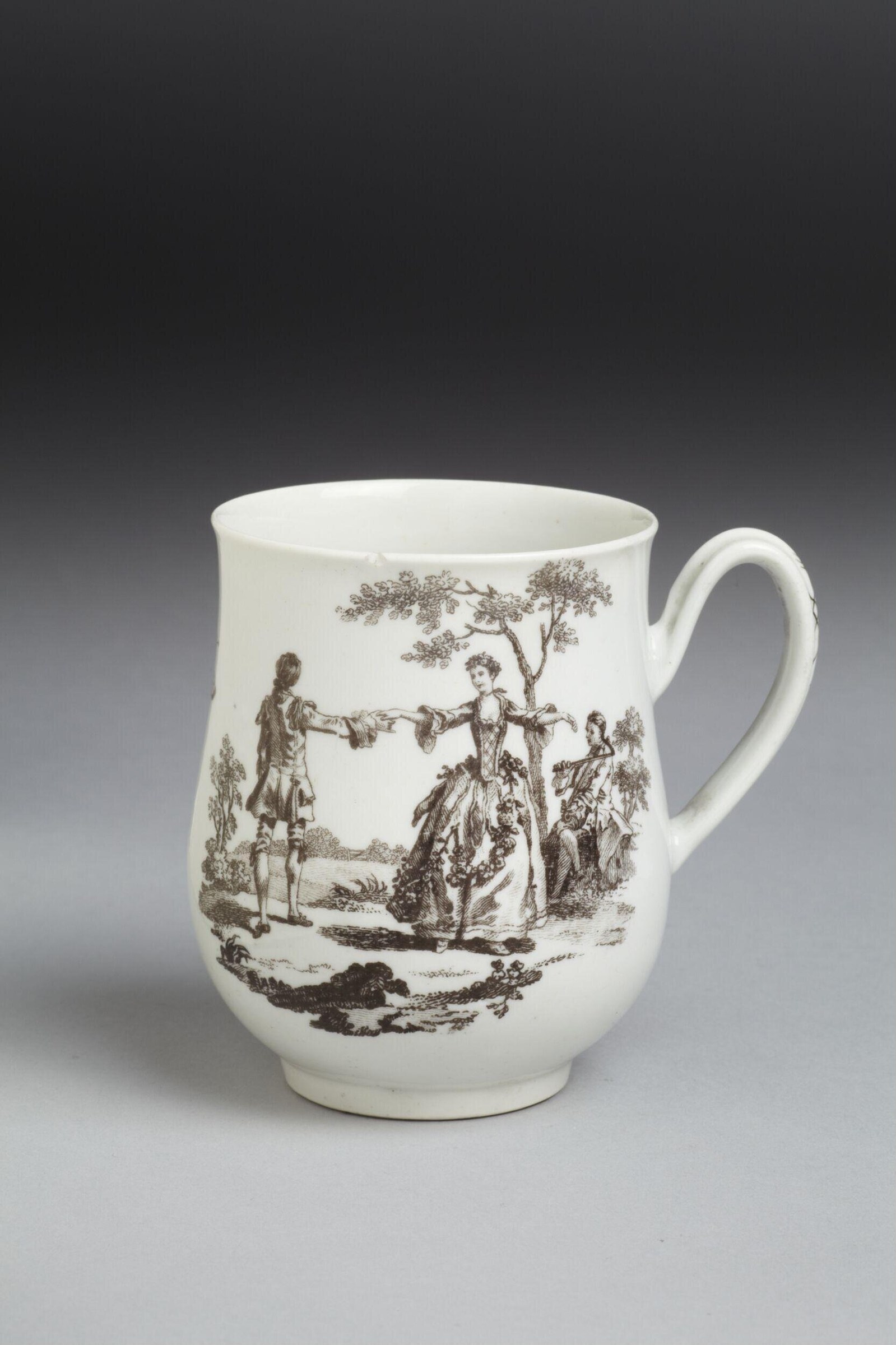
A porcelain mug printed in sepia or brown shows an 18th-century outdoor scene of courtship or social entertainment. A well-dressed man in a coat and tricorn hat stands to the left, extending his hand toward a woman in an elaborate dress with panniers and decorative trim, who stands beneath a gnarled tree. She gestures toward him with both arms raised in a welcoming or dancing posture. To their right, two other figures—a man and woman—stand together observing the central pair. The background shows a distant landscape with cypress trees and water. The composition is framed at the base by a grassy bank rendered in darker pigment, creating a theatrical stage effect. The engraved design is characteristic of mid-18th-century transfer-printed earthenware, where narrative scenes of refined leisure were popular decorative subjects.
The dancing
The central female figure displays the open, raised-arm posture typical of 18th-century social dance: both arms are lifted to shoulder height or above, with palms open and fingers extended in a gesture of invitation or welcome. Her weight appears evenly distributed, her body facing the man. The male figure adopts a responsive stance, one arm extended toward her in offer. Both figures maintain the upright carriage and formal frame expected of polite dancing in this period. The two background figures stand in static poses, positioned as spectators or as a couple in conversation rather than active dancers.
The dance depicted
This image most likely documents a moment from a Regency or early Georgian social dance, probably a minuet or another courtly social form such as a country dance or cotillion. The open arm positions, the formal dress, and the refined outdoor setting all align with documented 18th-century courtship dances. The scene emphasizes the invitation and acceptance of a dance partner—a pivotal social ritual—rather than the execution of a specific choreographic figure. The presence of spectators and the theatrical framing suggest this is a significant or admired pairing, recording a moment of social courtship through movement.
How it was made
This is a transfer-printed earthenware mug, a manufacturing technique that became widespread in England from the 1750s onward. The design was engraved on a copper plate, then transferred onto the ceramic surface via tissue paper and fixed by firing. This technique allowed for the mass production of decorated tableware with detailed narrative scenes, making refined imagery accessible to a broad middle-class market. Transfer printing was cheaper and faster than hand-painting, enabling makers like Robert Hancock to distribute their designs widely. The sepia or brown monochrome printing is typical of the period and reproduces the tonal qualities of an engraving.
About this work
This mug is a document of 18th-century dance culture embedded in domestic material culture. The transfer-printed image shows a moment of courtship through dance in refined outdoor society—the woman's open, raised arms and the man's responding gesture capturing the invitation and acceptance ritual that was central to minuets and other formal social dances of the period. Such scenes were popular decorative themes on English earthenware of the 1760s and after, aimed at consumers who wished to display their knowledge of polite society and fashionable behavior. The mug allowed owners to surround themselves daily with imagery of refined leisure and courtship, making the dances of the elite visually available to those who might aspire to them.
How to look at it
Attend to the woman's arm position and posture: the raised, open arms are the visual signature of an invitation to dance in 18th-century courtship ritual. Notice her upright frame and the man's mirroring response—the balanced, formal carriage that distinguishes courtly social dance from other movement. The theatrical framing of the scene at the base, the refined dress, and the presence of spectators all emphasize that this is a moment of significance in a formalized social ritual, not merely casual movement. The composition captures the moment of acceptance and proposal, the choreographic and social threshold that makes the dance possible.
The artist
Robert Hancock (c. 1730–1817) was a pioneering engraver and designer of transfer-printed earthenware who worked for English potteries including Worcester and Battersea. He developed and refined the technique of transfer printing on ceramics and created hundreds of designs, including narrative and allegorical scenes, chinoiserie, and landscape compositions. His designs were widely imitated and copied, and his work helped establish England as a center for decorated earthenware production in the mid-18th century.
The period
The 1760s were a peak period for English transfer-printed earthenware, as industrialization and the expansion of the middle class created demand for decorated domestic goods. Dance was central to 18th-century courtship ritual and social display, and minuets and country dances were the primary forms through which men and women of the gentry and aspiring middle class conducted their social and romantic lives. Images of dancers on plates, mugs, and other domestic objects allowed consumers to surround themselves with imagery of polite refinement and fashionable behavior. At the same time, the formal courtship dances of the earlier 18th century were beginning to give way to the more varied and lively social dances of the later period.
Where it lives
This mug is held in the V&A collection (as indicated by the source record 'va'). It is a product of English earthenware manufacture, likely from a London or provincial pottery such as Worcester or Battersea in the early 1760s. Transfer-printed domestic wares of this period are well-represented in major museums and remain common in the antiques market, reflecting their wide production and popularity.
Dance in this work
Questions about this work
How do we know this shows a dance and not just two people greeting?
The raised arms, the formal outdoor setting, the refined dress, and the presence of spectators all mark this as a choreographed social moment. The woman's open, symmetrical arm position is the visual signature of an invitation to dance in 18th-century courtship ritual. The man's responding gesture indicates acceptance of that invitation. The composition emphasizes the formal and ritualized nature of the interaction in a way that distinguishes dance from casual social greeting.
What dance is this showing?
The image most likely shows a minuet or a related courtly social dance such as a country dance or cotillion. The formal dress, the refined outdoor setting, the open arm positions, and the presence of spectators are all consistent with elite 18th-century social dances of invitation and courtship. However, the image captures the moment of invitation rather than a specific choreographic figure, so the precise form cannot be determined from the visual evidence alone.
Why would a dance scene appear on a mug?
Transfer-printed earthenware of the 1760s often featured narrative scenes of polite leisure, courtship, and refined behavior. Such imagery allowed middle-class consumers to display knowledge of and aspiration toward fashionable elite society. A mug with a dance scene allowed the owner to surround themselves daily with imagery of courtship and social refinement, making elite practices visually familiar and aspirational.
Who was Robert Hancock?
Robert Hancock was an English engraver and ceramicist (c. 1730–1817) who pioneered the technique of transfer printing on earthenware. He created hundreds of designs for English potteries including Worcester and Battersea, and his work helped establish England as a center for decorated ceramics in the mid-18th century. His designs were widely copied and imitated.
More dance artwork





