49 works in this view — arrow keys or swipe to move between them.
Dance in Art
The Love Song
Billedcentralen Politikens Presse
- Collection:
- Photograph
- Source:
- Victoria and Albert Museum
- Rights:
- Rights vary by item — check the source record before reusing this image. Source record ↗
- Recorded as:
- V&A — check rights per item
This image captures a specific moment in twentieth-century dance when historic dance forms were being actively revived and reinterpreted for theatrical audiences. The presence of the music and the formal, pedagogical quality of the pose suggest a production designed to educate and move its audience through the language of a past era—a practice that shaped both ballet and modern dance in the early twentieth century.
What you are looking at
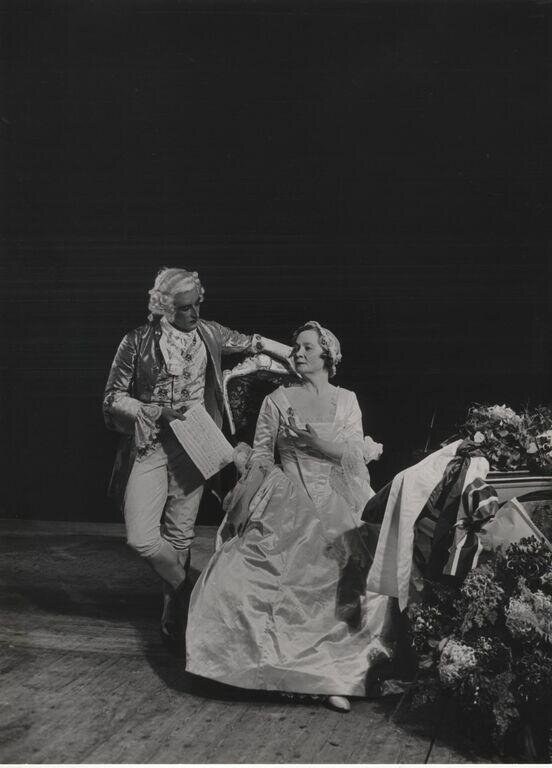
A man and woman dance together on a stage lit from above, their figures caught against a deep black background. The man, in eighteenth-century court dress—silk coat with ornate embroidery, breeches, and formal hair—reaches toward the woman with one arm while holding a sheet of music or text in the other. The woman wears a full-skirted gown in pale fabric, her posture open and receptive. The moment is theatrical and intimate: she looks toward him while he gazes outward, as though performing their encounter for an audience. The floor is visible beneath them, and flowering plants or greenery frame the right edge of the composition, suggesting a garden or pastoral setting. The photograph captures them mid-movement, the woman's skirt in soft motion.
The dancing
The pair stand in an open, facing position rather than a closed ballroom hold. The man extends one arm toward the woman in a gesture of courtship or declaration while retaining the music in his other hand; his body is upright and formal. The woman's weight appears centered, her arms loosely held, her gaze directed at the man. Neither figure shows the rigid frame of later ballroom technique; instead, the posture suggests the looser, more naturalistic carriage of eighteenth-century dance, where the upper body was relatively still and movement came from the legs and the turning of the torso.
The dance depicted
This appears to document a theatrical or balletic rendering of an eighteenth-century court dance or courtship scene, most likely a minuet or gavotte reimagined for the stage. The title *The Love Song* and the presence of music as a prop suggest a narrative piece in which dance enacts a declaration or exchange of affection. The formal, symmetrical composition and the carefully arranged costuming indicate this is a posed theatrical photograph rather than a record of social dance; it is the kind of image a ballet or operatic company would commission to promote a production or document a specific moment in a work's narrative.
How it was made
This is a black-and-white photograph, credited to Billedcentralen Politikens Presse (a Danish newspaper and publishing house's photo archive). The photograph is studio-lit, with the dancers positioned against a plain dark backdrop to isolate the figures and create drama. The clarity and stillness of the image, combined with the theatrical lighting and composed pose, indicate this is a promotional or documentary photograph of a stage performance, not candid photography. This type of photograph would have circulated in newspapers and theatre publicity during the 1930s, reaching both the theatre-going public and the archive.
About this work
This is a photographic record of a theatrical dance performance from 1932, likely from a European ballet, opera, or theatrical production. It captures a moment of courtship rendered in the vocabulary of eighteenth-century court dance—minuet, gavotte, or other historic balletic forms revived for the stage. The work sits within the long tradition of theatrical dance that uses historical costume and gesture to stage romantic narrative, a tradition central to both Romantic ballet and to early twentieth-century theatrical practice. The photograph is as much a document of 1930s theatre aesthetics and promotion as it is of dance itself.
How to look at it
Notice the deliberate formality of the pose and the way the photographer has lit the figures to emphasize their costumes and gestures rather than their movement quality. The man's gaze outward (rather than at his partner) and the woman's more enclosed, responsive posture enact a social dynamic in which the declaration comes from one direction. The sheet of music visible in the man's hand is not incidental: it anchors the dance to song and sentiment, suggesting this is a moment in which feeling is expressed through both music and movement together.
The artist
Billedcentralen Politikens Presse was the photography division of Politikens Hus, the main office of Politiken, Denmark's major newspaper. The archive produced thousands of photographs for editorial use and publicity purposes from the 1920s onward. These were professional studio photographers working in the service of journalism and cultural promotion; they documented theatre, dance, opera, and public events across Denmark and Scandinavia.
The period
The 1930s saw a broad European movement to recover and reinterpret historic dance forms, particularly those of the Baroque and Rococo courts. This impulse coexisted with the modernist avant-garde; while some choreographers pursued abstraction and contemporary movement, others staged elaborate productions that drew on period costume, music, and narrative. Denmark had a strong ballet tradition through the Royal Danish Ballet, and theatrical dance was a significant cultural form. This photograph dates to the period when such productions were widely documented and promoted through photography.
Where it lives
The photograph is held in the Billedcentralen Politikens Presse archive, a major newspaper photograph collection. It was created for editorial or promotional use and would have been available to newspapers and cultural publications of the time.
Dance in this work
Questions about this work
What dance are they doing?
The image does not specify. The formal court dress and the eighteenth-century style suggest a minuet, gavotte, or similar Baroque or Rococo form, but the theatrical staging means this is likely a choreographed interpretation created for the stage rather than a historically accurate reconstruction. The title *The Love Song* suggests the dance is being used to enact a romantic narrative rather than to preserve a specific historic form.
Who are the dancers?
The photograph does not identify them. Without additional documentation from the production itself or the newspaper archive's records, their names and the production they appeared in cannot be determined from the image alone.
Why is he holding sheet music?
The music is both a literal prop and a symbol. It anchors the dance to the emotion and poetry of song, suggesting that the 'love song' of the title is not sung but danced, and that the two are inseparable. This was a common theatrical device in ballet and operatic theatre of the period.
More dance artwork





