49 works in this view — arrow keys or swipe to move between them.
Dance in Art
Unknown
- Collection:
- Source:
- Victoria and Albert Museum
- Rights:
- Rights vary by item — check the source record before reusing this image. Source record ↗
- Recorded as:
- V&A — check rights per item
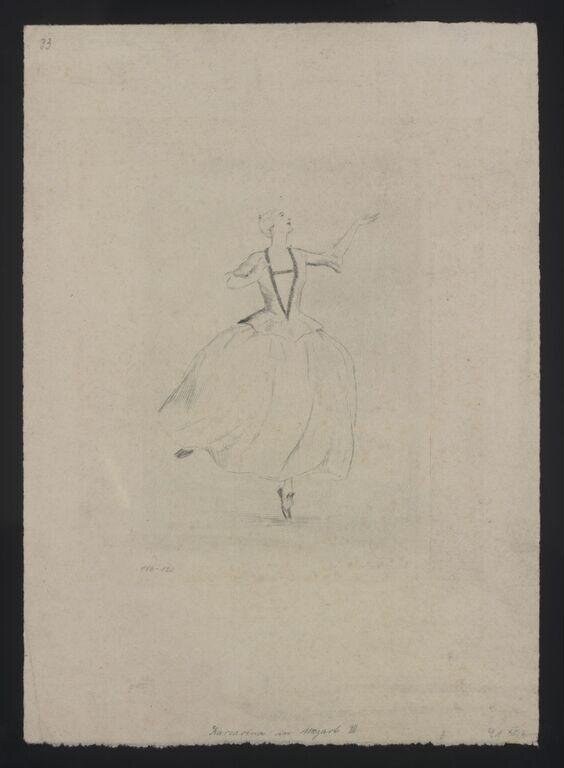
This sketch represents the working process of classical ballet at a moment when dance and visual art were closely integrated. Studies like this were made in the studio and were rarely preserved; its survival offers rare insight into how choreographic ideas were documented and transmitted before film. The confidence and economy of line suggest an artist with deep familiarity with ballet technique—someone who understood the body and its mechanics well enough to describe them in a handful of marks.
What you are looking at
A single female dancer is drawn in a light sketch on aged paper, captured mid-movement in a pose of elevated grace. She wears a fitted bodice with what appears to be a deep V-neckline, from which a full, voluminous skirt extends downward in soft folds. Her arms are raised and extended outward at approximately shoulder height, palms open in a gesture of expansive lyricism. Her weight appears to be on one leg, with the opposite leg suggested beneath the skirt, positioning her en relevé or in a balletic lift. Her head is tilted back slightly, completing the upward trajectory of the pose. The drawing is minimal and economical—quick pencil lines define the figure with particular attention to the line of the torso, the sweep of the arms, and the silhouette of the skirt. There is no setting or background; the dancer exists in white space.
The dancing
A single dancer in a posture of complete openness and height. The raised arms and lifted torso suggest either a moment of ascent in a jump or a sustained port de bras in an upright frame. The skirt falls heavily, indicating classical ballet technique and the weight of tulle or similar material. The pose reads as supported—a single leg carries the body with confidence, and the free leg is folded or raised beneath the skirt volume. The sketchy quality of the line work captures the moment without fixing it rigidly; the body appears suspended rather than solid.
The dance depicted
This is almost certainly a ballet dancer, drawn in a moment of classical technique. The silhouette—fitted bodice, full skirt, raised arms, vertical alignment—is consistent with late nineteenth or early twentieth-century theatrical ballet, particularly the Romantic and post-Romantic periods when tutus of this style were standard. The pose suggests either a penché, an arabesque penché, or a sustained développé with arms raised. The sketch quality and the paper suggest this is a study or rehearsal drawing, possibly made by a choreographer, ballet master, or artist documenting a dancer or a choreographic idea rather than a finished performance record.
How it was made
This is a graphite pencil sketch on aged paper, likely watermarked or toned with time. The lines are confident but loose, with no hatching or shading—the artist relies entirely on contour and the fall of the fabric to describe form. The sketchiness indicates this was likely made quickly, in a studio or rehearsal setting, and was not intended as a finished work for exhibition. The preservation on aged paper and the archival notation suggest it entered a collection as a document of choreographic process or artistic study rather than as an autonomous artwork.
About this work
This is a pencil sketch of a classical ballet dancer in a moment of raised, open-armed extension, drawn with the economy and immediacy of studio practice. The figure emerges from white paper through a few essential lines—the arch of the arms, the line of the torso, the weight of the skirt. The style, silhouette, and execution place it in the late nineteenth or early twentieth century, when such studies were made by choreographers, ballet masters, and artists collaborating with or documenting dance companies. The work belongs in a gallery of dance in art because it captures not a finished performance but the choreographic idea itself—the moment a movement was conceived or refined, before it reached the stage.
How to look at it
Notice the economy of line: the artist has drawn only what is necessary to convey the pose and weight of the body. The skirt is suggested by a few curved lines that indicate volume and fall; the arms are open and extended with only the barest indication of muscle or joint. The head is tilted back, completing the vertical lift of the figure. This is not a portrait of a person but a study of a moment—a frozen frame of a movement in progress. The paper and the casualness of the medium suggest you are looking over the shoulder of someone working, thinking through a choreographic phrase or recording a dancer's interpretation.
The period
This drawing dates to a period when ballet was becoming increasingly codified and when the notation and documentation of dance were subjects of serious artistic and technical interest. The silhouette and technique are consistent with the work of late Imperial Russian ballet or Western European ballet in the decades around 1900. The practice of making studio sketches was common among choreographers and dancers' partners; Edgar Degas and other visual artists also worked in this mode, capturing dancers in rehearsal and in the studio as a primary subject of artistic investigation.
Where it lives
The work is held as a print in an archive or collection, though the catalogue record does not specify the holding institution or the circumstances of its acquisition. The notation on the paper suggests it entered a collection as a numbered or catalogued item, indicating it was valued as a document or study rather than a finished artwork.
Dance in this work
Questions about this work
Is this a finished artwork or a study?
This is a studio sketch or choreographic study—a quick working drawing made in pencil on paper. It was likely made during rehearsal or in the process of choreographing or interpreting a ballet phrase. The casualness of the line work and the absence of any finished media or presentation suggest it was a working document, not intended for public exhibition until it entered a collection.
What ballet is this from?
The catalogue record does not identify a specific ballet, and the sketch does not contain enough information to assign it to one with certainty. It is a study of a balletic pose and silhouette rather than a documentation of a particular choreography. The style and technique suggest late nineteenth or early twentieth-century European or Russian ballet.
Who made this drawing?
The artist is unknown. The style and execution suggest it was made by someone with professional familiarity with ballet—possibly a choreographer, ballet master, or artist working within or closely observing a ballet company. Such sketches were rarely signed or formally documented.
More dance artwork





