49 works in this view — arrow keys or swipe to move between them.
Dance in Art
Theatre costume
Wilhelm
- Collection:
- Theatre costume
- Source:
- Victoria and Albert Museum
- Rights:
- Rights vary by item — check the source record before reusing this image. Source record ↗
- Recorded as:
- V&A — check rights per item
This garment is evidence of 19th-century ballet practice—the actual materials, construction methods, and design choices that shaped how dancers moved and how audiences perceived them. It preserves a moment when ballet's visual language was still being negotiated between technical virtuosity and romantic narrative, and between court dress and character costuming. For costume historians and dance researchers, the object raises a significant question: the record dates this to 1912, but its style clearly belongs to a much earlier era, making it a potential case study in how theatrical works and costumes were revived, reworked, or reattributed across decades.
What you are looking at
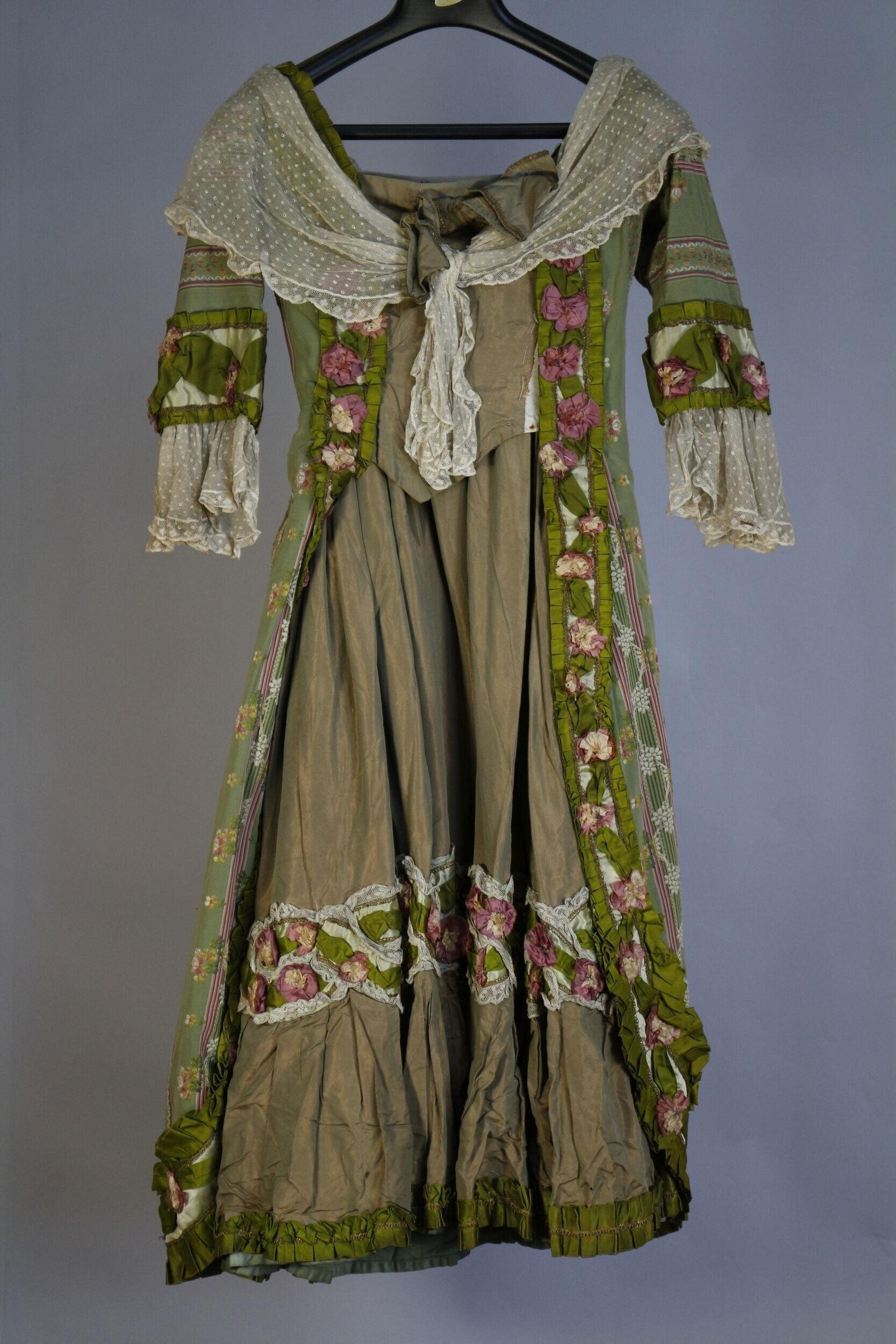
A theatre costume hangs on a black hanger against a neutral grey background. The dress is a full-length gown in muted sage green and cream, constructed in two contrasting sections. The upper bodice is cream linen or cotton, gathered loosely at the front and tied with a cream ribbon. A wide cream lace collar—the style known as a fichu or shawl collar—drapes generously across the shoulders and down the front, finished with delicate lace ruffles at the edges. The sleeves are three-quarter length, cream with fitted bands of sage green ribbon embroidered with pink and red florals. The skirt is the costume's most striking feature: a sage green foundation with bold vertical panels of embroidered floral motifs—pink roses and green foliage—running from waist to hem. The hem is finished with a gathered sage green ruffle. Cream lace edging appears at the waist and at the bottom of the skirt panels, suggesting both decoration and structural reinforcement. The overall silhouette is gathered and full, the waist undefined, suggesting early 19th-century or Romantic-era styling rather than the tighter corseted lines of the 1912 date the record assigns.
The dancing
No figures are present; this is costume documentation. However, the dress's construction tells us about the movement it was designed for. The full gathered skirt would swing and billow with motion, the loose bodice allows freedom in the upper arms and torso, and the wide collar would frame the face and neck in performance. The three-quarter sleeves and emphasis on the shoulders suggest a style that prioritized visibility of arm gestures.
The dance depicted
This is almost certainly a Romantic ballet costume, most likely from a 19th-century work rather than an early 20th-century one. The silhouette—the full gathered skirt, the cream lace fichu collar, the floral embroidery, and the overall palette—matches the aesthetics of 1840s Romantic ballet costuming. The style of dress appears designed for a female soloist or coryphée role, perhaps a peasant character or a woodland spirit figure. The emphasis on naturalistic floral detail and the soft, pastoral color scheme are consistent with mid-19th-century ballet's fascination with nature and rustic settings. The costume appears designed for a character role rather than classical technique, suggesting a narrative ballet rather than a plotless work.
How it was made
This is a three-dimensional object: an actual theatre costume, not a representation of one. It survives as a museum piece, likely preserved because of its designer or the production it belonged to. The garment reveals hand-sewing throughout—the lace is hand-applied, and the embroidered floral panels show fine needlework in silk thread on wool or linen. No closures are visible, suggesting it was tied or laced at the back. The photograph itself is studio documentation, lit to show construction detail and color against a neutral ground, a museum practice designed to allow conservation assessment and scholarly study.
About this work
This is a Romantic-era ballet costume preserved as a museum object and documented by studio photography. The dress exemplifies the aesthetics that dominated European ballet from the 1830s onwards: soft, naturalistic color; emphasis on movement and volume in the skirt; decorative rather than strictly classical styling. It bears a designer attribution to Wilhelm, dated 1912 in the record, but the costume's style contradicts that date significantly—the silhouette, construction techniques, and design language all point to the mid-19th century, suggesting either a costume revived or re-used for a later production, or a significant discrepancy in the catalogue record.
The work belongs in this archive because it preserves the physical reality of how a ballet dancer would have moved through space in a Romantic-era role. Unlike prints or paintings that represent dance at a distance, this actual garment shows seaming, weight, and balance. It documents not just what a costume looked like, but how it functioned—how the skirt would respond to a turn, how the collar would frame a port de tête, what range of arm movement the sleeves permitted.
How to look at it
Look at the construction details: observe how the lace is applied, how the seams are finished, and where wear or alteration marks might indicate the costume's history. Note the relationship between the skirt and the bodice—the bodice is soft and gathered, designed not to constrain, while the skirt is structured to hang in full volume. The color palette is subtle; there are no bright dyes, only natural pigments, suggesting 19th-century materials. The embroidered floral panels are the focal point; they would have caught light and movement during performance, drawing the eye to the lower body and the turn of the skirt.
The artist
The record attributes this to Wilhelm, dated 1912. Without additional documentation, the identity of Wilhelm cannot be confirmed from the object itself. The name could refer to a costume designer, a dressmaker in a theatre wardrobe, or a photographer-documentarian. If Wilhelm was indeed the designer, the 1912 date might indicate a point of costume remaking, revival, or archival documentation rather than original creation. The costume's style suggests it was made or remade in the mid-19th century, but costume history often involves layering: original 1840s construction can be repaired, altered, or supplemented well into the 20th century.
The period
The costume's visual language belongs to the Romantic ballet era (1830s–1850s), when European ballet was dominated by narrative works featuring sylphs, spirits, and peasant heroines. This was the era of La Sylphide, Giselle, and La Peri—works in which costume became a visual marker of character and otherworldliness. The embroidered floral panels and soft naturalistic palette are characteristic of this period's fascination with nature as both setting and subject. By 1912, when the record dates this object, European ballet was in transition: the Russian Imperial Ballet under Diaghilev was experimenting with modernist design, while classical technique was being codified. If this costume was indeed made or remade in 1912, it represents either a revival of a historical work or a conservative approach to ballet aesthetics.
Where it lives
The garment is documented in the Victoria and Albert Museum's collection (indicated by the source code 'va' in the record). The V&A holds one of the world's largest collections of historical theatre costume and has documented it in studio photography for archival purposes. The object is catalogued as 'Theatre costume' with designer attribution to Wilhelm, but the detailed record beyond title, artist, and date is not provided here.
Dance in this work
Questions about this work
What era is this costume actually from?
The style is unmistakably Romantic era, approximately 1840s–1850s, based on the silhouette, construction, and design language. The catalogue record dates it to 1912, which may indicate a revival production, a point of restoration or remaking, or possibly a documentation date rather than the date of original creation. This discrepancy is notable and would require the full archival record to resolve.
What role would a dancer have worn this costume in?
This appears to be a character costume for a female soloist or coryphée, most likely a peasant, spirit, or nature-themed role in a Romantic narrative ballet. The full gathered skirt and soft bodice would have allowed for the rapid turns and light footwork characteristic of the period's technique. The modest lace collar and floral embroidery suggest a character associated with nature or innocence rather than classical nobility.
How was this costume made?
The dress is hand-sewn throughout, with hand-applied lace and silk embroidery. The skirt and bodice are constructed separately and joined at the waist. There are no visible closures at the front, suggesting the dress was tied or laced at the back, a common practice in 19th-century costume design. The materials appear to be linen or cotton, with wool in the skirt, dyed in soft, muted tones consistent with natural dyes.
Why does a ballet costume belong in a museum?
Theatre costume is material evidence of how dancers actually moved and how audiences experienced dance. Unlike paintings or prints, the garment itself shows weight, construction logic, and the practical constraints on movement. It documents the intersection of fashion, technical requirements, and narrative storytelling in a specific historical moment.
More dance artwork





