49 works in this view — arrow keys or swipe to move between them.
Dance in Art
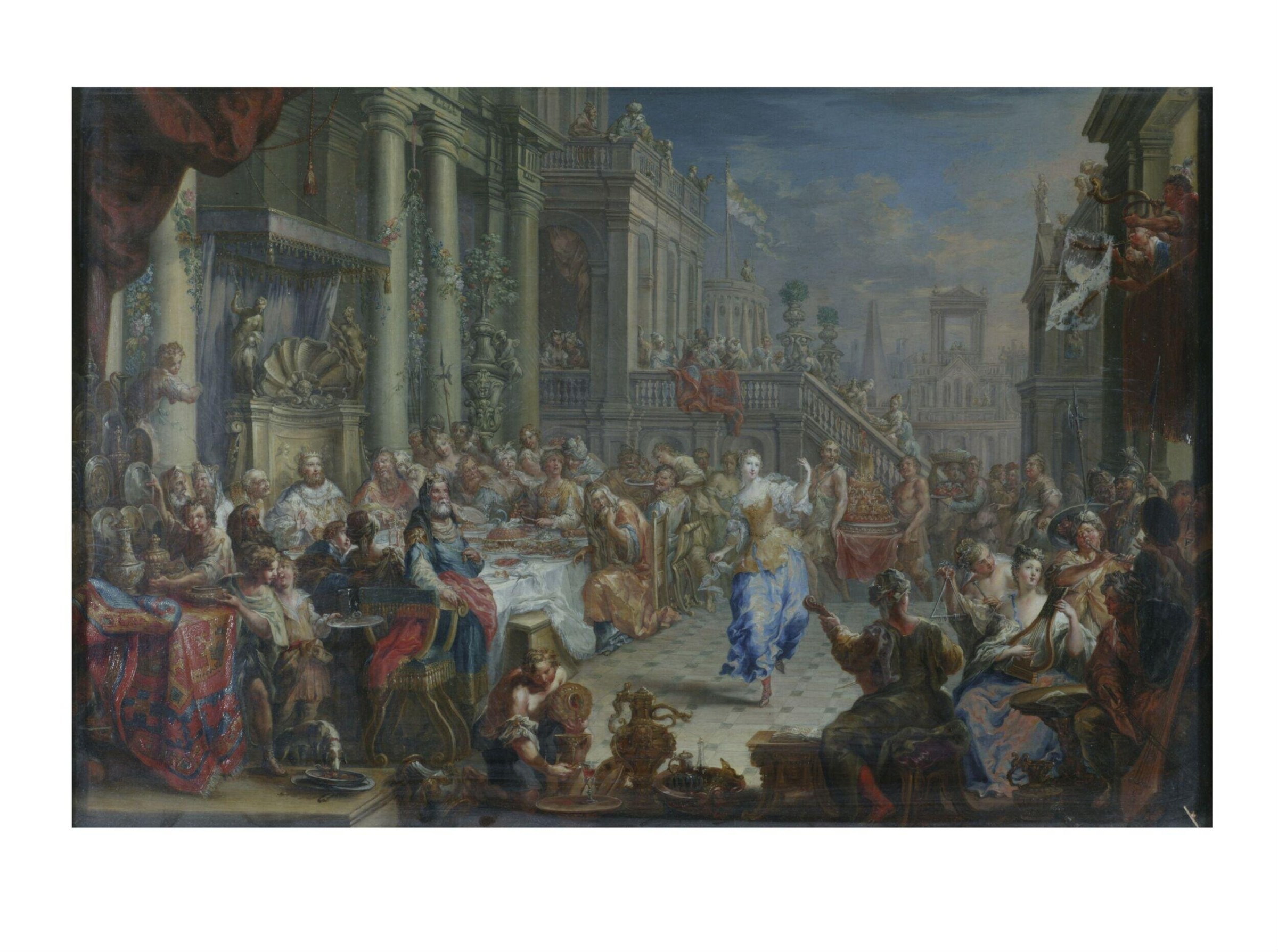
Salome dancing before Herod
Platzer, Johann Georg
- Collection:
- Oil painting
- Source:
- Victoria and Albert Museum
- Rights:
- Rights vary by item — check the source record before reusing this image. Source record ↗
- Recorded as:
- V&A — check rights per item
This painting is valuable evidence of how eighteenth-century artists visualized dance performance and choreographed movement within elite court settings. It shows a moment in which biblical narrative was staged as courtly entertainment, and reveals assumptions about the female body in performance, the role of the audience, and the relationship between movement and display in the rococo period. For dance historians, it documents the formal techniques and postures of early theatrical dance as they were understood and celebrated in visual art.
What you are looking at
A grand palace courtyard animated by a fashionable assembly in mid-eighteenth-century dress. The setting is a columned loggia or atrium with monumental architecture receding into the distance: paired columns, sculptural reliefs, a distant arch, all painted in soft stone tones under a luminous sky. The crowd—perhaps thirty figures—is arrayed loosely around the space in clusters of attention. In the center, isolated in an open floor, a woman in blue drapery performs a solo dance before a seated male figure of evident authority, whose attendants cluster behind him on a dais. The woman moves in an attitude of courtly grace, one arm raised, her pose suggesting controlled, ornamental movement. Scattered throughout the crowd are men in embroidered coats and breeches, women in voluminous silks and elaborate headdresses; some watch the dancer intently, others converse or gesture animatedly. The composition uses the architectural frame to focus the eye toward the central performance while preserving the bustle and social complexity of a court occasion. Light is warm and diffuse, lending the scene an atmosphere of cultivated leisure.
The dancing
The central dancer stands in a posture of balletic restraint: upright, elongated, with one arm raised in an open, arched line and the torso subtly twisted toward her audience. Her movement reads as linear and controlled, the body held in a frame that prioritizes display rather than dynamic motion. Her position suggests a held attitude or a moment of courtly presentation rather than vigorous turning or jumping. The watching figures around the courtyard are depicted in a range of attitudes—some leaning forward, some standing at ease, one figure appears to be gesturing commentary—but none are themselves dancing. The isolation of the soloist and the formal posture of the onlookers establish a clear hierarchy: this is performance for an audience, not participatory social dancing.
The dance depicted
The work depicts *Salome dancing before Herod*, and the painting illustrates the moment of her solo performance for the court. The choreography, such as it can be read, is consistent with eighteenth-century theatrical dance—the lifted carriage, the arched arm, the elongated line—but the artist has chosen to show the dance as a moment of courtly presentation rather than as spectacle or narrative climax. The dance appears to be a refined, controlled solo in the manner of court ballet or early theatrical dance, with the dancer's body composed into elegant poses for the gaze of the seated authority figure. The costume—a diaphanous blue drapery—suggests theatrical or allegorical dress rather than historical costume, reinforcing that this is a performed entertainment staged within a palace setting for an elite audience.
How it was made
This is an oil painting on canvas, likely created around 1740 as a cabinet picture for a wealthy patron. The technique is refined and detailed: the artist has controlled a large crowd scene through careful architectural framing and the careful modulation of light and color, using cool stone tones and warm fabrics to guide the eye. The painting's small to moderate scale and its subject matter—a moment of courtly leisure and entertainement—suggest it was made as a conversation piece for a patron's collection, depicting the kind of refined spectacle that would have appealed to the European aristocratic audience of the period. The precision of the costumes and the leisured complexity of the composition indicate a work of considerable ambition and technical accomplishment.
About this work
This painting depicts the biblical story of Salome dancing before King Herod, but frames it as an eighteenth-century court entertainment. The artist presents the dance not as a dramatic or sensual moment of biblical narrative, but as a choreographed performance within a cultivated palace setting, complete with fashionable dress, architectural grandeur, and an audience of aristocratic witnesses. The work is both a narrative painting and a document of eighteenth-century court practices—showing how the educated elite visualized antiquity through the lens of their own courtly spectacle and entertainment. The painting sits at the intersection of history painting (a prestigious genre) and the depiction of dance as a refined social practice, framed within the architecture and society of the rococo court.
How to look at it
Observe the isolation of the central dancer and the formal geometry of her pose: the artist has frozen a moment of presentation, not of dynamic motion. Note how the architecture frames her and directs the eye, and how the crowd is arranged in clusters that mirror her isolation—she is the object of collective attention. The clothing is scrupulously rendered, and the warmth of the fabrics contrasts with the cool stone of the palace; this contrast organizes the composition. Watch how the artist uses gesture and posture in the surrounding figures to convey their attention and their social roles: some are rapt, some indifferent, some conversational. The painting is as much about the social ritual of watching as about the dance itself—a point central to understanding eighteenth-century court performance.
The artist
Johann Georg Platzer (1704–1761) was an Austrian painter based in Vienna who specialized in court scenes, historical narratives, and festive assemblies—the kind of conversation pieces and cabinet pictures that appealed to the Habsburg nobility and wealthy merchant patrons of Vienna and Augsburg. He was known for his ability to depict large, animated crowds with individual attention to costume, gesture, and expression, and for his skill at rendering the architecture and light of palatial interiors. His work often combined narrative drama with the visual spectacle of court life, making him a frequent chronicler of the entertainments and ceremonies of the Viennese aristocracy.
The period
The painting dates to the 1740s, a period in which balletic technique was undergoing significant development in France and Italy. Court ballet was evolving from a pastime for nobility into a professional theatrical spectacle, with dancers becoming increasingly trained and acrobatic. At the same time, history painting and the depiction of classical or biblical scenes was the most prestigious genre available to painters, yet was often inflected with contemporary court imagery and modern dress. The rococo aesthetic—which privileged refined elegance, elaborate costume, and the representation of aristocratic leisure—was at its height. Platzer's painting reflects the period's fascination with staging antiquity through modern courtly spectacle, and its celebration of dance as a marker of civilization and elite culture.
Where it lives
The work is recorded in a museum collection (identified as 'va' in the source record, likely a US institution). It appears as an oil painting, though the exact dimensions and accession information are not recorded. It is a panel from a collection focused on dance in European art, suggesting it has been recognized as significant evidence for the visual history of performance.
Dance in this work
Questions about this work
Is this the biblical Salome from the Gospel of Mark?
The title and subject matter refer to the biblical story, but the artist has completely reframed it as an eighteenth-century court entertainment. There is nothing explicitly biblical in the painting—no John the Baptist, no head on a platter, no narrative drama. Instead, the artist uses the Salome story as a pretext to depict the kind of refined theatrical performance that would have been mounted in a European palace, with contemporary dress and architectural settings. This was common practice in history painting of the period: artists would cite classical or biblical subjects but visualize them through the lens of modern court life.
What does the dancer's pose tell us about eighteenth-century technique?
The dancer's upright carriage, arched arm, and elongated line reflect the emerging ideals of balletic form that would crystallize later in the century. She is shown in a pose of restraint and control, not the ornamented sprezzatura of earlier court dance. Her isolation and formal presentation suggest that dance was already being conceived as a specialized, trained practice—a performance for an audience rather than a social participation. The pose is refined and artificial, designed for display from a distance, which is consistent with the development of theatrical dance technique in the 1740s.
Who is the seated man and what is his significance?
The seated figure, toward whom the dancer is directed and who is framed by attendants, represents the royal or princely authority before whom the performance is staged. In the context of Salome's narrative, this would be Herod, but the painting emphasizes his role as the patron and focus of the entertainment rather than as a character in a biblical drama. His position—elevated, passive, attended—underscores the social hierarchy of the court: the dancer performs for his pleasure, and her virtuosity is a form of courtly homage.
Why did Platzer choose to paint this particular moment from the Salome story?
The moment of the dance itself, without narrative complication, allowed Platzer to depict what he excelled at: a grand assembly, elaborate costume, architectural grandeur, and a moment of refined entertainment. It also allowed him to sidestep the more morally complicated aspects of the biblical story (desire, manipulation, murder) in favor of a celebration of courtly culture and aesthetic display. The choice reflects the rococo period's preference for elegance and spectacle over moral or dramatic intensity.
More dance artwork





