49 works in this view — arrow keys or swipe to move between them.
Dance in Art
Eldorado Music Hall
Chéret, Jules
- Collection:
- Source:
- Victoria and Albert Museum
- Rights:
- Rights vary by item — check the source record before reusing this image. Source record ↗
- Recorded as:
- V&A — check rights per item
This poster documents a pivotal moment when popular dance became visual spectacle and entertainment became a commercial art form demanding sophisticated marketing. For historians of dance in popular culture, it provides concrete evidence of what music-hall dancing looked like, how it was understood, and how it was made desirable to urban audiences. For art historians, it exemplifies the artistic achievement of the Belle Époque poster and the centrality of dance imagery to the visual modernity of the 1890s.
What you are looking at
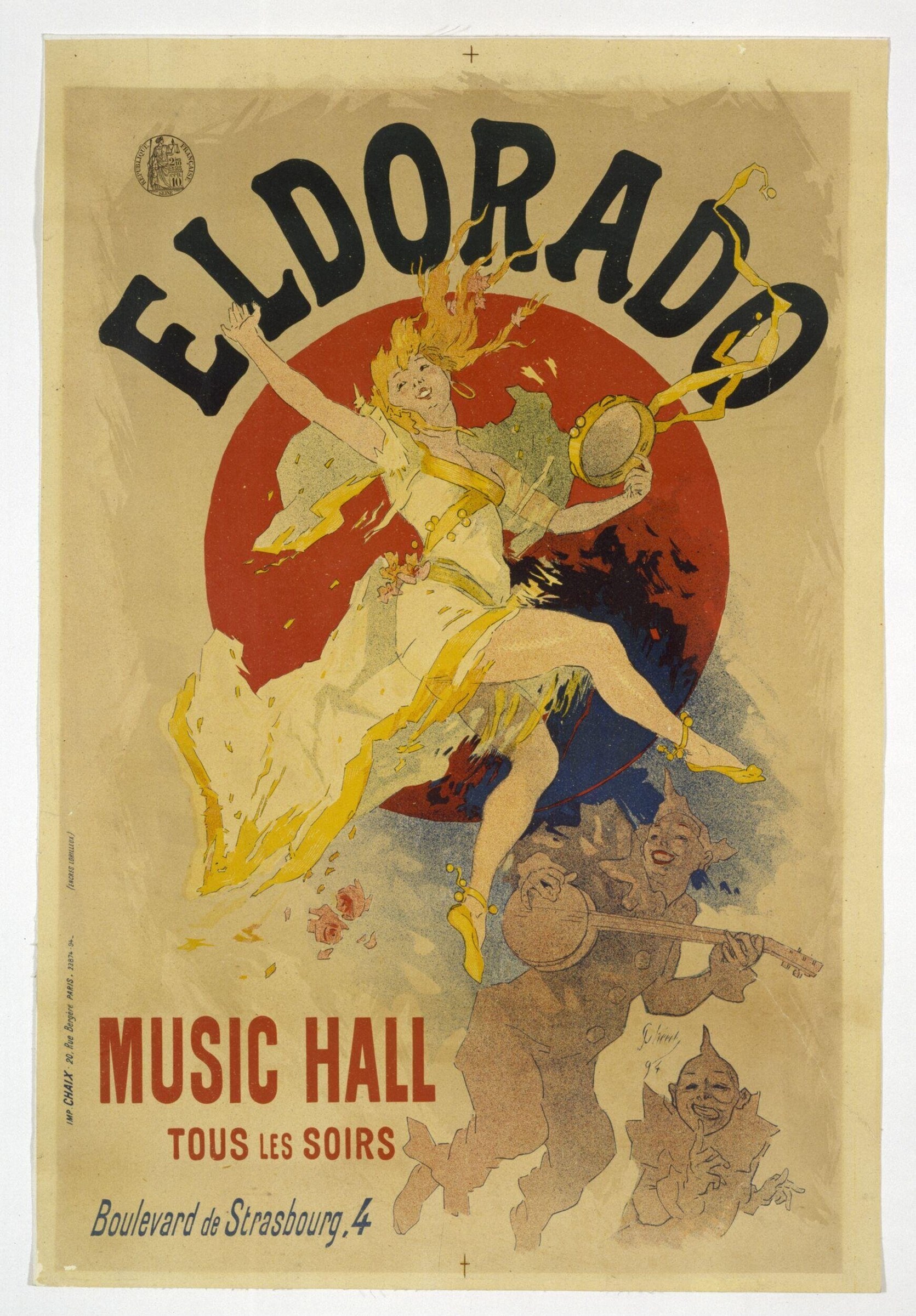
A chromolithographic poster advertising the Eldorado Music Hall in Paris depicts a vibrantly costumed female dancer leaping ecstatically against a large red circular backdrop, her body captured mid-jump with arms and legs flung wide in exuberant abandon. She wears a pale yellow corset and skirt trimmed with gold brocade, her golden hair flying, and holds a large round object (likely a tambourine or shield) aloft in one hand while gesturing expansively with the other. Below her, a musician in brown clothing plays a stringed instrument—possibly a guitar or similar—his face tilted upward toward the dancer. In the lower right corner, two small caricatured male faces peer upward with expressions of delighted amazement. The composition is typical of the Belle Époque poster style, with bold black lettering arching across the top spelling "ELDORADO" and red text at the bottom identifying the venue and address.
The dancing
The dancer's body is fully airborne, captured at the peak of a jump with explosive lateral extension: both legs are lifted and splayed, torso twisted, arms spread wide in opposing directions. The pose suggests a moment of uncontrolled joy rather than technical control—a dancer genuinely surrendering to rhythm and abandon. Her weight is entirely off the ground, and the positioning of her limbs conveys neither balletic line nor held frame, but rather the free, uninhibited movement of popular entertainment. The musician below anchors the composition, his body angled toward the dancer in a complementary gesture of musical engagement.
The dance depicted
This is not a representation of any specific codified dance technique but rather a theatrical or music-hall performance—the exuberant, high-energy entertainment that defined Parisian café-concert and music-hall culture in the 1890s. The dancer embodies the spirit of the can-can or related forms of popular social dance that had migrated into theatrical contexts: the emphasis is on explosive energy, high kicks, swirling skirts, and visible pleasure rather than technique. The presence of the live musician and the theatrical setting indicate this is staged performance rather than social dancing. This was the world of the Moulin Rouge and similar venues, where dancers like La Goulue and Jane Avril performed for audiences seeking modern, liberatory entertainment.
How it was made
This is a chromolithograph—a color lithographic print—evidenced by the bold, flat areas of color (particularly the striking red circle), the confident black outlines, and the visible registration of multiple color layers. Chromolithography, developed and perfected in the 1890s, allowed artists to produce vivid, multi-colored posters at relatively low cost, making it the dominant technology for commercial advertising and entertainment promotion in this period. Jules Chéret pioneered the artistic sophistication of the advertising poster and made color lithography an art form; the technique's bold simplicity and brilliant color field perfectly suited the immediate visual impact required of street advertising, while the drawn style gave the medium an artistic legitimacy fine-art audiences could respect.
About this work
This is a Parisian entertainment poster from 1894 advertising the Eldorado Music Hall, a venue that would have presented variety entertainment, cabaret, and popular theatrical dance to paying audiences. The image captures the spirit of the Belle Époque entertainment world—the moment when dance moved decisively from ballroom and stage into the café-concert and music hall, where it became faster, more democratic, and more openly theatrical. The poster is a work of art history in itself: it documents not only what people danced, but how that dancing was sold, how it was imagined, and what visual language was used to make entertainment desirable to the city of Paris.
The Eldorado was one of dozens of competing music halls and cabaret venues that emerged in Paris in the 1880s and 1890s, all competing for audiences with increasingly spectacular and morally provocative entertainment. The figure of the exuberant, high-kicking female dancer became the emblem of this new world—a figure both celebrated and scandalized. This poster, with its joyful energy and shameless theatricality, is evidence of how fundamentally entertainment dance had changed the visual culture of the modern city.
How to look at it
Look first at the moment of the jump: Chéret has frozen the dancer at the absolute peak of her leap, when she is completely airborne and at maximum vulnerability—a moment of maximum joyful recklessness. Notice how the position of her body breaks every rule of balletic decorum: legs splayed, torso twisted, hair flying. This is not the controlled body of classical dance but the abandoned body of pleasure. The large red circle behind her is not just a compositional device but suggests a sun, a spotlight, or an aureole—a halo of theatrical light and celebration. The caricatured male faces below suggest the point of view of an audience member looking up at the stage, making the viewer an implicit spectator in the pleasure being sold. The bold black lettering and commercial frame remind you that this is advertising: the poster sells not just a venue but an idea of modern, liberated, joyful entertainment.
The artist
Jules Chéret (1836–1932) was a French graphic artist and lithographer who effectively invented the modern advertising poster. Working in Paris from the 1860s onward, he developed a distinctive style combining bold typography, bright chromolithographic color, and elegantly drawn figures—often women in motion, frequently dancing. His posters for music halls, cabarets, and other entertainment venues (Moulin Rouge, Eldorado, Folies-Bergère) became iconic images of Belle Époque Paris and are now recognized as masterworks of graphic design. Chéret understood that entertainment advertising required visual excitement and motion; his figures are almost always caught in gestures of abandonment or joy. He was celebrated in his lifetime and awarded the Legion of Honor; his hundreds of posters defined how modern commercial imagery could be both functional and artistically significant.
The period
The 1890s were the decade of the music hall and café-concert boom in Paris. Venues like the Eldorado, Moulin Rouge, and Folies-Bergère had emerged in the 1880s and become wildly popular with middle-class audiences seeking modern, morally relaxed entertainment. The dancers of these venues—including La Goulue, Jane Avril, and others—became celebrities and cultural icons. Simultaneously, the development of color lithography made possible the vivid, large-scale posters that could be pasted on Paris's walls, transforming public space and creating a new visual language of desire and entertainment. The dance imagery of these posters—women in motion, often mid-kick, often in states of abandon—became synonymous with modernity itself, with the liberation of female sexuality and pleasure, and with the pleasures of urban nightlife. This was the visual world that would influence the Fauves, Matisse, and other modernists who came after; it was revolutionary both as dance and as visual culture.
Where it lives
This is a chromolithographic poster from a collection marked 'va' in the catalogue record, which typically indicates holdings related to visual and applied arts. Such posters were mass-produced and widely distributed as street advertising; many survive in museum collections, archives, and private collections. The poster's commercial origin does not diminish its art-historical significance; Chéret's work is now recognized as foundational to modern graphic design and poster art.
Dance in this work
Questions about this work
Was the Eldorado Music Hall a real venue?
Yes, the Eldorado was one of several music halls and café-concerts operating in Paris in the 1890s, competing with more famous venues like the Moulin Rouge for audiences seeking entertainment, dancing, and cabaret. The address given on the poster (Boulevard de Strasbourg 4) places it in the 10th arrondissement, a neighborhood with several entertainment venues.
What kind of dancing happened at music halls like the Eldorado?
Music halls presented a mix of variety entertainment: singing, comedy, acrobatics, and dance. The dancing was theatrical and spectacular rather than ballroom-based—can-can was popular, as were high-kicking solo female performances, ensemble numbers, and novelty acts. The emphasis was on energy, visibility, and excitement rather than technical virtuosity in the balletic sense.
Why are there so many posters like this from 1890s Paris?
Chromolithography made color posters economical to produce at scale, and competition among music halls and entertainment venues meant they invested in eye-catching advertising. Posters were pasted on walls throughout Paris and became a dominant form of public visual culture. The best of them, like Chéret's, are now recognized as masterpieces of graphic design.
What does the round object the dancer is holding represent?
It is most likely a large tambourine, a common prop in theatrical dance of the period that both added visual spectacle and made percussive sound as part of the performance. It could also represent a shield or other prop, but the tambourine is most consistent with music-hall practice.
More dance artwork





