49 works in this view — arrow keys or swipe to move between them.
Dance in Art
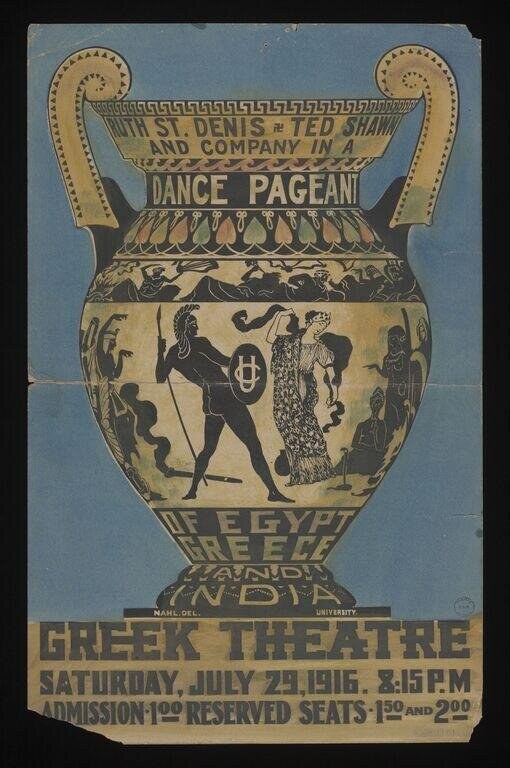
Poster design for the Dance Pageant of Egypt Greece and India, Greek Theatre, University of California, 1916
Nahl
- Collection:
- Poster
- Source:
- Victoria and Albert Museum
- Rights:
- Rights vary by item — check the source record before reusing this image. Source record ↗
- Recorded as:
- V&A — check rights per item
This poster documents a crucial moment in American modern dance history when St. Denis and Shawn were establishing their company and aesthetic; the Denishawn company became the training ground for the next generation of modern dancers, including Martha Graham and Doris Humphrey. The visual strategy—anchoring contemporary dance to classical antiquity—reveals how early modern dancers justified their break from ballet by claiming ancient authority and cross-cultural sophistication. For anyone studying how modern dance claimed legitimacy in the early 20th century, this poster is primary evidence.
What you are looking at
This poster advertises a dance pageant staged at UC Berkeley's Greek Theatre in July 1916. The central image is a large ancient Greek amphora rendered in tan and black, depicted against a blue ground. The vase's body shows silhouetted figures in profile: a nude male dancer with one arm raised, a draped female figure, and at least one other attendant or musician. The vessel sits on a pedestal base and is framed by two large scrolled handles characteristic of classical Greek design. Above the vase runs a horizontal band inscribed with the event details—"RUTH ST. DENIS # TED SHAWN AND COMPANY IN A / DANCE PAGEANT"—rendered in serif capitals. Below, the venue and date appear in bold sans-serif type: "GREEK THEATRE / SATURDAY, JULY 29, 1916. 2:15 P.M." with admission prices at the bottom. The overall composition mimics museum display or scholarly publication, treating dance as a subject worthy of classical reference and serious cultural presentation.
The dancing
The male figure on the vase is rendered in profile with weight on one leg, the other bent or extended, and his free arm raised at roughly shoulder height—a pose suggesting movement or lyrical gesture rather than a supported turn or closed frame. The draped female figure stands in contrapposto, her robed form suggesting classical statuary. The silhouette technique eliminates detail of footwork or precise hold, but the compositions suggest solo or parallel movement within a group rather than partnered ballroom-style dancing. The artist (Nahl) has chosen a moment of display and relative stillness rather than peak momentum.
The dance depicted
This pageant, produced by Ruth St. Denis and Ted Shawn in the summer of 1916, is documented as presenting dances inspired by three ancient civilizations—Egypt, Greece, and India. The vase imagery explicitly references Greek sources and Hellenic revival, a major theme in Denishawn dance aesthetics. The silhouetted figures suggest interpretive or "artistic" dance rooted in pantomime and classical allusion rather than codified folk or ballroom forms. St. Denis and Shawn were pioneers of modern dance who drew heavily on non-Western and historical sources, staging elaborate theatrical productions with elaborate costuming, music, and narrative. This particular performance capitalized on the prestige of the Greek Theatre venue and the scholarly associations of classical archaeology—visual framing that positioned their work as educational and culturally elevated.
How it was made
The poster is a lithograph rendered in three colors—blue, tan/buff, and black—executed in a style consistent with early 20th-century theatrical poster design. The technique allowed bold, flat areas of color and high contrast, essential for outdoor advertising and visual impact from a distance. The Greek vase design permits economical rendering of complex figural content through silhouette, reducing the image to essentials. Lithography's accessibility and relative affordability made it the standard for theatrical promotion of this era, and the quality of reproduction here suggests a professional workshop, likely Berkeley-based or commissioned from a major printing house serving the West Coast.
About this work
This is a promotional poster for a landmark 1916 dance pageant by Ruth St. Denis and Ted Shawn, two of the founding figures of American modern dance. The design frames the performance within classical antiquity by depicting an ancient Greek vase populated with dancing figures, a visual strategy that elevated dance to the status of high art and scholarly inquiry. The poster is both a document of a specific historical event and an artifact of how early modern dance positioned itself—not as popular entertainment but as a revival and reinterpretation of ancient cultural forms. The choice of the UC Berkeley Greek Theatre as venue reinforced this academic and classical framing, and the poster's design mirrors that ambition.
How to look at it
Attend to the deliberate classicism of the poster's design: the vase is not merely decorative but a visual argument that dance belongs to the history of high civilization. Notice the posture and gesture of the silhouetted figures—they are idealized and graceful but not naturalistically proportioned, suggesting a stylized or interpretive movement vocabulary rather than mimicry. The poster's restraint—no realistic representation of the performers, no narrative detail—emphasizes abstraction and timelessness, a rhetorical choice that asks the viewer to see this dance as descended from antiquity. The institutional framing (venue, price, time) grounds the artistic claim in a real, public event.
The artist
Nahl is recorded as the poster designer but little else is known from this record. The style and execution are consistent with commercial theatrical poster design of the 1910s on the West Coast. If the artist is the German-American artist Charles Nahl or a member of his circle, the poster would reflect the strong German graphic design tradition and lithographic practice that influenced American poster art in this period, but this attribution cannot be confirmed from the image alone.
The period
In 1916, Ruth St. Denis and Ted Shawn were at the height of their influence as pioneers of American modern dance. Their Denishawn School and Company, founded in 1915, were built on the principle that "natural" or "artistic" movement could be recovered from historical and non-Western sources. The pageant form—a large-scale narrative or thematic dance production—was a popular vehicle for experimental choreography in the 1910s and 1920s. The choice to frame the performance through classical Greek imagery reflects broader early-20th-century fascination with ancient civilizations as sources of aesthetic purity and also the racialized hierarchies embedded in that fascination. The Greek Theatre venue at UC Berkeley, opened in 1903, positioned the university as a center of cultural prestige and made the performance accessible to an educated, middle-class audience.
Where it lives
The poster is held in a digital collection (source listed as 'va', likely an institutional repository). It is a promotional artifact for a specific historical performance, issued by the theater or production company to advertise the event on the date specified.
Dance in this work
Questions about this work
Who were Ruth St. Denis and Ted Shawn?
Ruth St. Denis (1879–1968) and Ted Shawn (1891–1972) were pioneering American modern dancers and choreographers who founded the Denishawn Company in 1915. They rejected the rigid conventions of classical ballet and instead drew on non-Western dance traditions, ancient art, and theatrical spectacle to create a new form of concert dance. Their company became the primary training ground for the next generation of American modern dancers, including Martha Graham and Doris Humphrey.
What was the Denishawn aesthetic?
Denishawn dance combined theatrical spectacle with claims to authenticity and cultural depth. St. Denis and Shawn studied non-Western movement traditions and presented them as sources of natural or spiritually elevated dance. They created elaborate pageants with custom music, exotic costumes, and evocative lighting. The work was marketed to middle and upper-class audiences as culturally enriching and intellectually serious, distinct from both ballet and commercial popular dance.
Why use a Greek vase to advertise a dance pageant?
The Greek vase connected the performance to classical antiquity and high culture, suggesting that the dances were scholarly revivals or interpretations rather than entertainment. This visual strategy was central to how early modern dancers justified breaking from ballet tradition—by claiming descent from even older, more authentic sources. The vase also permitted the designer to show multiple dancers in a single, elegant composition, economical for a poster.
What happened to the Denishawn Company?
The company remained active through the 1920s and 1930s, toured extensively, and produced numerous dancers and choreographers who went on to define American modern dance. St. Denis and Shawn eventually separated professionally but both continued to influence modern dance practice and pedagogy throughout their lives. The Denishawn School's legacy persists in contemporary dance training.
More dance artwork





